


China has started a pair of investigations into US trade practices, retaliating against similar probes by US President Donald Trump’s administration as the superpowers stake out positions before an expected presidential summit in May.
The move, announced by the Chinese Ministry of Commerce on Friday, is a direct mirror of steps Trump took to revive his tariff agenda after the US Supreme Court last month struck down some of his duties.
“China expresses its strong dissatisfaction and firm opposition to these actions,” a ministry spokesperson said in a statement, referring to the so-called Section 301 investigations initiated on March 11.
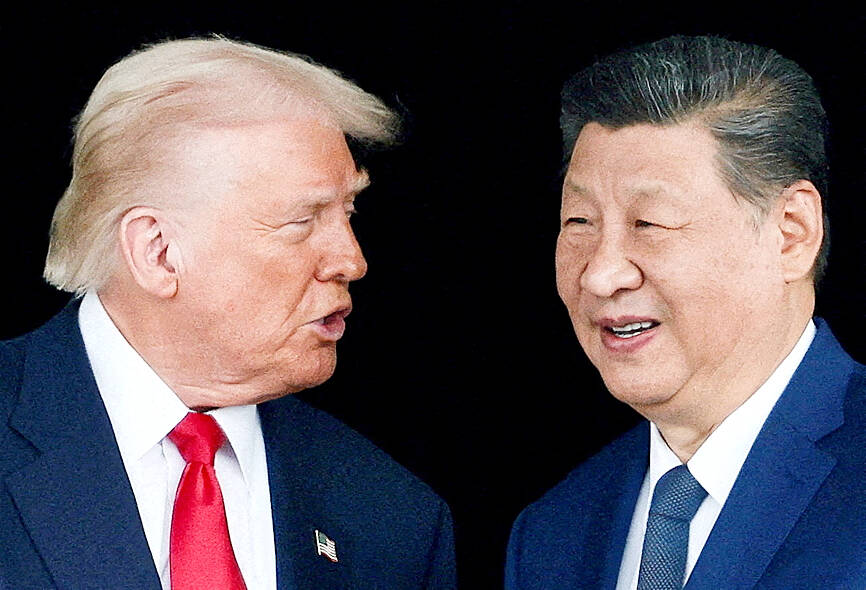
Photo: Reuters
The Chinese measures come days after the White House said Trump would travel to China in mid-May to meet with Chinese President Xi Jinping (習近平) for a summit delayed by the US conflict with Iran. The world’s two biggest economies have largely stabilized ties after a tariff tit-for-tat last year, although Beijing has signaled its opposition to fresh US actions.
“We know that these are merely symbolic investigations initiated by China, which is in fact the world’s most profligate disrupter of supply chains and trade in green products. No one is fooled,” US Trade Representative Jamieson Greer said in a statement. “Despite this posturing, the US objective continues to be economic stability and balanced trade with China, in line with the US-China deal reached last year in Busan, [South] Korea.”
The attacks on Iran, a partner of China, also brought new strains to US-China ties, although both governments have sought to continue on a path of engagement. Relations are also dogged by lingering issues including China’s record trade surplus and US arms sales to Taiwan.
Beijing has not yet confirmed Trump’s visit to China.
Each of the new investigations carries a six-month deadline, with a possible three-month extension, giving Beijing a legal justification for future countermeasures and leverage ahead of any talks.
One such probe, brought separately against Mexico in September last year, concluded on Monday. Beijing found the country’s tariffs on Chinese goods to be trade barriers and vowed to take measures to defend the interests of China’s firms, without specifying.
An investigation announced on Friday targets US practices that Beijing said disrupt global supply chains, covering restrictions on Chinese goods entering US markets, export controls on advanced technology and limits on bilateral investment in critical sectors.
The other action focuses specifically on what China described as US barriers to trade in green products, including restrictions on exports of Chinese renewable goods to the US and limits on cooperation in green technology.

Through the noise of rushing papers and whirring belts at a print factory in Kyoto, two creators watch their photo essay come to life in broadsheet form — part of an effort to win new audiences in the age of artificial intelligence (AI). Despite the decline of the publishing industry, self-publication and handmade “zine” magazines are growing in popularity in Japan, reflecting the nation’s enduring love of paper in the digital era. While speaking to Agence France-Presse at the plant, his hands black with ink, one of the creators, Kazuma Obara, said: “I think [paper] is a medium that engages all five
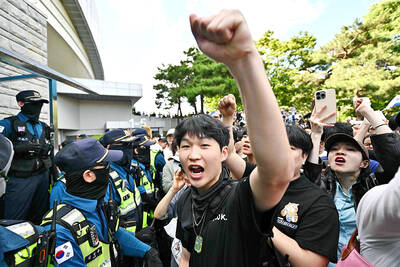
‘ABSURD MISTAKE’: The election commission said that there had been a failure to anticipate turnout after 14 polling stations ran short of ballot papers South Korean riot police yesterday cleared protesters from a Seoul polling station after a 35-hour blockade sparked by a shortage of ballot papers during local elections earlier this week. Wednesday’s election was the first nationwide vote since South Korean President Lee Jae-myung took office following the ouster of Yoon Suk-yeol over his short-lived martial law declaration. Lee’s ruling Democratic Party swept most races, but failed to flip the crucial Seoul mayoral seat. The South Korean National Election Commission apologized, blaming a failure to anticipate turnout after 14 polling stations in Seoul ran short of ballot papers. Some polling stations stayed open until 10pm to

Australian researchers have trained lab-grown brain cells on a silicon computer chip to play the 1990s shooter game Doom and said they are just scratching the surface of what the neurons could be capable of doing. It is the science-fiction work of biotech boffins at Cortical Labs, who researched and developed the technology that harnesses the workings of the brain’s networking system. Each so-called “biological computer” contains about 200,000 living human brain cells, grown from stem cells that were harvested from blood donations. Having mastered the simple computer game Pong, where a paddle is moved up and down to send a ball

France experienced its hottest spring on record, the French weather service said on Tuesday, after an exceptional early heat wave that also broke highs for the season in England and Wales. Meteo-France said the average nationwide temperature over March to May was 13.8°C — about 1.7°C above the norm, and surpassing records set in 2011 and 2020. “The warmest spring since records began in 1900,” it said in a bulletin. All three months were warmer than average, but the onset of an “unprecedented heatwave” late last month pushed the mercury to highs typically seen at the height of the summer. “Our country had never


 RSS
RSS