


The amount of heat trapped by the Earth reached record levels last year, with the consequences of such warming feared to last for thousands of years, the UN said yesterday.
The 11 hottest years ever recorded were all between 2015 and last year, the UN’s World Metrological Organization (WMO) confirmed in its flagship State of the Global Climate annual report.
Last year was the second or third-hottest year on record, at about 1.43°C above the 1850-1900 average, the WMO said.
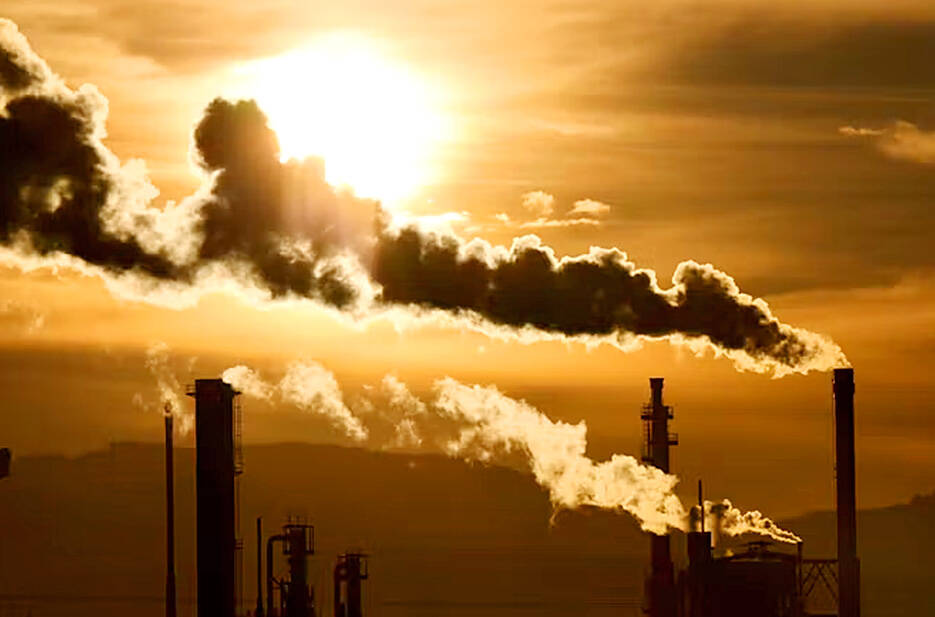
Photo: AP
“The global climate is in a state of emergency. Planet Earth is being pushed beyond its limits. Every key climate indicator is flashing red,” UN Secretary-General Antonio Guterres said.
“Humanity has just endured the 11 hottest years on record. When history repeats itself 11 times, it is no longer a coincidence. It is a call to act,” he said.
For the first time, the WMO climate report includes the planet’s energy imbalance: the rate at which energy enters and leaves the Earth system.
Under a stable climate, incoming energy from the sun is about the same as the amount of outgoing energy, the Geneva-based agency said.
However, the increase in concentrations of heat-trapping greenhouse gases — carbon dioxide, methane and nitrous oxide — “to their highest level in at least 800,000 years” has “upset this equilibrium,” the WMO said.
“The Earth’s energy imbalance has increased since its observational record began in 1960, particularly in the past 20 years. It reached a new high in 2025,” it said.
WMO Secretary-General Celeste Saulo said scientific advances had improved understanding of the energy imbalance and its implications for the climate.
“Human activities are increasingly disrupting the natural equilibrium and we will live with these consequences for hundreds and thousands of years,” she said.
More than 91 percent of the excess heat is stored in the ocean.
“Ocean heat content reached a new record high in 2025 and its rate of warming more than doubled from 1960-2005 to 2005-2025,” the WMO said.
Ocean warming has far-reaching consequences, such as degradation of marine ecosystems, biodiversity loss and reduction of the ocean carbon sink, the agency said.
“It fuels tropical and subtropical storms and exacerbates ongoing sea-ice loss in the polar regions,” it said.
The Antarctic and Greenland ice sheets have both lost considerable mass, and the annual average extent of Arctic sea ice last year was the lowest or second-lowest ever recorded in the satellite era.
Last year, the global mean sea level was about 11cm higher than when satellite altimetry records began in 1993. Ocean warming and sea level rise are projected to continue for centuries.
WMO scientific officer John Kennedy said global weather is still under the influence of La Nina, a naturally occurring climate phenomenon that cools surface temperatures in the central and eastern equatorial Pacific Ocean. It brings changes in winds, pressure and rainfall patterns.
Conditions oscillate between La Nina and its warming opposite El Nino, with neutral conditions in between.
The warmest year on record, 2024, was around 1.55°C above the 1850-1900 average, and started in a strong El Nino.
Forecasts indicate neutral conditions by the middle of this year, with a possible El Nino developing before the end of the year, Kennedy said.
If so, “then we’re likely to see maybe elevated temperatures again in 2027,” he told a news conference.
WMO Deputy Secretary-General Ko Barrett said the outlook was a “dire picture.”
She said the WMO provided the evidence it sees, hoping that the information “will encourage people to take action.”
However, there was “no denying” that “these indicators are not moving in a direction that provides for a lot of hope,” she said.
With war gripping the Middle East and fuel prices soaring, Guterres said the world should heed the alarm call.
“In this age of war, climate stress is also exposing another truth: our addiction to fossil fuels is destabilizing both the climate and global security,” he said.
“Today’s report should come with a warning label: Climate chaos is accelerating and delay is deadly,” he said.
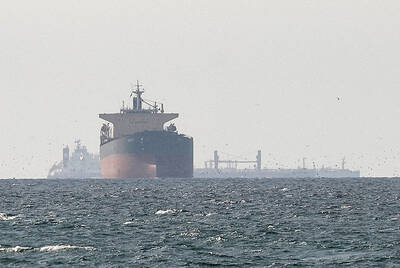
A ship that appears to be taking on the identity of a scrapped gas carrier exited the Strait of Hormuz on Friday, showing how strategies to get through the waterway are evolving as the Middle East war progresses. The vessel identifying as liquefied natural gas (LNG) carrier Jamal left the Strait on Friday morning, ship-tracking data show. However, the same tanker was also recorded as having beached at an Indian demolition yard in October last year, where it is being broken up, according to market participants and port agent’s reports. The ship claiming to be Jamal is likely a zombie vessel that

Cannabis-based medicines have shown little evidence of effectiveness for treating most mental health and substance-use disorders, according to a large review of past studies published in a major medical journal on Monday. Medical use of cannabinoids has been expanding, including in the US, Canada and Australia, where many patients report using cannabis products to manage conditions such as anxiety, post-traumatic stress disorder and sleep problems. Researchers reviewed data from 54 randomized clinical trials conducted between 1980 and May last year involving 2,477 participants for their analysis published in The Lancet. The studies assessed cannabinoids as a primary treatment for mental disorders or substance-use

NATIONWIDE BLACKOUT: US President Donald Trump cut off Venezuelan oil shipments to Cuba, strangling the Caribbean island’s already antiquated grid Cuba’s national electric grid collapsed on Monday, the nation’s grid operator said, leaving about 10 million people without power amid a US-imposed oil blockade that has crippled the already obsolete generation system. Grid operator UNE on social media said that it is investigating the causes of the blackout, the latest in a series of widespread outages that last for hours or days and that this weekend sparked a rare violent protest in the communist-run nation. Officials ruled out a major power plant failure, but had still not pinpointed the root cause of the grid collapse, suggesting a problem with transmission. Officials said that

CONSERVING FUEL: State institutions are to operate only four days a week starting tomorrow, with the measures also applying to schools and universities Sri Lanka on Monday announced a shorter working week to conserve its scarce fuel reserves as it prepares for a prolonged war in the Middle East. The Strait of Hormuz, a key waterway through which about 20 percent of global exports pass in peacetime, has been effectively closed by Iran in retaliation over the US and Israeli war against it, now in its third week. Sri Lankan Commissioner-General of Essential Services Prabath Chandrakeerthi said state institutions would operate only four days a week starting tomorrow. The new austerity measures would also apply to schools and universities, and would remain in place indefinitely. “We are


 RSS
RSS