


Sri Lanka on Monday announced a shorter working week to conserve its scarce fuel reserves as it prepares for a prolonged war in the Middle East.
The Strait of Hormuz, a key waterway through which about 20 percent of global exports pass in peacetime, has been effectively closed by Iran in retaliation over the US and Israeli war against it, now in its third week.
Sri Lankan Commissioner-General of Essential Services Prabath Chandrakeerthi said state institutions would operate only four days a week starting tomorrow.
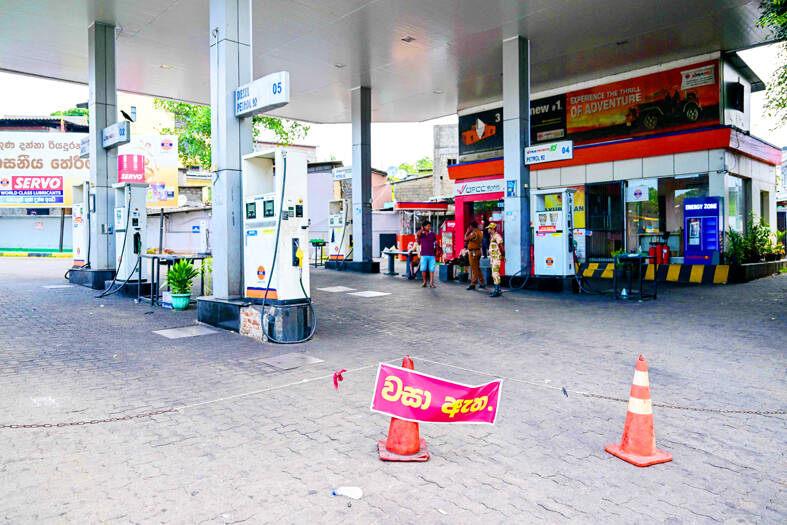
Photo: AFP
The new austerity measures would also apply to schools and universities, and would remain in place indefinitely.
“We are also asking the private sector to follow suit and declare every Wednesday a holiday from now on,” Chandrakeerthi told reporters after an emergency meeting chaired by Sri Lankan President Anura Kumara Dissanayake.
“We must prepare for the worst, but hope for the best,” Dissanayake told senior officials, according to a person who attended the meeting.
Dissanayake said essential services, including hospitals, ports and emergency services would continue to operate as usual.
The Sri Lankan government is also suspending all public ceremonies and asking civil servants to work from home where possible to limit fuel use.
Sri Lanka imports all of its oil and also buys coal for electricity generation.
Fuel rationing began on Sunday, limiting each motorist to 15 liters of gasoline or diesel per week, while public transport was allocated up to 200 liters.
Officials said the nation’s gasoline and diesel reserves would last nearly six weeks, but warned that any disruption to fresh supplies could severely affect the nation.
Sri Lanka buys refined petroleum products from Singapore, Malaysia and South Korea, while crude oil for its Iran-built refinery is sourced from the Middle East.
The Sri Lankan government has warned that any escalation in fighting in the Middle East and a prolonged war could seriously undermine its efforts to emerge from the economic meltdown of 2022.
Sri Lanka defaulted on its US$46 billion foreign debt in 2022 after the country ran out of foreign exchange. Since then, Colombo has secured a US$2.9 billion IMF bailout.

Crowds in Bangladesh are flocking to snap photographs with an unlikely social media star — an albino buffalo with flowing blond hair nicknamed “Donald Trump” that is due to be sacrificed within days. Owner Zia Uddin Mridha, 38, said his brother named the 700kg bull over its flowing helmet of hair resembling the signature look of the US president. “My younger brother picked this name because of the buffalo’s extraordinary hair,” he said at his farm in Narayanganj, just outside the capital, Dhaka. Mridha said that a constant stream of curious visitors — social media fans, onlookers and children — have come throughout

It began as a satirical online project. Now millions of young people in India are flocking to it as an outlet for their frustration. A parody political party called the Cockroach Janta Party, with the insect as its symbol, has exploded across India’s social media by turning absurdist humor into protest. Memes and short videos mocking corruption, joblessness and political dysfunction have flooded social media sites, where millions of users are embracing the cockroach — known for its ability to survive harsh conditions — as a tongue-in-cheek symbol of endurance. The online movement’s rise has been unusually rapid. The Cockroach Janta Party (CJP)
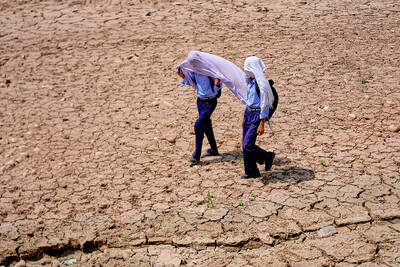
HOTTER: While Indians are accustomed to summer heat, climate change has caused northwestern India to warm faster than other parts of the country, an academic said Roads and markets have emptied during afternoons and some farmers have switched to nighttime work to avoid scorching temperatures as a heat wave grips large parts of India. The India Meteorological Department forecast maximum temperatures for yesterday of about 45°C in the capital, New Delhi, where authorities have opened temporary “cooling zones” to help people cope. The weather department warned that conditions would likely persist across several northern regions in the coming days, with temperatures staying well above seasonal averages. Authorities urged people to stay indoors during the hottest hours and take precautions against heat-related illnesses. India declares a heat wave whenever maximum temperatures

A Hong Kong astronaut is to join a Chinese space mission for the first time as part of a three-person crew launching today, as Beijing edges closer to its goal of landing people on the moon. The Tiangong space station — crewed by teams of three astronauts that are typically rotated every six months — is the crown jewel of China’s space program, boosted by billions in state investment in a bid to catch up with the US and Russia. The Shenzhou-23 mission is to blast off at 11:08pm from the Jiuquan Satellite Launch Center in northwestern China, carrying three astronauts to


 RSS
RSS