


North of Stockholm, Rosersberg prison is making preparations to house children as young as 13 in response to a much-criticized juvenile judicial reform expected to take effect in July.
The minority right-wing government, which is backed by the far-right Sweden Democrats, in January announced that it would reduce the age of criminal responsibility from 15 to 13 for crimes punishable by at least four years in prison.
Its goal is to break a surge in children being recruited by criminal networks to carry out bombings and shootings, knowing they would not face prison time if caught.
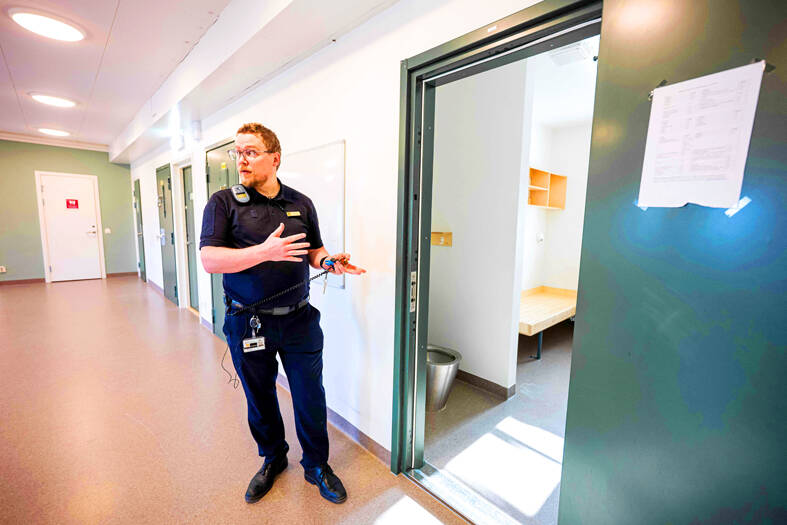
Photo: AFP
Until now, minors who committed serious offenses were placed in secure youth care homes, but these homes have faced problems, including reports of them becoming recruitment grounds for gangs.
The legislation still needs to pass parliament, but Rosersberg is one of eight prisons preparing to house young offenders starting on July 1.
“You have to keep in mind that it may be the first time they sleep away from home, and then it’s here in an institution,” prison director Gabriel Wessman said during a tour.
Preparations include transferring some adult inmates to other facilities, building classrooms and remodeling cells.
One unit has been emptied of its 51 adult inmates to make room for up to 24 minors.
The austere, concrete yards are being redone.
“It will be nicer, more green bushes, more sofas, more places to train, and of course, take away the cigarette boxes. They are not allowed to smoke,” Wessman said.
Each young person is to be placed in a 10m2 single cell, previously shared by two adults. The cells are equipped with TVs and the walls have been repainted green.
There would be six young offenders per corridor, with a shared shower and a dedicated yard. Each corridor would have its own classroom.
The most important thing “is compulsory schooling up to age 16,” Wessman said.
The cafeteria in the adjacent building, located between the adult and youth sections, has been demolished to make way for a classroom. The prison staff must be reinforced — twice as many guards are to be deployed for each child as for adults, and the guards would have to take on new responsibilities.
“We will always have to take into account the principle of the best interests of the child. It will be a bit different,” said Wessman, who has only worked with adults in his 20 years of working in the prison system.
“It’s not something we thought about every day in our previous work,” he added, noting that younger inmates would have different needs and rights.
“In a way, we become their legal guardians. How do we handle, for example, a child who doesn’t want to get up in the morning and go to school? It will be a challenge,” he said.
Unlike adults, the younger inmates would always be accompanied by guards, whether to play soccer, paint or make sure they go to school and do their homework. They are to be locked in their cells between 8pm and 7am. Each room is equipped with an intercom to contact guards if needed.
The reform has been controversial. Most of the dozens of organizations and authorities consulted on the proposal — including the prison administration — were against the measure that many consider counterproductive.
“This is not going to stop children from committing offenses ... on the contrary, it risks having the opposite effect, with crime starting at an even younger age,” said Julia Hogberg, a legal adviser to children’s rights group Bris.
Incarcerating someone that young “is harmful to the child’s development” and increases the risk of reoffending, Hogberg said.
“We have kept the same age of criminal responsibility for more than 150 years, including during periods with high crime rates,” she said. “The fact that we are now choosing to lower the age of criminal responsibility will undermine Sweden’s credibility as a model country when it comes to children’s rights.”
The right-wing government, which came to power with a promise to crack down on crime, is trying to rapidly push through a slew of reforms in various areas ahead of legislative elections in September.
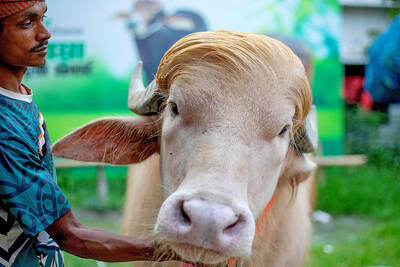
Crowds in Bangladesh are flocking to snap photographs with an unlikely social media star — an albino buffalo with flowing blond hair nicknamed “Donald Trump” that is due to be sacrificed within days. Owner Zia Uddin Mridha, 38, said his brother named the 700kg bull over its flowing helmet of hair resembling the signature look of the US president. “My younger brother picked this name because of the buffalo’s extraordinary hair,” he said at his farm in Narayanganj, just outside the capital, Dhaka. Mridha said that a constant stream of curious visitors — social media fans, onlookers and children — have come throughout

It began as a satirical online project. Now millions of young people in India are flocking to it as an outlet for their frustration. A parody political party called the Cockroach Janta Party, with the insect as its symbol, has exploded across India’s social media by turning absurdist humor into protest. Memes and short videos mocking corruption, joblessness and political dysfunction have flooded social media sites, where millions of users are embracing the cockroach — known for its ability to survive harsh conditions — as a tongue-in-cheek symbol of endurance. The online movement’s rise has been unusually rapid. The Cockroach Janta Party (CJP)
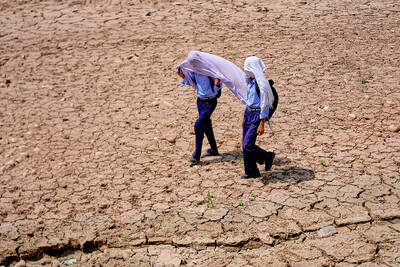
HOTTER: While Indians are accustomed to summer heat, climate change has caused northwestern India to warm faster than other parts of the country, an academic said Roads and markets have emptied during afternoons and some farmers have switched to nighttime work to avoid scorching temperatures as a heat wave grips large parts of India. The India Meteorological Department forecast maximum temperatures for yesterday of about 45°C in the capital, New Delhi, where authorities have opened temporary “cooling zones” to help people cope. The weather department warned that conditions would likely persist across several northern regions in the coming days, with temperatures staying well above seasonal averages. Authorities urged people to stay indoors during the hottest hours and take precautions against heat-related illnesses. India declares a heat wave whenever maximum temperatures
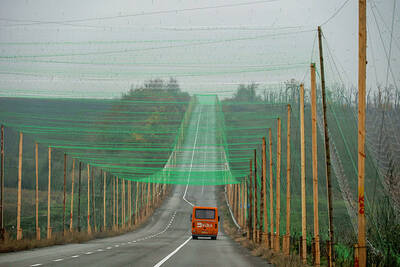
BIGGER ROLE: Beijing has said it maintains an impartial stance on the war in Ukraine, but by training Russian troops, China is far more involved than previously known China’s armed forces secretly trained about 200 Russian military personnel in China late last year, and some have since returned to fight in Ukraine, according to three European intelligence agencies and documents seen by Reuters. While China and Russia have held a number of joint military exercises since Moscow’s full-scale invasion of Ukraine in 2022, Beijing has repeatedly said that it is neutral in the conflict and presents itself as a peace mediator. The covert training sessions, which predominantly focused on the use of drones, were outlined in a dual-language Russian-Chinese agreement signed by senior Russian and Chinese officers in Beijing on


 RSS
RSS