


Traditional reindeer racing that has been delighting spectators for decades in Finland brought hundreds of fans to the Salla Reindeer Cup in the town of Salla over the weekend.
About 1,000 people attended the competition, despite frigid subfreezing temperatures and the remote location near the Russian border, roughly 264km northeast of the Finnish city of Oulu.
They watched and cheered as the reindeer galloped across the snow-covered track, pulling their handlers behind them on skis. Whoever is fastest wins the race.
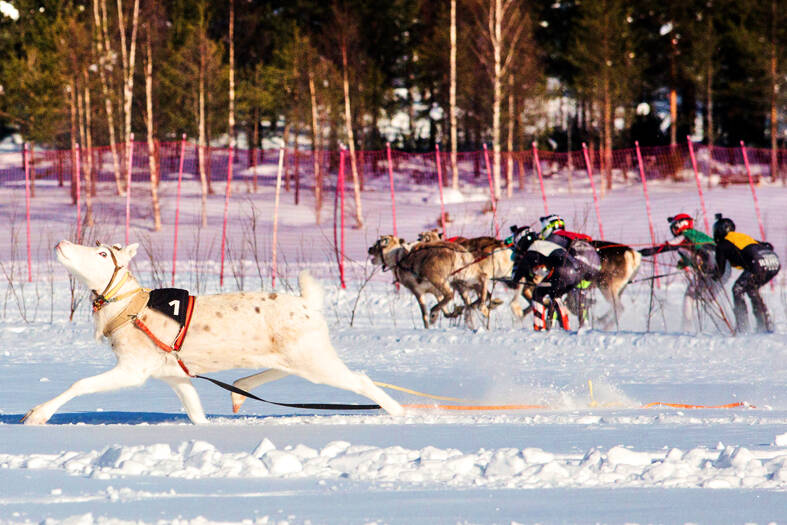
Photo: AP
Spectators came not only from Finland, but also Italy, Norway, Germany and France, among other countries.
Reindeer husbandry has been an important part of Scandinavian culture for many decades, especially for the Sami indigenous people in the far north of the country.
“Salla has a long history in reindeer racing — it’s been going on here since the 1950s,” said Lasse Aatsinki, the head of Salla Reindeer Cup. “Back then, men spent winters in the forest, there were no snowmobiles. In late winter, the reindeer were in great shape, so they started racing them.”
These days, reindeer racing is an organized and regulated competition with trained male reindeer.
The premiere event was the so-called hot series, in which reindeer qualify if they race the kilometer-long track in 1 minute, 19 seconds, or less. Only the fastest reindeer get to compete in this race.
“It’s a science. A lot depends on the reindeer’s character — it has to tolerate a lot: the audience, other reindeer, noise, movement,” Aatsinki said. “Everyone has their tricks — and they’re usually kept under the fur hat. Every owner has their own way.”
During the race, crowds cheered their favorites on with calls of “hyva, hyva” and “mene, mene” — which is Finnish for “good, good” and “go, go” — as the reindeer sprinted down the final stretch.
In between races, people kept warm with reindeer soup and kampanisu, a traditional local pastry specialty from Salla.
The competition culminated on Sunday with the final rounds and it was reindeer named Pompom that won the final race.
“Pompom is exceptionally fast and smart, and you rarely find one like that,” said Hannu Krupula, the winning animal’s owner.
“If there’s any weakness, it’s that it’s not very good-looking — which can be misleading,” he added.
“When you look at that reindeer, you might quickly think it’s poorly fed or something. But it eats well. It’s a rare individual,” he said.
And thus after the race, Pompom and all the other reindeer got their own reward — lichen, a symbiotic, colorful organism that grows on trees or rocks, and is the animals’ favorite treat.

School bullies in Singapore are to face caning under new guidelines, but the education minister on Tuesday said it would be meted out only as a last resort with strict safeguards. Human rights groups regularly criticize Singapore for the use of corporal punishment, which remains part of the school and criminal justice systems, but authorities have defended it as a deterrent to crime and serious misconduct. Caning was discussed in the parliament after legislators asked how it would be used in relation to bullying in schools. The debate followed stricter guidelines on serious student misconduct, including bullying, unveiled by the Singaporean Ministry of

As evening falls in Fiji’s capital, a steady stream of people approaches a makeshift clinic that is a first line of defense against one of the world’s fastest-growing HIV epidemics. In the South Pacific nation — a popular tourist destination of just under a million people — more than 2,000 new HIV cases were recorded last year, a 26 percent increase from 2024. The government has declared an HIV outbreak and described it as a national crisis. “It’s spreading like wildfire,” said Siteri Dinawai, 46, who came to be tested. The Moonlight Clinic, a converted minibus parked in a suburban cul-de-sac in Suva, is
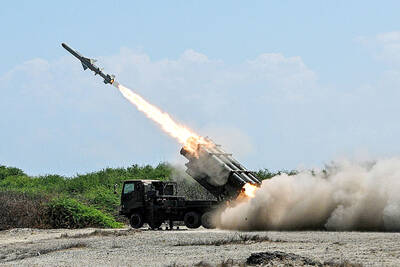
A MESSAGE: Japan’s participation in the Balikatan drills is a clear deterrence signal to China not to attack Taiwan while the US is busy in the Middle East, an analyst said The Japan Self-Defense Forces yesterday fired a Type 88 anti-ship missile during a joint maritime exercise with US, Australian and Philippine forces, hitting a decommissioned Philippine Navy ship in waters facing the disputed South China Sea, in drills that underscore Tokyo’s rising willingness to project military power on China’s doorstep. The drill took place as Manila and Tokyo began talks on a potential defense equipment transfer, made possible by Japan’s decision to scrap restrictions on military exports. The discussions include the possible early transfer of Abukuma-class destroyers and TC-90 aircraft to the Philippines, Japanese Minister of Defense Shinjiro Koizumi said. Philippine Secretary of
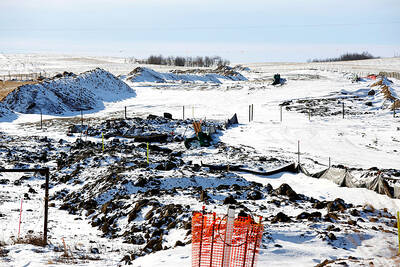
Separatists in Alberta are preparing to submit a petition tomorrow that they said has enough signatures to force a referendum on independence for the oil-rich Canadian province. Polls indicate the pro-independence camp remains a minority among Alberta’s 5 million people, but has hit a historic high of roughly 30 percent. Alberta separatists are also closer than ever to forcing a referendum, riding momentum fueled by intensifying grievances over Ottawa’s control of the provincial oil industry. They have also undeniably gotten a boost from the return to power of US President Donald Trump. After launching a petition in January, Stay Free Alberta, the group


 RSS
RSS