


As Russia’s war in Ukraine rages to the east and the US piles on pressure to spend more on the military, Czech Prime Minister Andrej Babis has been focusing on a very different agenda.
The billionaire leader has made a point of placing healthcare at the center of his focus since returning to power in December. Even as his government vows to scale back NATO-mandated defense spending because of budget constraints, Babis said in an interview in Prague that when it comes to funding for healthcare, there would be no such limits.
“We can’t cut corners when it comes to people’s health,” Babis, 71, said last week. “We want to have the best care. We will absolutely subordinate the budget to that. That money has absolute priority.”
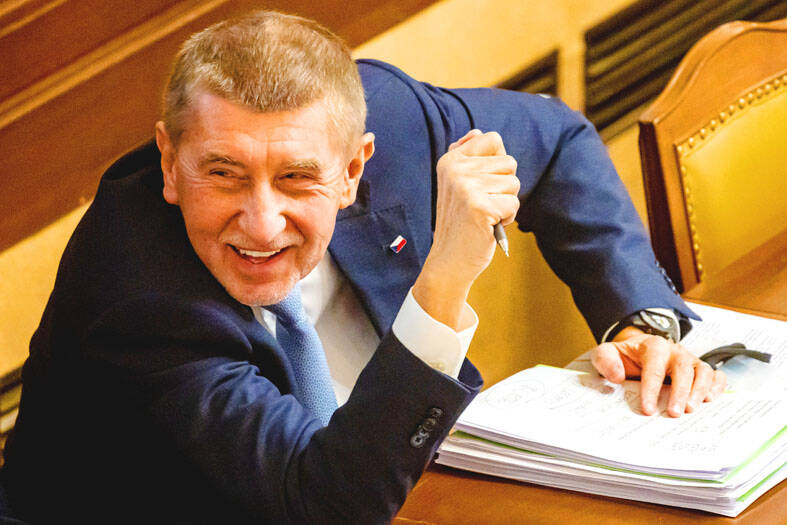
Photo: EPA
That spending approach has been part of Babis’ singular focus on health issues, with plans for a state-of-the-art hospital and a vigorous messaging campaign on cancer prevention, heart disease and mental health.
The agenda collides with mounting pressure from NATO allies — including the US ambassador — and political opponents at home to maintain higher defense spending. Czech President Petr Pavel told lawmakers last week that there is “not a single justifiable reason” for curtailing such investment.
Babis, whose ANO party has forged a coalition with far-right and climate-skeptic allies, has pledged to ditch defense targets set out by his predecessor, including a new NATO benchmark of spending 3.5 percent of economic output on core defense.
He said spending on military would account for more than 2 percent of economic output.
“This represents the maximum we can realistically do within the framework of the state budget,” Babis said. “As our GDP grows, defense spending also increases in nominal term.”
However, in marked contrast with the previous government’s belt-tightening, Babis said the Czech Republic’s low indebtedness, including a debt-to-GDP ratio of about 44 percent, meant that it had the fiscal room to spend on health — and that it should.
“Those investments will bring higher GDP and money — and most importantly, they will bring a healthy, long-lived generation and mentally healthy children,” he said.
That priority was on display last month. Instead of attending an event to mark four years of war, the prime minister toured a hospital in Pilsen, pledging state funding for a new surgical unit worth 3.2 billion koruna (US$152 million).
Babis said he would stand by the Czech Republic’s universal healthcare, which covers the population of 11 million through mandatory insurance.
Doing otherwise would create a dual-track system — “for the rich, and for the others,” Babis said.
The country performs above average on several health policy metrics within the Organisation for Economic Co-operation and Development. Still, healthcare spending per capita and life expectancy remain below the OECD average.
Babis declined to discuss Ukraine or defense spending at length — and would not say whether the country would surpass the EU’s deficit-spending limit of 3 percent of GDP. His agenda will appear in next year’s budget, the first to be determined by his coalition, Babis said.
The priorities align with Babis’ claims on the campaign trail last year that the Czech Republic had placed too much emphasis on military aid to Ukraine. An ally of Hungarian Prime Minister Viktor Orban and Slovakian Prime Minister Robert Fico, the billionaire also denounced the EU’s migration policies, calling for tighter restrictions with rhetoric that echoed US President Donald Trump.
However, the domestic focus in his three months back in power has meant that he has avoided the running battles waged by Budapest and Bratislava against Brussels. As a populist, Babis has embraced a level of pragmatism that has allowed him to avoid more divisive tension among European capitals.
He has spent more time talking about his flagship plan for a new hospital, a greenfield project that would combine services from two of Prague’s three older hospitals and absorb some capacity from a third.
Still, Babis’s health obsession has drawn some mixed reactions. Critics say the approach lacks a strategy and some of his medical advice runs counter to the country’s healthcare recommendations.
Health policy has also been Babis’s undoing. His handling of the COVID-19 pandemic during his first term was pilloried by the opposition for its ballooning spending and the issue contributed to his election defeat in 2021.
However, the prime minister is undeterred. In his office, he leafed through a stack of health-related material detailing new technologies, project pitches — even a timeline on cracking down on the availability of the stimulant herb kratom, which has opioid-like effects, for young people.
Czech citizens write to him for help in fighting cancer and other health problems, he said.
“Being a micromanager — that’s what everyone criticizes me of being, but I’m fine with that,” Babis said. “The people who criticize me should first have a look at their CV and compare it with mine and my achievements in life and politics.”


PHISHING: The con might appear convincing, as the scam e-mails can coincide with genuine messages from Apple saying you have run out of storage For a while you have been getting messages from Apple saying “your iCloud storage is full.” They say you have exceeded your storage plan, so documents are no longer being backed up, and photos you take are not being uploaded. You have been resisting Apple’s efforts to get you to pay a minimum of £0.99 (US$1.33) a month for more storage, but it seems that you cannot keep putting off the inevitable: You have received an e-mail which says your iCloud account has been blocked, and your photos and videos would be deleted very soon. To keep them you need

For two decades, researchers observed members of the Ngogo chimpanzee group of Kibale National Park in Uganda spend their days eating fruits and leaves, resting, traveling and grooming in their tropical rainforest abode, but this stable community then fractured and descended into years of deadly violence. The researchers are now describing the first clearly documented example of a group of wild chimpanzees splitting into two separate factions, with one launching a series of coordinated attacks against the other. Adult males and infants were targeted, with 28 deaths. “Biting, pounding the victim with their hands, dragging them, kicking them — mostly adult males,

The Israeli military has demolished entire villages as part of its invasion of south Lebanon, rigging homes with explosives and razing them to the ground in massive remote detonations. The Guardian reviewed three videos posted by the Israeli military and on social media, which showed Israel carrying out mass detonations in the villages of Taybeh, Naqoura and Deir Seryan along the Israel-Lebanon border. Lebanese media has reported more mass detonations in other border villages, but satellite imagery was not readily available to verify these claims. The demolitions came after Israeli Minister of Defense Israel Katz called for the destruction of

SUPERFAN: The Japanese PM played keyboard in a Deep Purple tribute band in middle school and then switched to drums at university, she told the British rock band Legendary British rock band Deep Purple yesterday made Japanese Prime Minister Sanae Takaichi’s day with a brief visit to their high-profile superfan as they returned to the nation they first toured more than half a century ago. Takaichi’s reputation as an amateur drummer, and a fan of hard rock and heavy metal has been well documented, and she has referred to Deep Purple as one of her favorite bands along with the likes of Black Sabbath and Iron Maiden. “You are my god,” a giddy Takaichi said in English to Deep Purple drummer Ian Paice, presenting him with a set of made-in-Japan


 RSS
RSS