


The Israeli military has demolished entire villages as part of its invasion of south Lebanon, rigging homes with explosives and razing them to the ground in massive remote detonations.
The Guardian reviewed three videos posted by the Israeli military and on social media, which showed Israel carrying out mass detonations in the villages of Taybeh, Naqoura and Deir Seryan along the Israel-Lebanon border. Lebanese media has reported more mass detonations in other border villages, but satellite imagery was not readily available to verify these claims.
The demolitions came after Israeli Minister of Defense Israel Katz called for the destruction of “all houses” in border villages “in accordance with the model used in Rafah and Beit Hanoun in Gaza” to stop threats to communities in northern Israel.
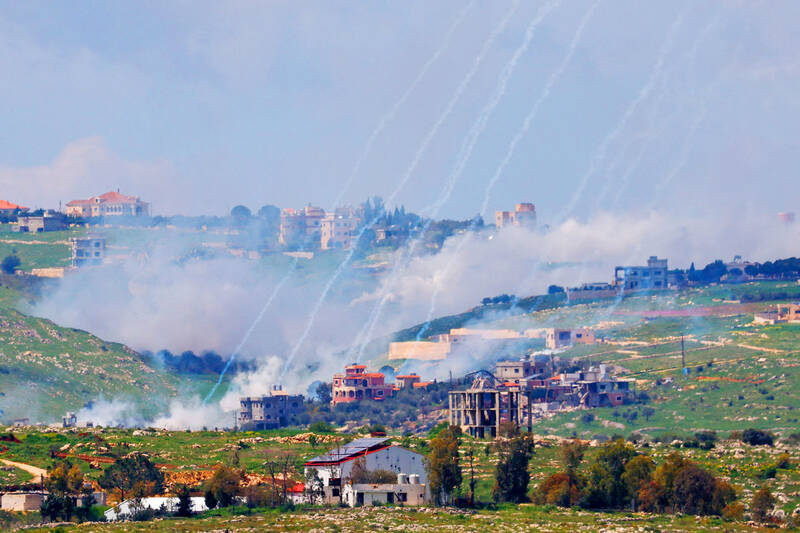
Photo: Reuters
The Israeli military destroyed 90 percent of homes in Rafah, in south Gaza.
The tactic of mass destruction of homes in Gaza, where Israel has been accused of committing genocide, was described as domicide by academics, a strategy that is used to systematically destroy and damage civilian housing to render entire areas uninhabitable.
The Israeli military has said they are targeting Hezbollah infrastructure such as tunnels and military facilities, which it claims the armed group has embedded in civilian homes, through these demolitions.
Israel has said that it would occupy vast swathes of south Lebanon, establishing a “security zone” in the entire area up to the Litani River, and that displaced people would not be allowed to return to their homes until the safety of Israel’s northern cities is guaranteed, prompting concern there would be long-term displacement.
However, rights groups have said these mass remote detonations could amount to wanton destruction: a war crime. The laws of war prohibit the deliberate destruction of civilian homes, except when necessary for lawful military reasons.
“The possibility that Hezbollah might use some civilian structures in Lebanon’s border villages for military purposes does not justify the wide-scale destruction of entire villages along the border,” Human Rights Watch researcher Ramzi Kaiss said.
For residents of border villages, who watched the videos of the destruction of their houses with horror, the detonations erased not only their homes, but also generations of memories.
“The first thing we saw was the town square being blown up. I have a shop there. A person’s whole life is in that place, their work, their memories, everything. Suddenly you see it exploding in front of you,” said Ahmad Abu Taam, a 56-year-old construction supply shop owner from Taybeh.
“From that moment, I felt that I had become a refugee. I feel like I have no home,” he added.
Abu Taam had also been displaced in the 2024 Hezbollah-Israel war. Although much of the village was damaged in that round of conflict, his return was still a joyous one. He took a picture of Deir Seryan after its residents returned — string lights were hung over the town square, lighting up the town.
“I forgot the displacement then and started rebuilding my shop from scratch — without even feeling the fatigue. When you arrive, it feels like you’ve found something you lost, but this time, everything is gone. Everything has been wiped out,” Abu Taam said.
Ahmad Ibrahim, a 50-year-old farmer from Deir Seryan, has only a few pictures of his house. He left the rest back home, leaving them behind as he fled the town on March 2, expecting that he would collect them when he came back.
“My whole life is there. I’ve never really left beyond 10-13km. It’s a beautiful, typical village — at least it was before the war. Its people are kind and generous,” Ibrahim said.
The weather in Lebanon is turning to spring and Deir Seryan would be becoming lush, its flowers in full bloom, after the months of winter rain. Ibrahim mourned that his children would not enjoy springtime in their homes, but instead would spend it displaced.
“The children remember the good times — spring and summer evenings, going out to the fields, collecting flowers and herbs, having dinner outdoors, making tea over a fire,” he said. “For the children, it was a beautiful place to grow up.”
Mohammed Hashem, a 65-year-old doctor, spent 15 years working 18-hour days to save up enough money to build the Luna motel in Naqoura. The multi-story hotel was built in 2012 and hosted foreign travelers, Lebanese vacationers and off-duty UN peacekeepers, who all flocked to the seaside town, whose residents boasted of the most beautiful beaches in all of Lebanon.
“In summer, occupancy would reach 100 percent. We received good ratings and awards. Overall, we were happy — living peacefully, with good productivity,” Hashem said. “It really was a family business.”
When news of the hotel’s destruction was published, Hashem was overwhelmed by the outpouring of support from his former customers.
“We received thousands of likes and comments. People expressed how much they loved the place. Our guests were always happy — good prices, good service,” he said.
The story of villages in Lebanon’s south, which has been subject to Israeli invasion and occupation on-and-off since the late 1970s, is also one of displacement. Families from border villages are scattered across the world — in Australia, Africa, Europe — having searched for stability and livelihoods abroad.
These villages served as an anchor for scattered families. The diaspora used to take comfort that they could always return home, descending upon old family homes in droves in the summer and spring, at times doubling border villages’ populations during holiday season.
“People would build houses worth a million dollars just to stay for a week or 10 days a year. The village becomes the center of the family,” Abu Taam said. “Because no matter where you go, you always long for your home. The place where you grew up, where you first felt at ease.”
For many, that anchor is now gone.
“You feel a deep sense of frustration. Like someone has the power to erase you,” Abu Taam said.

‘CROSSING THE LINE’: China’s embassy in Seoul criticized US Forces Korea Commander General Xavier Brunson, asking if his ‘hostile’ remarks were authorized by Washington South Korea and the US are in talks over recent public remarks by the commander of US Forces Korea, Seoul’s presidential office said yesterday, after the comments drew sharp criticism from China. In a recent podcast interview, US Forces Korea Commander General Xavier Brunson described South Korea as “the dagger in the heart of Asia” from China’s east coast, prompting the Chinese embassy in Seoul to say that he had “truly crossed the line.” The interview came amid growing speculation that Washington might seek to expand the role of US Forces Korea in countering the growing regional influence of China, a key

SEEKING ORDER: Rodrigo Paz said that ‘anyone who wants to destroy the nation will have to deal with this president and the full force of the constitution’ Bolivian President Rodrigo Paz on Wednesday said that the nation was at a “breaking point” after nearly a month of protests that have caused shortages of food, fuel and medicine. Paz, who took office six months ago amid the worst economic crisis there in four decades, is battling a groundswell of fury over his policies. The political capital, La Paz, has been besieged by low-income workers and members of the indigenous majority calling for his resignation. “The country needs order and is reaching breaking point,” the 58-year-old said at a public event in La Paz, renewing his appeal for dialogue. On Tuesday, the Bolivian

Forecasters in Europe yesterday warned of exceptional heat as record temperatures driven by a “heat dome” push temperatures well above seasonal norms across the continent. The surge follows a record-breaking Monday, with France logging its hottest day in the month of May on record, its weather agency said, and the UK also posting unprecedented highs. A so-called “heat dome” of warm air from northern Africa trapped under a high-pressure system over western Europe is behind the high temperatures not usually seen until high summer. Restrictions on outdoor work were imposed in parts of Italy, beaches in southwest France filled earlier than usual and

Australian researchers have trained lab-grown brain cells on a silicon computer chip to play the 1990s shooter game Doom and said they are just scratching the surface of what the neurons could be capable of doing. It is the science-fiction work of biotech boffins at Cortical Labs, who researched and developed the technology that harnesses the workings of the brain’s networking system. Each so-called “biological computer” contains about 200,000 living human brain cells, grown from stem cells that were harvested from blood donations. Having mastered the simple computer game Pong, where a paddle is moved up and down to send a ball


 RSS
RSS