


China’s top political advisory body, the Chinese People’s Political Consultative Conference (CPPCC), has voted to remove three generals, state media said, a week after nine military officials were ousted from the National People’s Congress (NPC).
The move comes as Beijing escalates a sweeping purge of military officials, days before thousands of delegates meet for the annual Two Sessions political conclave today.
Simultaneous gatherings of the the NPC and the CPPCC are to be held over the course of a week.
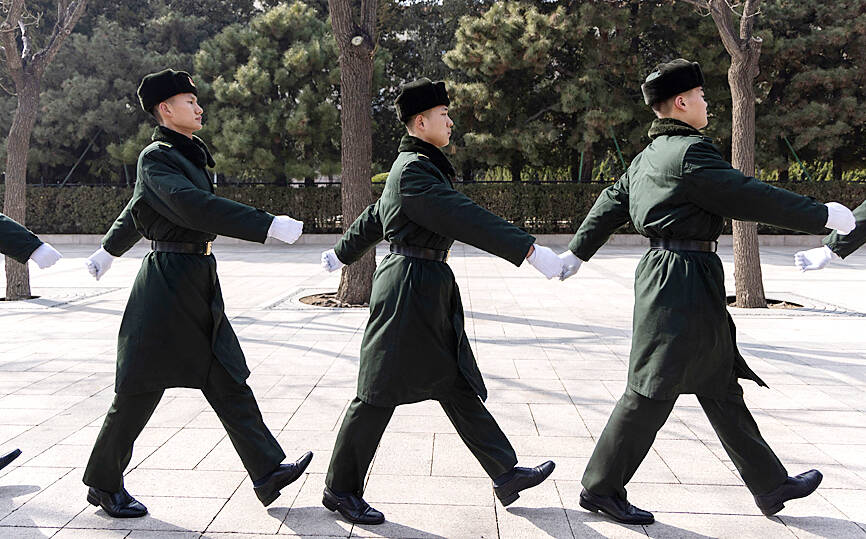
Photo: Reuters
The CPPCC voted at a Standing Committee meeting to remove retired military generals Han Weiguo (韓衛國), Liu Lei (劉雷) and Gao Jin (高津), Xinhua news agency reported on Monday.
It also voted to remove two other members, while 10 more were officially ousted.
The move comes after the NPC ousted 19 of its delegates on Thursday last week, including nine military officials.
The reason for the removals was not specified.
Wang Xiangxi (王祥喜) was also removed as minister of emergency management that same day after a probe by the nation’s anti-corruption watchdog, while Liu Shaoyun (劉少雲) was removed from his position as head of the Chinese People’s Liberation Army’s military court.
Since Chinese President Xi Jinping (習近平) came to power more than a decade ago, he has launched a massive drive to root out graft at all levels of the Chinese Communist Party and state, with the drive now targeting the military.
Xi hailed the military’s “fight against corruption” last month in a rare acknowledgement of graft, weeks after Beijing escalated a sweeping purge by probing its top general.
The Chinese Ministry of National Defense in January said that it was investigating Zhang Youxia (張又俠), a vice chairman of the powerful Central Military Commission, as well as Liu Zhenli (劉振立), chief of staff of the commission’s joint staff department, which oversees combat planning.


PHISHING: The con might appear convincing, as the scam e-mails can coincide with genuine messages from Apple saying you have run out of storage For a while you have been getting messages from Apple saying “your iCloud storage is full.” They say you have exceeded your storage plan, so documents are no longer being backed up, and photos you take are not being uploaded. You have been resisting Apple’s efforts to get you to pay a minimum of £0.99 (US$1.33) a month for more storage, but it seems that you cannot keep putting off the inevitable: You have received an e-mail which says your iCloud account has been blocked, and your photos and videos would be deleted very soon. To keep them you need

For two decades, researchers observed members of the Ngogo chimpanzee group of Kibale National Park in Uganda spend their days eating fruits and leaves, resting, traveling and grooming in their tropical rainforest abode, but this stable community then fractured and descended into years of deadly violence. The researchers are now describing the first clearly documented example of a group of wild chimpanzees splitting into two separate factions, with one launching a series of coordinated attacks against the other. Adult males and infants were targeted, with 28 deaths. “Biting, pounding the victim with their hands, dragging them, kicking them — mostly adult males,

The Israeli military has demolished entire villages as part of its invasion of south Lebanon, rigging homes with explosives and razing them to the ground in massive remote detonations. The Guardian reviewed three videos posted by the Israeli military and on social media, which showed Israel carrying out mass detonations in the villages of Taybeh, Naqoura and Deir Seryan along the Israel-Lebanon border. Lebanese media has reported more mass detonations in other border villages, but satellite imagery was not readily available to verify these claims. The demolitions came after Israeli Minister of Defense Israel Katz called for the destruction of

SUPERFAN: The Japanese PM played keyboard in a Deep Purple tribute band in middle school and then switched to drums at university, she told the British rock band Legendary British rock band Deep Purple yesterday made Japanese Prime Minister Sanae Takaichi’s day with a brief visit to their high-profile superfan as they returned to the nation they first toured more than half a century ago. Takaichi’s reputation as an amateur drummer, and a fan of hard rock and heavy metal has been well documented, and she has referred to Deep Purple as one of her favorite bands along with the likes of Black Sabbath and Iron Maiden. “You are my god,” a giddy Takaichi said in English to Deep Purple drummer Ian Paice, presenting him with a set of made-in-Japan


 RSS
RSS