


US Secretary of Defense Pete Hegseth gave Anthropic’s CEO until tomorrow to open the company’s artificial intelligence (AI) technology for unrestricted military use or risk losing its government contract, a person familiar with their meeting said on Tuesday.
Anthropic makes the chatbot Claude and is the last of its peers to not supply its technology to a new US military internal network. CEO Dario Amodei repeatedly has made clear his ethical concerns about unchecked government use of AI, including the dangers of fully autonomous armed drones and of AI-assisted mass surveillance that could track dissent.
Defense officials warned they could designate Anthropic a supply chain risk or use the Defense Production Act to essentially give the military more authority to use its products even if it does not approve of how they are used, said the person familiar with the meeting and a senior Pentagon official, who both were not authorized to comment publicly and spoke on condition of anonymity.
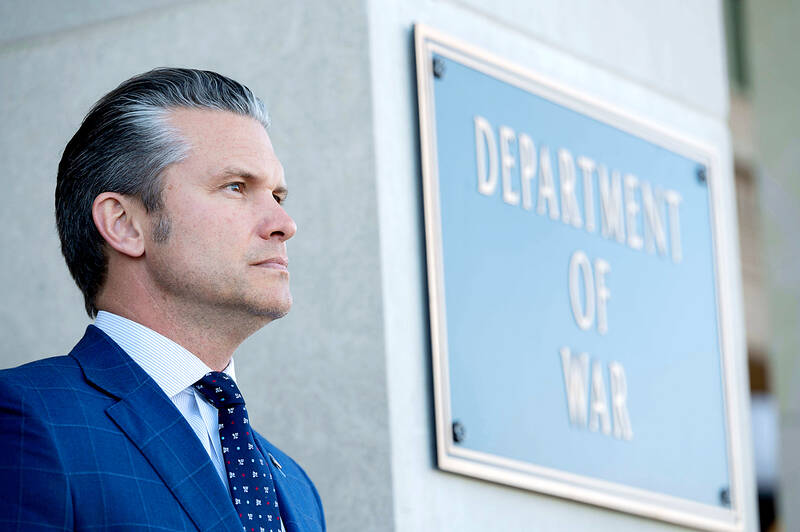
Photo: AP
The development, which was reported earlier by Axios, underscores the debate over AI’s role in national security and concerns about how the technology could be used in high-stakes situations involving lethal force, sensitive information or government surveillance. It also comes as Hegseth has vowed to root out what he calls a “woke culture” in the armed forces.
“A powerful AI looking across billions of conversations from millions of people could gauge public sentiment, detect pockets of disloyalty forming, and stamp them out before they grow,” Amodei wrote in an essay last month.
The person familiar called the tone of the meeting cordial, but said Amodei did not budge on two areas he has established as lines Anthropic would not cross: fully autonomous military targeting operations and domestic surveillance of US citizens.
The Pentagon objects to Anthropic’s ethical restrictions, saying military operations need tools that do not come with built-in limitations, the senior Pentagon official said.
Anthropic has long pitched itself as the more responsible and safety-minded of the leading AI companies, ever since its founders quit OpenAI to form the start-up in 2021.
The uncertainty with the Pentagon is putting those intentions to the test, said Owen Daniels, associate director of analysis and fellow at Georgetown University’s Center for Security and Emerging Technology.
“Anthropic’s peers, including Meta, Google and xAI, have been willing to comply with the department’s policy on using models for all lawful applications,” Daniels said. “So the company’s bargaining power here is limited, and it risks losing influence in the department’s push to adopt AI.”
The Pentagon’s “breakneck” adoption of AI shows the need for greater AI oversight or regulation by US Congress, particularly if AI is being used to surveil Americans, said Amos Toh, senior counsel at the Brennan Center’s Liberty and National Security Program at New York University.
“The law is not keeping up with how quickly the technology is evolving,” Toh wrote in a post on Bluesky. “But that doesn’t mean DoD [the Department of Defense] has a blank check.”

FEROCIOUS FISH-EATER Scientists have found a new species of dinosaur from the Cretaceous Period, a ‘hell heron’ that stalked the rivers, deep in the Saharan desert At a remote Sahara desert site in Niger, scientists have unearthed fossils of a new species of Spinosaurus, among the biggest of the meat-eating dinosaurs, notable for its large blade-shaped head crest and jaws bearing interlocking teeth for snaring fish. It prowled a forested inland environment and strode into rivers to catch sizable fish like a modern-day wading bird — a “hell heron,” as one of the researchers put it, considering it was about 12 meters long and weighed 5-7 tons. The dinosaur presented a striking profile on the Cretaceous Period landscape of Africa some 95 million years ago as it hunted
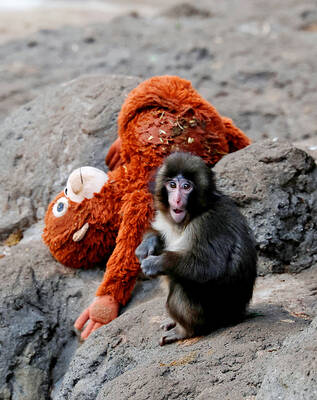
THE TRAGEDY OF PUNCH: Footage of the seven-month-old Japanese macaque has gone viral online after he was rejected by his mother and formed a bond with a soft toy A baby monkey in Japan has captured hearts around the world after videos of him being bullied by other monkeys and rejected by his mother went viral last week. Punch, a Japanese macaque, was born in July last year at Ichikawa City Zoo. He has drawn international attention after zookeepers gave him a stuffed orangutan toy after he was abandoned by his mother. Without maternal guidance to help him integrate, Punch has turned to the toy for comfort. He has been filmed multiple times being dragged and chased by older Japanese macaques inside the enclosure. Early clips showed him wandering alone with

DRUG WAR: The former president said there was no campaign to kill addicts, but his speeches called for violence and told police to use lethal force if necessary Former Philippine president Rodrigo Duterte earned global infamy for the deadly drug crackdown that led to his arrest over crimes against humanity charges, despite his huge popularity at home. A profane-lipped populist and self-professed killer, Duterte’s anti-crime campaign resulted in the deaths of thousands of alleged dealers and addicts. Rights groups said many of those killed were poor men, often without any proof they were linked to drugs. Yet, while drawing condemnation abroad, tens of millions of Filipinos backed his swift brand of justice — even as he joked about rape in his rambling speeches, locked up his critics and failed to

GAME CHANGER The Russian invasion of Ukraine has shown the utility of small drones for recon, for supporting logistics and for killing across the modern battlefield Five European nations have announced a new program to produce low-cost air defense systems and autonomous drones using Ukrainian expertise, hard-won over the past four years fighting against Russia. Friday’s initiative of the five nations — France, Poland, Germany, the UK and Italy — comes as one of many European efforts to bolster defense along their borders, like a “drone wall ” with Russia and Ukraine to better detect, track and intercept drones violating Europe’s airspace. Both Moscow and Kyiv have cutting-edge drone warfare capabilities forged in the grim laboratory of war where battlefield innovations have rewritten modern battle tactics. Poland is


 RSS
RSS