


Five European nations have announced a new program to produce low-cost air defense systems and autonomous drones using Ukrainian expertise, hard-won over the past four years fighting against Russia.
Friday’s initiative of the five nations — France, Poland, Germany, the UK and Italy — comes as one of many European efforts to bolster defense along their borders, like a “drone wall ” with Russia and Ukraine to better detect, track and intercept drones violating Europe’s airspace.
Both Moscow and Kyiv have cutting-edge drone warfare capabilities forged in the grim laboratory of war where battlefield innovations have rewritten modern battle tactics.
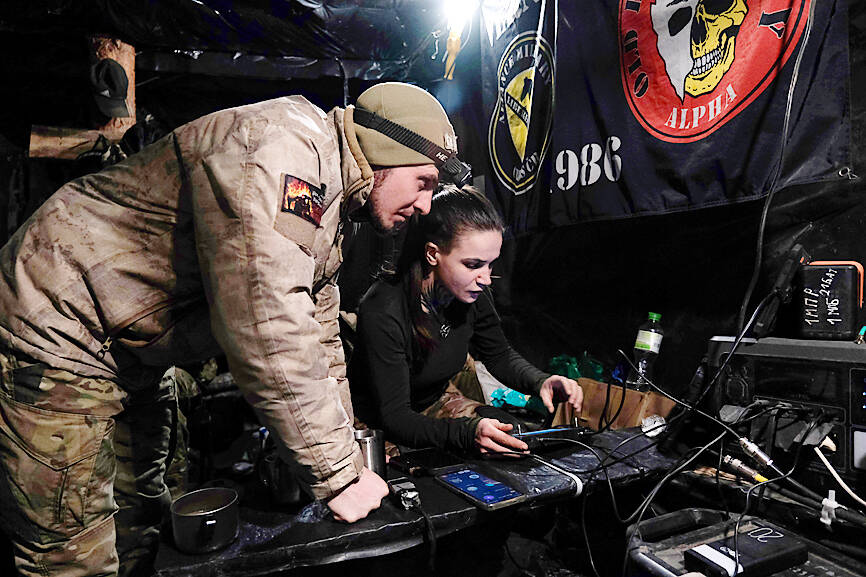
Photo: EPA
Poland is already working with Ukraine on drone technology in joint military training programs and manufacturing projects.
Those efforts were sparked by a spate of incidents in which Europe’s borders and airports have been tested by rogue drones.
Russia has been blamed for some of them, but denies that anything was done on purpose or that it played a role.
“The UK and our E5 partners are stepping up — investing together in the next generation of air defense and autonomous systems to strengthen NATO’s shield,” British Minister for Defense Readiness and Industry Luke Pollard said.
“We have some of the best kit on the entire planet for shooting down air threats. The problem is to be effective at shooting down relatively low-cost missiles, drones, and other threats facing us,” he said. “We need to make sure that we’re matching the cost of the threats with the cost of defense.”
Polish Minister of Defense Wladyslaw Kosiniak-Kamysz said the group of countries signed an agreement to jointly invest in the production and procurement of drone-based strike capabilities as well as cheap drone defense systems in a program called Low-Cost Effectors and Autonomous Platforms.
“Combat technologies and techniques are changing rapidly — we must respond quickly and appropriately,” Kosiniak-Kamysz said. “We also signed a crucial commitment regarding the joint development of drone-based strike capabilities, low-cost joint production, and joint procurement of drone effectors, i.e, combat payloads, using artificial intelligence.”
When Russian drones entered Polish airspace in September last year, Warsaw and its NATO allies used multimillion-dollar jets to respond to drones that cost thousands, and that ended up crashing into the Polish countryside. Low-cost kinetic or electronic effectors would allow the detection and destruction of drones at a fraction of the price.
Europe has scrambled to arm itself in the wake of US President Donald Trump’s deep criticism of NATO, European defense spending and once iron-clad alliances. The EU has ramped up spending and is openly questioning even deeper military projects.
“Europe’s security is more uncertain than it has been in decades,” said the EU’s Foreign Policy Chief Kaja Kallas, citing Russian aggression, instability in the Middle East, China and a “redefined” alliance with the US. She said that the low-cost interceptor program exemplifies the European commitment to its own security.
“If we want to keep our country safe, we must strengthen our hard power. The good news is that we are already investing record sums in defense. Europe is stepping up. But it’s not about competing with NATO. It’s about making Europe stronger within NATO. A stronger Europe makes the alliance also stronger,” she said.
The 32-nation military alliance has been shaken by the Trump administration.
His repeated threats to seize Greenland, a semiautonomous territory of NATO ally Denmark, and disparaging remarks about his NATO allies’ troops in Afghanistan drew another outcry.
While tensions over Greenland have subsided for now, the infighting has seriously undercut the ability of the world’s biggest security alliance to deter adversaries.

School bullies in Singapore are to face caning under new guidelines, but the education minister on Tuesday said it would be meted out only as a last resort with strict safeguards. Human rights groups regularly criticize Singapore for the use of corporal punishment, which remains part of the school and criminal justice systems, but authorities have defended it as a deterrent to crime and serious misconduct. Caning was discussed in the parliament after legislators asked how it would be used in relation to bullying in schools. The debate followed stricter guidelines on serious student misconduct, including bullying, unveiled by the Singaporean Ministry of

As evening falls in Fiji’s capital, a steady stream of people approaches a makeshift clinic that is a first line of defense against one of the world’s fastest-growing HIV epidemics. In the South Pacific nation — a popular tourist destination of just under a million people — more than 2,000 new HIV cases were recorded last year, a 26 percent increase from 2024. The government has declared an HIV outbreak and described it as a national crisis. “It’s spreading like wildfire,” said Siteri Dinawai, 46, who came to be tested. The Moonlight Clinic, a converted minibus parked in a suburban cul-de-sac in Suva, is
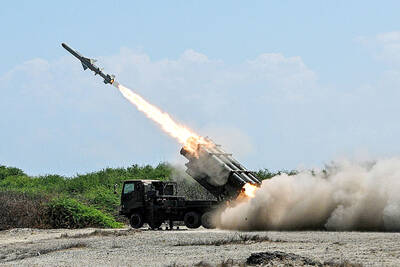
A MESSAGE: Japan’s participation in the Balikatan drills is a clear deterrence signal to China not to attack Taiwan while the US is busy in the Middle East, an analyst said The Japan Self-Defense Forces yesterday fired a Type 88 anti-ship missile during a joint maritime exercise with US, Australian and Philippine forces, hitting a decommissioned Philippine Navy ship in waters facing the disputed South China Sea, in drills that underscore Tokyo’s rising willingness to project military power on China’s doorstep. The drill took place as Manila and Tokyo began talks on a potential defense equipment transfer, made possible by Japan’s decision to scrap restrictions on military exports. The discussions include the possible early transfer of Abukuma-class destroyers and TC-90 aircraft to the Philippines, Japanese Minister of Defense Shinjiro Koizumi said. Philippine Secretary of

A South Korean judge who last week more than doubled former South Korean first lady Kim Keon-hee’s prison sentence was found dead yesterday, police said. Shin Jong-o was found unconscious at about 1am at the Seoul High Court building, an investigator at the Seocho District Police Station in Seoul said. Shin was taken to a hospital and pronounced dead, he said. “There is no sign of foul play in the death,” the investigator added. Local media reported that Shin had left a suicide note, but the investigator said there was none. On Tuesday last week, Shin presided over 53-year-old Kim’s appeal trial, finding her guilty


 RSS
RSS