


The world’s only flightless parrot species was once thought to be doomed by design. The kakapo is too heavy, too slow and, frankly, too delicious to survive around predators, and takes a shamelessly relaxed approach to reproduction.
However, the nocturnal and reclusive New Zealand native bird’s fate is teetering toward survival after an unlikely conservation effort that has coaxed the population from 50 to more than 200 over three decades.
This year, with a bumper crop of the strange parrot’s favorite berries prompting a rare enthusiasm for mating, those working to save the birds hope for a record number of chicks this month, which would move the kakapo closer to defying what was not long ago believed to be certain extinction.
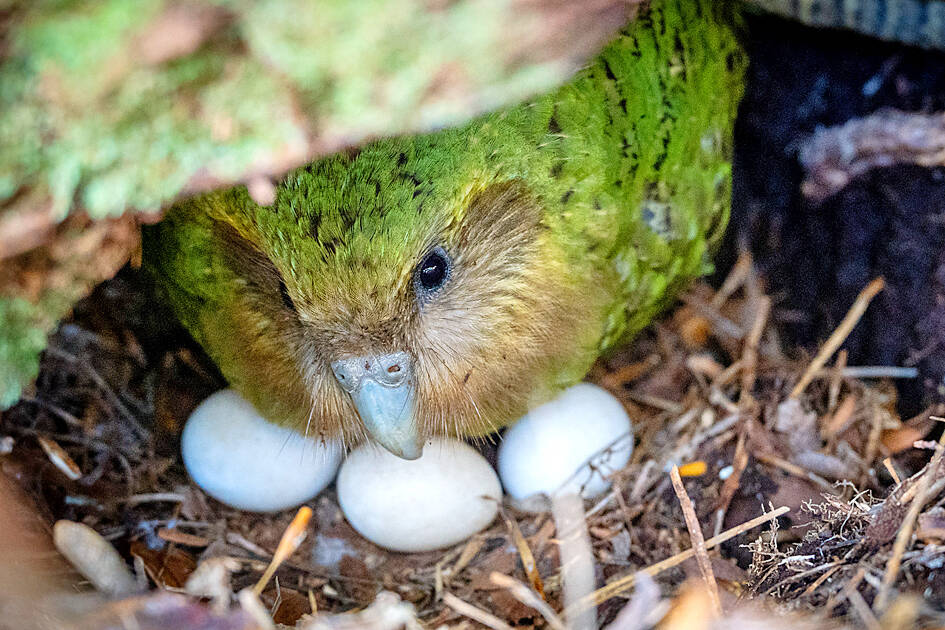
Photo: New Zealand Department of Conservation via AP
Kakapo live on three tiny, remote islands off New Zealand’s southern coast and chances to see them in the wild are scarce. This breeding season has launched one of the birds to Internet fame through a livestreamed video of her underground nest, where her chick was born yesterday.
The kakapo is a majestic creature that can live for 60 to 80 years — but they are undoubtedly weird to look at.
Birds can weigh more than 3kg. They have owl-like faces, whiskers, and mottled green, yellow and black plumage that mimics dappled light on the forest floor. That is where the flightless parrot lives, which has made its survival complicated.
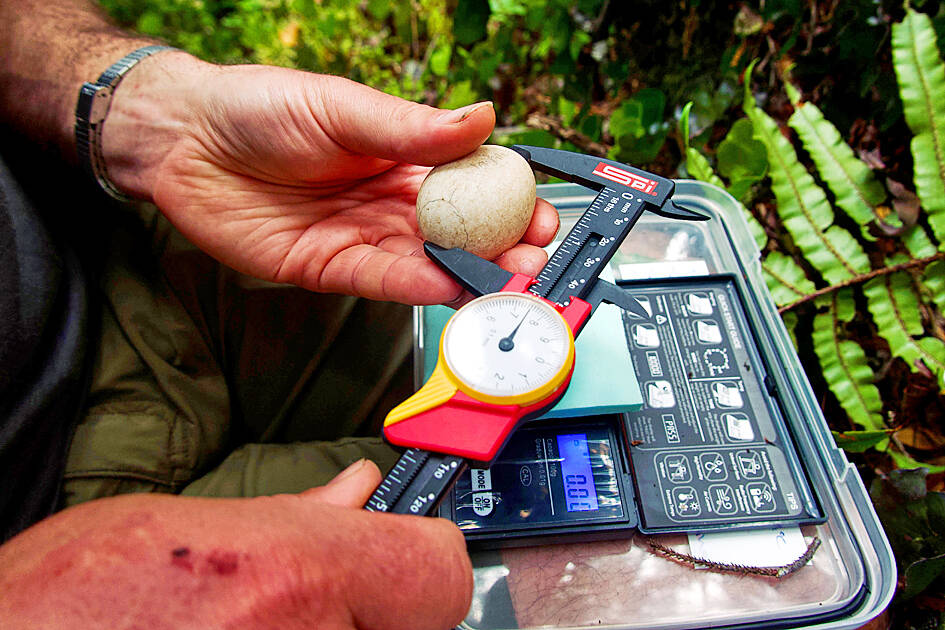
Photo: New Zealand Department of Conservation, New Zealand via AP
“Kakapo also have a really strong scent,” said Deidre Vercoe, the operations manager for the Department of Conservation’s kakapo program. “They smell really musky and fruity — gorgeous smell.”
The pungent aroma was bad news for the parrots when humans arrived in New Zealand hundreds of years ago. The introduction of rats, dogs, cats and stoats, as well as hunting by people and destruction of native forest habitats, drove species of the country’s flourishing flightless birds — the kakapo among them — to near or complete extinction.
By 1974, no kakapo were known to exist. However, conservationists kept looking, and in the late 1970s, a new population of the birds was discovered.
Reversing their fortunes has not been simple.
One reason the kakapo population has grown slowly is that its breeding is, like everything about the birds, peculiar. Years or even decades can pass between successful clutches of eggs.
A breeding season only happens every two to four years, in response to bumper crops of fruit from the native rimu trees the parrots favor, which last happened in 2022. A huge food source is needed for chicks to survive, but it is now known exactly how adult birds become aware of an abundant harvest.
“They’re probably up there in the canopy assessing the fruiting,” Vercoe said. “When there’s a large crop developing, they somehow tune into that.”
That is when things get really strange. Male kakapo position themselves in dug-out bowls in the ground and emit sonorous booming sounds followed by noises known as “chings,” which sound like the movement of rusty bedsprings.
The deep booms, which on clear nights can be heard across the forest, attract female kakapo to the bowls. Females can lay up to four eggs before raising their chicks alone.
Since last month, admirers of the birds have had a rare glimpse into the process through a livestream showing the underground nest of 23-year-old kakapo Rakiura on the island of Whenua Hou, where she has laid three eggs, two of them fertile. So precarious is the species’ survival that the eggs were exchanged for fake replacements while the real ones were incubated indoors.
A technician yesterday replaced the fake eggs with the first near-hatching egg. The kakapo kept her distance while the switch was made, but quickly returned to the nest, seemingly unperturbed. The chick hatched just over an hour later. The second real egg is expected to be added within days.
Native birds are beloved in New Zealand
Perhaps the only thing stranger than the kakapo is the lengths to which New Zealanders have gone to save it.
Quadrupling the population over the past three decades has required their relocation to three remote, predator-free offshore islands and the micromanaging of the parrots’ every romantic entanglement.
“We do what we can to make sure we don’t lose any further genetic diversity,” Vercoe said. “We manage that carefully through having the best matches possible on each island.”
Each bird has a name and is monitored by a small backpack tracker; if a bird vanishes, they are nearly impossible to find. With the kakapo still critically endangered, there is little prospect of conservation efforts ending anytime soon, although those working with the birds are easing their hands-on management each breeding season.
The painstaking work to preserve the species might seem odd to outsiders, but the parrot is just one of many spirited and strange avians in a country where birds reign supreme.
The only native land mammals are two types of bat, so New Zealand’s birds, which evolved eccentrically before human and predator arrival, have become beloved national symbols.
“We don’t have the Eiffel Tower or the pyramids, but we do have kakapo and kiwi,” Vercoe said. “It’s a real New Zealand duty to save these birds.”

FEROCIOUS FISH-EATER Scientists have found a new species of dinosaur from the Cretaceous Period, a ‘hell heron’ that stalked the rivers, deep in the Saharan desert At a remote Sahara desert site in Niger, scientists have unearthed fossils of a new species of Spinosaurus, among the biggest of the meat-eating dinosaurs, notable for its large blade-shaped head crest and jaws bearing interlocking teeth for snaring fish. It prowled a forested inland environment and strode into rivers to catch sizable fish like a modern-day wading bird — a “hell heron,” as one of the researchers put it, considering it was about 12 meters long and weighed 5-7 tons. The dinosaur presented a striking profile on the Cretaceous Period landscape of Africa some 95 million years ago as it hunted

‘COST OF DEFECTION’: Duterte’s announcement could be an effort to keep allies in line with the promise of a return to power amid political uncertainty, an analyst said Philippine Vice President Sara Duterte yesterday announced she would run for president of the Southeast Asian nation of 116 million in 2028. Duterte, who is embroiled in a bitter feud with Philippine President Ferdinand Marcos Jr, was impeached last year only to see the country’s Supreme Court throw the case out over procedural issues. Her announcement comes just days before her father, former Philippine president Rodrigo Duterte, begins a pretrial hearing at the International Criminal Court (ICC) in the Netherlands over crimes against humanity allegedly committed as part of a brutal crackdown on drugs. “I offer my life, my strength and my future

NOT YET THERE: While the show was impressive, it failed to demonstrate their ability to move in unstructured environments, such as a factory floor, an expert said Dancing humanoid robots on Monday took center stage during the annual China Media Group’s Spring Festival Gala, China’s most-watched official television broadcast. They lunged and backflipped (landing on their knees), they spun around and jumped. Not one fell over. The display was impressive, but if robots can now dance and perform martial arts, what else can they do? Experts have mixed opinions, with some saying the robots had limitations and that the display should be viewed through a lens of state propaganda. Developed by several Chinese robotics firms, the robots performed a range of intricate stunts, including martial arts, comedy sketches and choreographed

DRUG WAR: The former president said there was no campaign to kill addicts, but his speeches called for violence and told police to use lethal force if necessary Former Philippine president Rodrigo Duterte earned global infamy for the deadly drug crackdown that led to his arrest over crimes against humanity charges, despite his huge popularity at home. A profane-lipped populist and self-professed killer, Duterte’s anti-crime campaign resulted in the deaths of thousands of alleged dealers and addicts. Rights groups said many of those killed were poor men, often without any proof they were linked to drugs. Yet, while drawing condemnation abroad, tens of millions of Filipinos backed his swift brand of justice — even as he joked about rape in his rambling speeches, locked up his critics and failed to


 RSS
RSS