


Prime Minister Sanae Takaichi pledged yesterday to make Japan “strong and prosperous,” while hitting out at China and pledging to keep “hitting the growth button” following her party’s landslide election win.
“China is intensifying its attempts to unilaterally change the status quo by force or coercion in the East China Sea and the South China Sea, while also expanding and stepping up its military activities in the areas surrounding our country,” Takaichi told the Japanese House of Representatives in a policy address.
Echoing her predecessor Shigeru Ishiba, Takaichi also said that Japan was facing “the most severe and complex security environment” since World War II, citing not just China, but also Russia and North Korea.
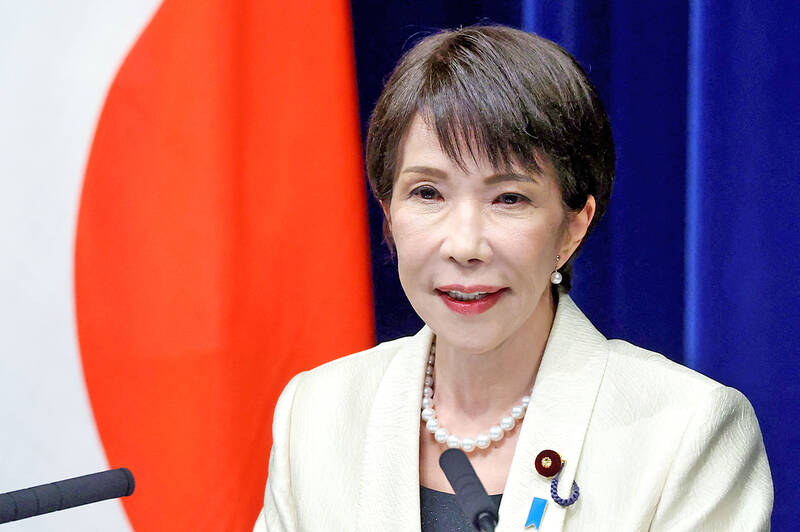
Photo: AFP
Takaichi said she would aim this year to revise Japan’s three key defense policy documents, as “changes in the security environment — such as the emergence of new ways of warfare and the need to prepare for prolonged conflicts — are accelerating across a wide range of fields.”
She added that she wanted to accelerate discussions on further loosening Japan’s self-imposed ban on the export of lethal weapons.
“This will contribute to strengthening the deterrence and response capabilities of our allies and like-minded partners, while also helping to reinforce Japan’s defense production base and its foundation of civilian technologies,” she said.
Takaichi, whose ruling Liberal Democratic Party (LDP) party won a two-thirds majority in snap elections on Feb. 8, angered China by suggesting in November last year that Japan could intervene militarily if Beijing sought to take Taiwan by force.
China, which regards the democratic island as part of its territory and has not ruled out force to annex it, advised its citizens to avoid travel to Japan.
Chinese Minister of Foreign Affairs Wang Yi (王毅) told the Munich Security Conference on Saturday that forces in Japan were seeking to “revive militarism.”
Takaichi insisted that her fiscal economic policies would not be “reckless,” as investors worry that her efforts to boost growth and help consumers with inflation could swell Japan’s debts.
“We are not going to pursue a reckless fiscal policy that would undermine the market’s confidence,” Takaichi told the House of Representatives, undertaking to reduce Japan’s ratio of debt to GDP.
“I will keep hitting that growth switch — again and again and again — pushing it as much as I possibly can,” she said.
She pledged to promote domestic investment in “risk management” areas such as energy, health, infrastructure and cyber security.
Her government would focus on “growth” areas such as AI, chips and ship-building.
Japanese inflation slowed last month, government data showed yesterday, in welcome news for Takaichi.
Soaring inflation in Asia’s number-two economy — after decades of flat or falling prices — contributed to the downfall of Takaichi’s two predecessors and Japan’s first woman premier has made helping households a priority.
Excluding fresh food, “core” consumer prices rose 2.0 percent year-on-year, the slowest rise in two years, down from 2.4 percent in December last year, and in line with market forecasts.
In the address, Takaichi repeated her campaign pledge to consider suspending consumption tax on food for two years to help households cope with inflation.
This has exacerbated market worries about Japan’s Godzilla-sized debts, with yields on long-dated government bonds hitting record highs last month.
She also announced in her policy speech a cross-party “national council” to discuss taxation and how to fund ageing Japan’s ballooning social security bill.
Takaichi said she also wanted to “make maximum use of decarbonized power sources” to ensure energy security.
“Ensuring domestically produced energy is important from the viewpoint of energy security,” Takaichi said.
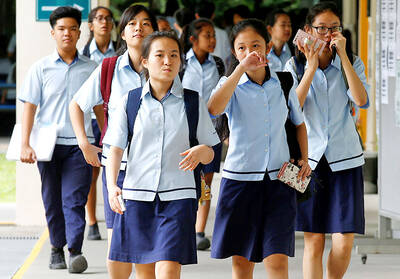
School bullies in Singapore are to face caning under new guidelines, but the education minister on Tuesday said it would be meted out only as a last resort with strict safeguards. Human rights groups regularly criticize Singapore for the use of corporal punishment, which remains part of the school and criminal justice systems, but authorities have defended it as a deterrent to crime and serious misconduct. Caning was discussed in the parliament after legislators asked how it would be used in relation to bullying in schools. The debate followed stricter guidelines on serious student misconduct, including bullying, unveiled by the Singaporean Ministry of

As evening falls in Fiji’s capital, a steady stream of people approaches a makeshift clinic that is a first line of defense against one of the world’s fastest-growing HIV epidemics. In the South Pacific nation — a popular tourist destination of just under a million people — more than 2,000 new HIV cases were recorded last year, a 26 percent increase from 2024. The government has declared an HIV outbreak and described it as a national crisis. “It’s spreading like wildfire,” said Siteri Dinawai, 46, who came to be tested. The Moonlight Clinic, a converted minibus parked in a suburban cul-de-sac in Suva, is
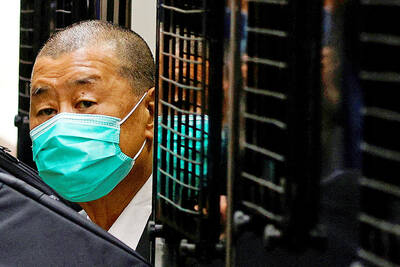
Jailed media entrepreneur Jimmy Lai (黎智英) has been awarded Deutsche Welle’s (DW) freedom of speech award for his contribution to Hong Kong’s pro-democracy movement. The German public broadcaster on Thursday said Lai would be presented in absentia with the 12th iteration of the award on June 23 at the DW Global Media Forum in Bonn. Deutsche Welle director-general Barbara Massing praised the 78-year-old founder of the now-shuttered news outlet Apple Daily for standing “unwaveringly for press freedom in Hong Kong at great personal risk.” “With Apple Daily, he gave journalists a platform for free reporting and a voice to the democracy movement in
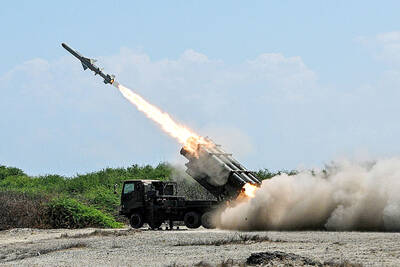
A MESSAGE: Japan’s participation in the Balikatan drills is a clear deterrence signal to China not to attack Taiwan while the US is busy in the Middle East, an analyst said The Japan Self-Defense Forces yesterday fired a Type 88 anti-ship missile during a joint maritime exercise with US, Australian and Philippine forces, hitting a decommissioned Philippine Navy ship in waters facing the disputed South China Sea, in drills that underscore Tokyo’s rising willingness to project military power on China’s doorstep. The drill took place as Manila and Tokyo began talks on a potential defense equipment transfer, made possible by Japan’s decision to scrap restrictions on military exports. The discussions include the possible early transfer of Abukuma-class destroyers and TC-90 aircraft to the Philippines, Japanese Minister of Defense Shinjiro Koizumi said. Philippine Secretary of


 RSS
RSS