


Long ago, when Romans wanted to build a new temple, they would head to the nearby quarries of Tivoli, chisel out blocks of porous rock called lapis tiburtinus — now known as travertine — and float the cargo downstream on rafts to craftsmen in town.
That was how they made the Colosseum 2,000 years ago. That was how they made St Peter’s Basilica and Gian Lorenzo Bernini’s great colonnade hundreds of years later.
Today, the same quarries that built Rome with their distinctive pock-marked travertine are still being dug out to build a new generation of churches, temples and mosques around the world — as well as banks, museums, government buildings and private homes.
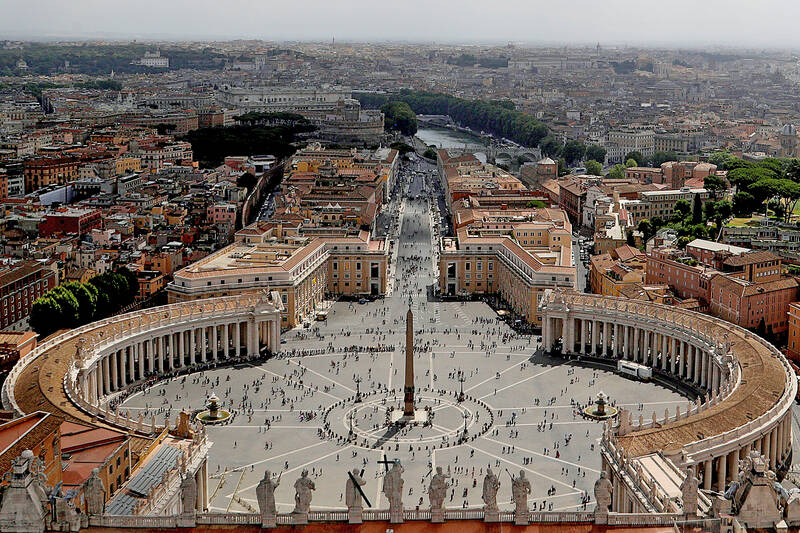
Photo: AP
While other countries have versions of the sedimentary limestone, Roman travertine is unique because it is quarried underground in the sulfuric springs and basins around Tivoli. Made up mostly of calcium carbonate minerals, Roman travertine was formed hundreds of thousands of years ago by deposits of calcium, sulfur and other minerals, and shows the region’s history of volcanic eruptions, forests and fossils in its striated layers.
It is prized by architects for a number of reasons: It is strong, plentiful and can withstand any number of climactic and environmental assaults. Depending on how and where it is cut, it has a variety of looks: rough or sleek, from a warm white with irregular black holes to sandy beige with gray, brown or even greenish veins.
For four generations, the Mariotti Carlo SpA stonecutting firm has been carving travertine to order, fulfilling some of the world’s most distinctive architectural commissions: the Getty Center in Los Angeles, the Bank of China headquarters in Beijing, the Great Mosque in Algiers, Algeria, to name a few.
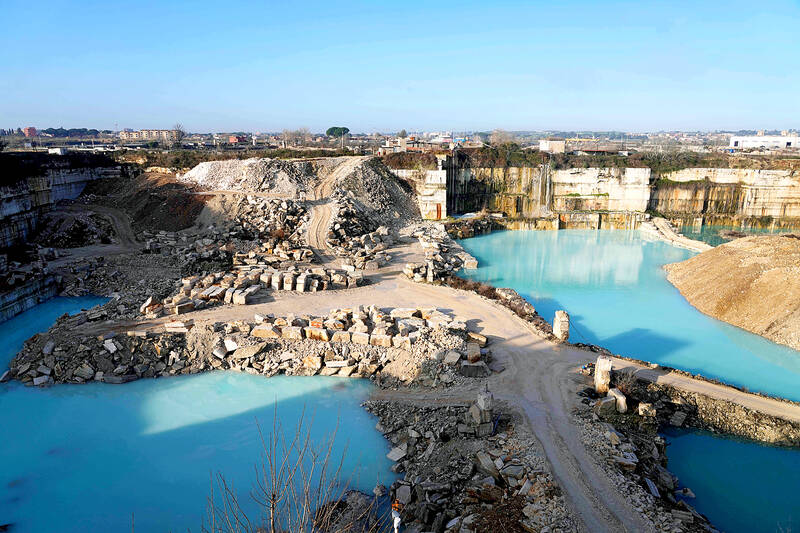
Photo: AP
On a recent workday, pieces of a temple being rebuilt by The Church of Jesus Christ of Latter-day Saints, widely known as the Mormon church, are lying neatly on the floor of Mariotti’s Tivoli warehouse — hunks of travertine carved from the nearby quarries and cut in made-to-measure puzzle pieces that will be assembled onsite in New York City.
After providing the travertine for the Latter-day Saint temple in Rome, Mariotti was chosen by the church’s architects to restore the temple on Manhattan’s Upper West Side. The temple sits across Broadway from Lincoln Center and the Julliard School, both built with Mariotti-cut travertine decades ago when the rock first reached the US market.
“Travertine is a classic stone known all over the world. It’s a bit like carrying the light of Rome everywhere, because the way travertine reflects light is very special,” said Fabrizio Mariotti, head of the family business.
All around the Tivoli quarries, the air is heavy with the stench of sulfur and the constant pounding, clinking and cracking of giant jackhammers blasting ancient rock into pieces.
At the Degemar quarries, drilled down to 30m under sea level, bright blue ponds of sulfur springs pool the travertine residue as flat-bed trucks haul stone slabs weighing 33 tons up to street level.
It was here that Bernini, the great Baroque sculptor and architect, sourced the brilliant white travertine for the 284 columns and 88 pillars of the colonnade embracing St Peter’s Square, as well as his other Catholic and Roman marvels.
Bernini spent so much time here selecting his rock that he had a home overlooking the quarry, which still stands today.
The quarry’s current head, Vincenzo De Gennaro, reminds visitors that Bernini’s tower still features the coop for the homing pigeons that would transport the orders to the quarry from Rome for the measurements of rocks that were needed.
Nowadays, the quarry is filling orders much farther afield: the new airport in Riyadh, Saudi Arabia, the new headquarters of China’s governing party in Shenzhen, among others.
“It is special, a special stone because it is a living stone, a stone that is born in a cocktail of mineral waters,” De Gennaro said, as he dodged earth movers and walked among the sulfur pools.
Lest anyone question travertine’s durability, they need only look to Rome, he said.
“There is the concrete experience of a civilization dating back thousands of years that stands in the light of day and has been shining undisturbed for 2,000 years,” he said. “That is the guarantee.”
Marco Ferrero, professor of civil engineering at Rome’s La Sapienza University, said part of travertine’s appeal is that it harks back to ancient Rome “and therefore also to the magic of the classical world.”
He said it embodies Rome’s spirit in many ways: Travertine is solid, resistant and noble, but not showy like its cousin, marble, which does not fare as well over time when exposed to the elements.
“We can make this comparison: Marble speaks to us in beautiful Italian, in literary Italian, while travertine speaks to us in Roman dialect,” he said. “It is truly the stone of the Romans. And like Roman cuisine, which is made up of simple dishes, often using discarded ingredients, travertine is a genuine and traditional stone.”

School bullies in Singapore are to face caning under new guidelines, but the education minister on Tuesday said it would be meted out only as a last resort with strict safeguards. Human rights groups regularly criticize Singapore for the use of corporal punishment, which remains part of the school and criminal justice systems, but authorities have defended it as a deterrent to crime and serious misconduct. Caning was discussed in the parliament after legislators asked how it would be used in relation to bullying in schools. The debate followed stricter guidelines on serious student misconduct, including bullying, unveiled by the Singaporean Ministry of
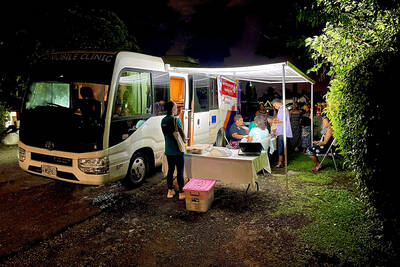
As evening falls in Fiji’s capital, a steady stream of people approaches a makeshift clinic that is a first line of defense against one of the world’s fastest-growing HIV epidemics. In the South Pacific nation — a popular tourist destination of just under a million people — more than 2,000 new HIV cases were recorded last year, a 26 percent increase from 2024. The government has declared an HIV outbreak and described it as a national crisis. “It’s spreading like wildfire,” said Siteri Dinawai, 46, who came to be tested. The Moonlight Clinic, a converted minibus parked in a suburban cul-de-sac in Suva, is

A MESSAGE: Japan’s participation in the Balikatan drills is a clear deterrence signal to China not to attack Taiwan while the US is busy in the Middle East, an analyst said The Japan Self-Defense Forces yesterday fired a Type 88 anti-ship missile during a joint maritime exercise with US, Australian and Philippine forces, hitting a decommissioned Philippine Navy ship in waters facing the disputed South China Sea, in drills that underscore Tokyo’s rising willingness to project military power on China’s doorstep. The drill took place as Manila and Tokyo began talks on a potential defense equipment transfer, made possible by Japan’s decision to scrap restrictions on military exports. The discussions include the possible early transfer of Abukuma-class destroyers and TC-90 aircraft to the Philippines, Japanese Minister of Defense Shinjiro Koizumi said. Philippine Secretary of
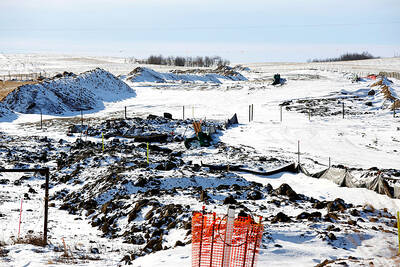
Separatists in Alberta are preparing to submit a petition tomorrow that they said has enough signatures to force a referendum on independence for the oil-rich Canadian province. Polls indicate the pro-independence camp remains a minority among Alberta’s 5 million people, but has hit a historic high of roughly 30 percent. Alberta separatists are also closer than ever to forcing a referendum, riding momentum fueled by intensifying grievances over Ottawa’s control of the provincial oil industry. They have also undeniably gotten a boost from the return to power of US President Donald Trump. After launching a petition in January, Stay Free Alberta, the group


 RSS
RSS