


The desire of Chinese and Americans for exchanges and cooperation would not change regardless of how bilateral relations evolve, Chinese President Xi Jinping (習近平) said in a reply to Iowa friends ahead of an expected meeting with US President Donald Trump in April, the official Xinhua news agency reported.
“The hope of US-China relations lies in the people,” Xi wrote on Monday in response to a Lunar New Year’s greeting from Iowa businessman Luca Berrone, whom he first met in May 1985 when he led a delegation from Hebei Province to its “sister state” of Iowa to learn about food production.
Xi in 2022 said in a Lunar New Year’s greeting to Sarah Lande, another friend from his Iowa trip, that the world required stability in US-China ties, which were strained during the COVID-19 pandemic.
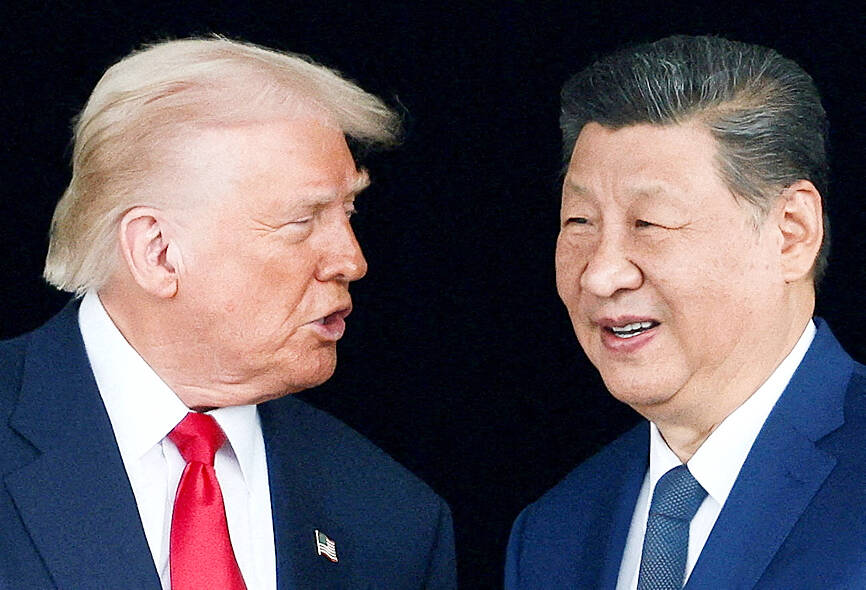
Photo: Reuters
US-China relations had a tumultuous 2025, with Trump in October threatening to impose additional 100 percent tariffs on imports from China, but it also saw a revival in people-to-people ties as Trump’s threatened TikTok ban pushed American Internet users onto Chinese app Xiaohongshu (小紅書, also known in English as RedNote).
“Chinamaxxing,” or the online trend of adopting Chinese cultural habits, also surged in popularity among the US’ Gen Z, influenced by the growing perception of China as a technological superpower.
High-level bilateral ties appeared to stabilize after Xi-Trump talks in South Korea in October led to a one-year extension of a trade truce. Trump agreed to trim tariffs in exchange for Beijing committing to crack down on the illegal fentanyl trade, resume US soybean purchases and pause rare earth export controls.
The two then had a surprise phone call earlier this month that touched on Taiwan and other security issues.
Trump said that Xi also discussed how China would consider increasing its purchases of US soybeans, of which Iowa is a top producer.
Trump last month said he is planning to visit China in April, adding that Xi would travel to the US toward the end of the year.


PHISHING: The con might appear convincing, as the scam e-mails can coincide with genuine messages from Apple saying you have run out of storage For a while you have been getting messages from Apple saying “your iCloud storage is full.” They say you have exceeded your storage plan, so documents are no longer being backed up, and photos you take are not being uploaded. You have been resisting Apple’s efforts to get you to pay a minimum of £0.99 (US$1.33) a month for more storage, but it seems that you cannot keep putting off the inevitable: You have received an e-mail which says your iCloud account has been blocked, and your photos and videos would be deleted very soon. To keep them you need

For two decades, researchers observed members of the Ngogo chimpanzee group of Kibale National Park in Uganda spend their days eating fruits and leaves, resting, traveling and grooming in their tropical rainforest abode, but this stable community then fractured and descended into years of deadly violence. The researchers are now describing the first clearly documented example of a group of wild chimpanzees splitting into two separate factions, with one launching a series of coordinated attacks against the other. Adult males and infants were targeted, with 28 deaths. “Biting, pounding the victim with their hands, dragging them, kicking them — mostly adult males,

The Israeli military has demolished entire villages as part of its invasion of south Lebanon, rigging homes with explosives and razing them to the ground in massive remote detonations. The Guardian reviewed three videos posted by the Israeli military and on social media, which showed Israel carrying out mass detonations in the villages of Taybeh, Naqoura and Deir Seryan along the Israel-Lebanon border. Lebanese media has reported more mass detonations in other border villages, but satellite imagery was not readily available to verify these claims. The demolitions came after Israeli Minister of Defense Israel Katz called for the destruction of

SUPERFAN: The Japanese PM played keyboard in a Deep Purple tribute band in middle school and then switched to drums at university, she told the British rock band Legendary British rock band Deep Purple yesterday made Japanese Prime Minister Sanae Takaichi’s day with a brief visit to their high-profile superfan as they returned to the nation they first toured more than half a century ago. Takaichi’s reputation as an amateur drummer, and a fan of hard rock and heavy metal has been well documented, and she has referred to Deep Purple as one of her favorite bands along with the likes of Black Sabbath and Iron Maiden. “You are my god,” a giddy Takaichi said in English to Deep Purple drummer Ian Paice, presenting him with a set of made-in-Japan


 RSS
RSS