


Garbage-choked streets, overloaded landfills and the fear of trash avalanches haunt greater Jakarta, as the world’s most populous metropolis grapples with a waste crisis.
Jakarta and its satellite cities, known collectively as Jabodetabek, are home to 42 million people and produce up to an estimated 14,000 tonnes of waste daily.
That has placed increasing strain on the approximately eight landfill sites that serve the region, which are now all close to or entirely full, local media reports said.
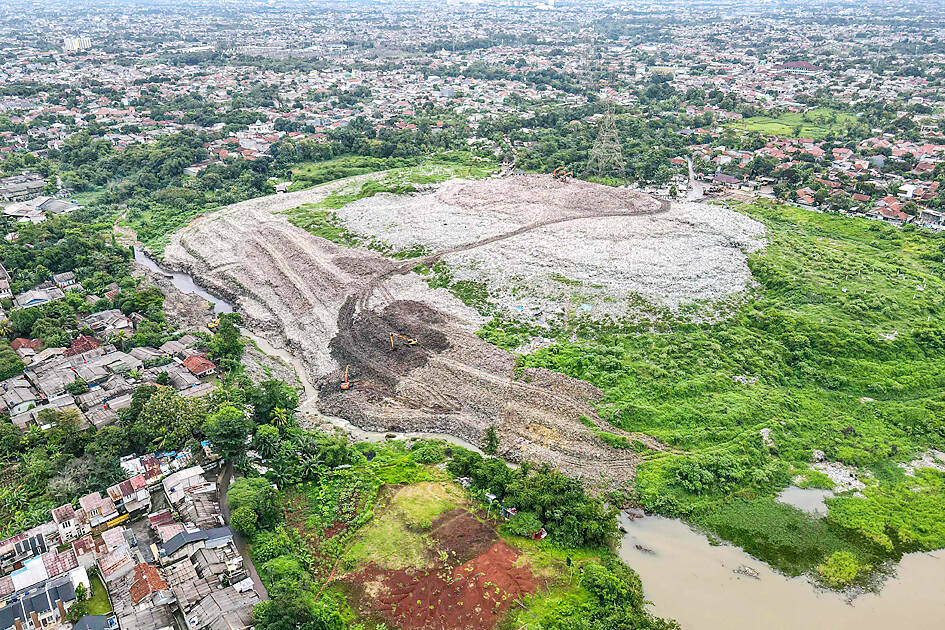
Photo: AFP
At a traditional market in the city’s south, Nurhasanah said the garbage piling up by her coffee and snacks stand was bad for business.
“The smell is awful, very pungent. It is also unpleasant to look at. It looks filthy,” said Nurhasanah, who like many Indonesians only has one name.
Experts say population growth, rising incomes leading to higher consumption, and a chronic lack of sorting and disposal enforcement have created the crisis.
Capacity is even an issue at the massive Bantar Gebang site, one of the world’s largest open landfills, sprawling over more than 110 hectares.
It already holds about 55 million tonnes of trash, said a local environment agency official, who did not specify how much space was left, despite reports it is at overcapacity.
In South Tangerang, several pedestrians gagged and swatted at swarms of flies as they walked down littered streets.
“I’m disappointed. We, as civilians, pay taxes, right? So why is the government like this? Waste management should be their responsibility,” said Muhammad Arsil, a 34-year-old motorbike taxi driver.
Another resident, Delfa Desabriyan, said people threw rubbish in the street because the local landfill was full.
“Every single day, there’s always someone dumping trash,” the 19-year-old shop attendant said. “It’s annoying, to be honest, like when we want to eat, I lose my appetite. The smell is just off-putting.”
The nearest landfill only holds 400 tonnes of waste, well below the 1,100 tonnes South Tangerang produces daily, according to the local government.
The problem extends beyond the capital, with Indonesian President Prabowo Subianto warning almost all the country’s landfills would be full — or over capacity — by 2028.
Hundreds still use open dumping, despite it being illegal, and waste is often burned, releasing potentially hazardous pollutants.
Overcapacity landfills come with additional risks. In 2022, a 30m-high garbage heap at a landfill in West Java’s Cipayung triggered a landslide that entered a river, submerging a bridge to the neighboring village.
Locals now rely on a makeshift raft made from plastic barrels and plywood to cross the river.
“If the trash keeps piling up higher, the garbage from the top will slide down again,” resident Muhammad Rizal said.
The Cipayung landfill has been at overcapacity since 2014, a University of Indonesia study found.
And in 2005, 143 people were killed by a garbage avalanche at another landfill in West Java’s Cimahi, triggered by a methane gas explosion and heavy rain.
The government says it plans to permanently close several landfills, including those in South Tangerang and Cipayung.
It is promoting waste-to-energy sites that incinerate garbage and produce electricity, with 34 planned within two years.
“This is a substantial investment, almost US$3.5 billion,” Prabowo said last week.
However, the planned plants would not tackle the lack of sorting and recycling, said Wahyu Eka Styawan of environmental group WALHI.
“This is a complex issue, a mix of poor awareness, policy, and a kind of inconsistency in how waste management is implemented,” he said.
“It’s one of those things that has been left unaddressed for a long time,” he said.
Reforms are needed for a waste management system that is still designed on the collect-transport-dispose model without prioritizing reduction at the household level, he said.
Jakarta’s environmental agency did not respond to Agence France-Presse’s request for comment.
Nur Azizah, a waste management expert at Gadjah Mada University, said the government’s failure to educate people and a lack of law enforcement were partly to blame.
“The problem lies in the consumption pattern, so what we need to fix is the way we consume,” she said.

Crowds in Bangladesh are flocking to snap photographs with an unlikely social media star — an albino buffalo with flowing blond hair nicknamed “Donald Trump” that is due to be sacrificed within days. Owner Zia Uddin Mridha, 38, said his brother named the 700kg bull over its flowing helmet of hair resembling the signature look of the US president. “My younger brother picked this name because of the buffalo’s extraordinary hair,” he said at his farm in Narayanganj, just outside the capital, Dhaka. Mridha said that a constant stream of curious visitors — social media fans, onlookers and children — have come throughout

It began as a satirical online project. Now millions of young people in India are flocking to it as an outlet for their frustration. A parody political party called the Cockroach Janta Party, with the insect as its symbol, has exploded across India’s social media by turning absurdist humor into protest. Memes and short videos mocking corruption, joblessness and political dysfunction have flooded social media sites, where millions of users are embracing the cockroach — known for its ability to survive harsh conditions — as a tongue-in-cheek symbol of endurance. The online movement’s rise has been unusually rapid. The Cockroach Janta Party (CJP)
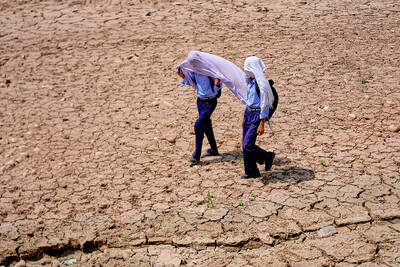
HOTTER: While Indians are accustomed to summer heat, climate change has caused northwestern India to warm faster than other parts of the country, an academic said Roads and markets have emptied during afternoons and some farmers have switched to nighttime work to avoid scorching temperatures as a heat wave grips large parts of India. The India Meteorological Department forecast maximum temperatures for yesterday of about 45°C in the capital, New Delhi, where authorities have opened temporary “cooling zones” to help people cope. The weather department warned that conditions would likely persist across several northern regions in the coming days, with temperatures staying well above seasonal averages. Authorities urged people to stay indoors during the hottest hours and take precautions against heat-related illnesses. India declares a heat wave whenever maximum temperatures

BIGGER ROLE: Beijing has said it maintains an impartial stance on the war in Ukraine, but by training Russian troops, China is far more involved than previously known China’s armed forces secretly trained about 200 Russian military personnel in China late last year, and some have since returned to fight in Ukraine, according to three European intelligence agencies and documents seen by Reuters. While China and Russia have held a number of joint military exercises since Moscow’s full-scale invasion of Ukraine in 2022, Beijing has repeatedly said that it is neutral in the conflict and presents itself as a peace mediator. The covert training sessions, which predominantly focused on the use of drones, were outlined in a dual-language Russian-Chinese agreement signed by senior Russian and Chinese officers in Beijing on


 RSS
RSS