


Barcelona’s eternally unfinished Basilica de la Sagrada Familia has grown to become the world’s tallest church, but a conflict with residents threatens to delay the finish date for the monument designed more than 140 years ago.
Swathed in scaffolding on a platform 54m above the ground, an enormous stone slab is being prepared to complete the cross of the central Jesus Christ tower.
A huge yellow crane is to bring it up to the summit, which will stand at 172.5m and has snatched the record as the world’s tallest church from Germany’s Ulm Minster.
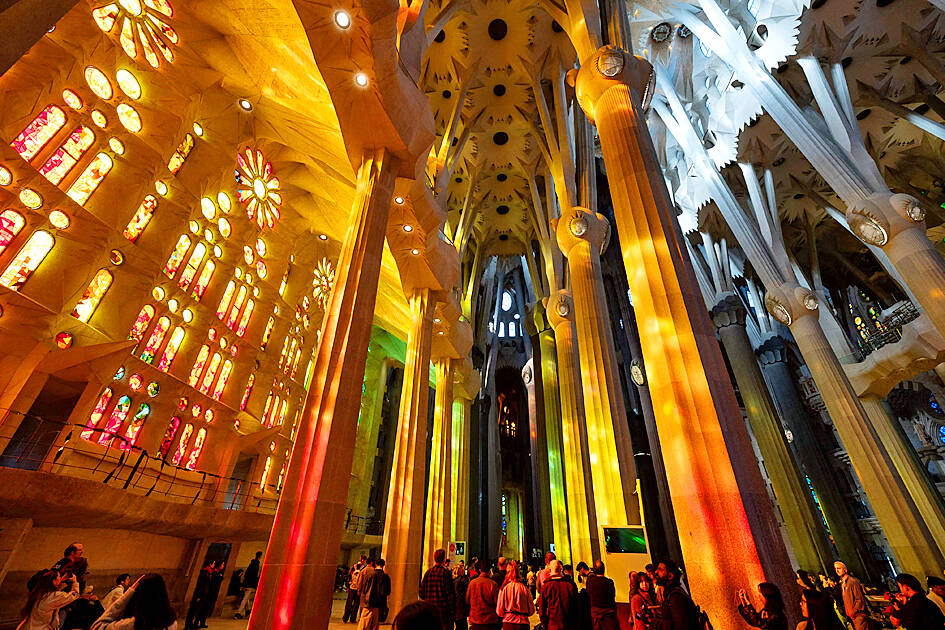
Photo: AFP
The basilica’s peak will deliberately fall short of the 177m of Barcelona’s Montjuic hill, in accordance with the devout Catholic faith of famed Catalan architect Antoni Gaudi, who took charge of the project in 1883.
“Gaudi did not want to exceed that height,” because the Montjuic hill was the work of God, said Mauricio Cortes, a senior architect working on the construction site.
When the structure is completed and the scaffolding dismantled, the tower is to be blessed on June 10 to coincide with the centenary of the death of Gaudi, whose body lies in the basilica’s crypt.
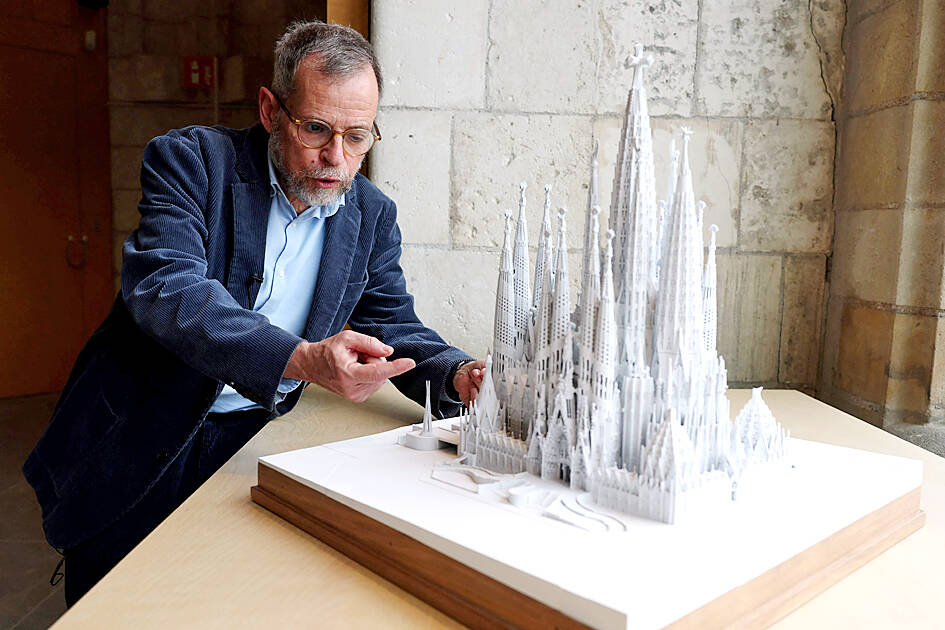
Photo: AFP
The Vatican has not yet confirmed whether Pope Leo XIV would accept an invitation to the tower’s inauguration.
“Once the cross is installed, the project will be nearly 80 percent complete,” said Jordi Fauli, the architect who has led the work for more than a decade.
The construction board, a private canonical foundation, had intended to complete work on the Sagrada Familia, considered the world’s most famous unfinished building, this year.
However, the COVID-19 pandemic paralyzed the tourism industry — and with it the key source of income of the most-visited of Spain’s monuments that charge an entrance fee.
Tourists from around the world are now flooding back: 4.8 million visitors arrived in 2024, boosting the coffers of the basilica, which relies on the takings as well as private donations.
Yet the board is reticent to set a new finish date for the remaining work, including the divisive Glory Facade and its four bell towers.
The board’s plan to precede the front entrance by a large flight of steps and a square would entail destroying up to two blocks of homes.
The residents have spent years fighting to halt the plan.
“Our houses are legal,” reads a sign hanging from one of the threatened buildings.
“The Sagrada Familia owns a plot of land; it does not own the rest. So why should it reach my home?” said Salvador Barroso, president of an association for residents affected by the construction work.
Residents say their apartments were purchased legally, and no one warned them that the area could form part of the Sagrada Familia site.
Barroso acquired his home in the late 1980s and only started hearing about the stairway project from 1992, when the Barcelona Olympics transformed the city’s image as a tourist magnet.
“What this is really about is business,” Barroso said of the expansion.
The residents have also questioned the stairs’ place in Gaudi’s original plan. Critics frequently point out that the architect’s models were mostly destroyed during the Spanish Civil War (1936-1939) and say the church has lost its creator’s essence.
Lead architect Fauli, speaking to AFP next to various models of the Sagrada Familia in a room away from the droves of tourists, said that “we are, in all parts of the project, faithfully following what Gaudi wanted.”
Other documents were saved, and a portion of the models were reconstructed afterward by Gaudi’s disciples, he added.
“Gaudi was an extraordinary architect, and it is worth following his project and finishing it,” said Fauli, who hopes to find “a fair solution” for the Glory Facade.
Barcelona’s town hall will mediate the conflict and says any agreement must guarantee a solution for the residents, in a city already undergoing a severe housing crisis.
However, after years of disagreements, an end to almost a century and a half of work at the Sagrada Familia seems closer than ever.
“I hope the dispute is resolved. What I cannot say is whether it will be resolved in the courts or ... sat at a table,” Barroso said.

PHISHING: The con might appear convincing, as the scam e-mails can coincide with genuine messages from Apple saying you have run out of storage For a while you have been getting messages from Apple saying “your iCloud storage is full.” They say you have exceeded your storage plan, so documents are no longer being backed up, and photos you take are not being uploaded. You have been resisting Apple’s efforts to get you to pay a minimum of £0.99 (US$1.33) a month for more storage, but it seems that you cannot keep putting off the inevitable: You have received an e-mail which says your iCloud account has been blocked, and your photos and videos would be deleted very soon. To keep them you need

For two decades, researchers observed members of the Ngogo chimpanzee group of Kibale National Park in Uganda spend their days eating fruits and leaves, resting, traveling and grooming in their tropical rainforest abode, but this stable community then fractured and descended into years of deadly violence. The researchers are now describing the first clearly documented example of a group of wild chimpanzees splitting into two separate factions, with one launching a series of coordinated attacks against the other. Adult males and infants were targeted, with 28 deaths. “Biting, pounding the victim with their hands, dragging them, kicking them — mostly adult males,
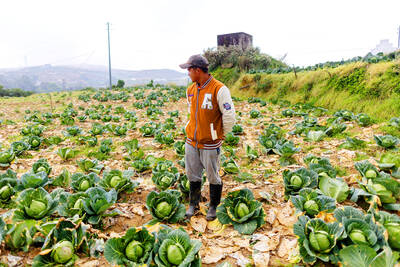
Filipino farmers like Romeo Wagayan have been left with little choice but to let their vegetables rot in the field rather than sell them at a loss, as rising oil prices linked to the Iran war drive up the cost of harvesting, labor and transport. “There’s nothing we can do,” said Wagayan, a 57-year old vegetable farmer in the northern Philippine province of Benguet. “If we harvest it, our losses only increase because of labor, transportation and packing costs. We don’t earn anything from it. That’s why we decided not to harvest at all,” he said. Soaring costs caused by the Middle East
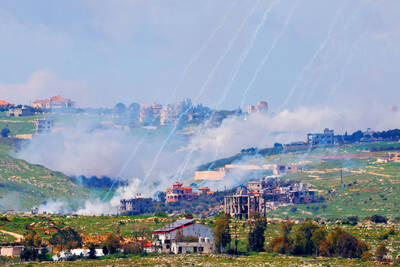
The Israeli military has demolished entire villages as part of its invasion of south Lebanon, rigging homes with explosives and razing them to the ground in massive remote detonations. The Guardian reviewed three videos posted by the Israeli military and on social media, which showed Israel carrying out mass detonations in the villages of Taybeh, Naqoura and Deir Seryan along the Israel-Lebanon border. Lebanese media has reported more mass detonations in other border villages, but satellite imagery was not readily available to verify these claims. The demolitions came after Israeli Minister of Defense Israel Katz called for the destruction of


 RSS
RSS