


Iran’s supreme leader on Saturday said that “rioters must be put in their place” after a week of protests that have shaken the Islamic Republic, likely giving security forces a green light to aggressively put down the demonstrations.
The first comments by 86-year-old Ayatollah Ali Khamenei come as violence surrounding the demonstrations sparked by Iran’s ailing economy has killed at least 15 people, according to human rights activists.
The protests show no sign of stopping and follow US President Donald Trump warning Iran on Friday that if Tehran “violently kills peaceful protesters,” the US “will come to their rescue.”
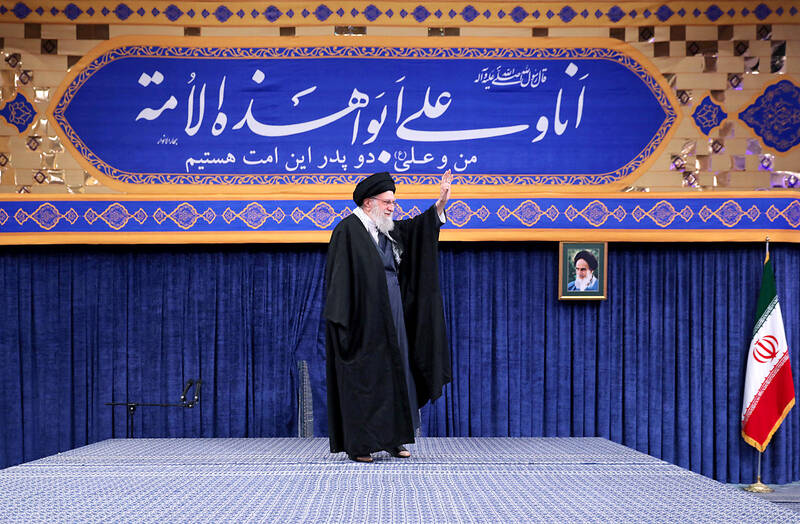
Photo: EPA / IRAN’S SUPREME LEADER OFFICE HANDOUT
While it remains unclear how and if Trump would intervene, his comments sparked an immediate, angry response, with officials within the theocracy threatening to target US troops in the Middle East. They also take on new importance after Trump on Saturday said that the US military had captured Venezuelan President Nicolas Maduro, a long-time ally of Tehran.
The protests have become the biggest in Iran since 2022, when the death of 22-year-old Mahsa Amini in police custody triggered nationwide demonstrations. However, the protests have yet to be as widespread and intense as those surrounding the death of Amini, who was detained over not wearing her hijab, or headscarf, to the liking of authorities.
State television aired remarks by Khamenei to an audience in Tehran that sought to separate the concerns of protesting Iranians upset about the rial’s collapse from “rioters.”
“We talk to protesters, the officials must talk to them,” Khamenei said. “But there is no benefit to talking to rioters. Rioters must be put in their place.”
He also reiterated a claim constantly made by officials in Iran that foreign powers like Israel or the US were pushing the protests, without offering any evidence. He also blamed “the enemy” for Iran’s collapsing rial.
“A bunch of people incited or hired by the enemy are getting behind the tradesmen and shopkeepers and chanting slogans against Islam, Iran and the Islamic Republic,” he said. “This is what matters most.”
The US-based Human Rights Activists News Agency monitor said that over the past seven days, protests have been recorded at least 174 locations in 60 cities across 25 of Iran’s 31 provinces.
During this period, at least 582 people were arrested, and at least 15 protesters have been killed, it said.
It was not immediately possible to verify the figures.
The protests began last week following a shutdown by merchants in the Tehran bazaar, an influential economic hub, and spread to other regions as well as universities.
Hard-line officials within the country are believed to have been pushing for a more-aggressive response to the demonstrations, while Iranian President Masoud Pezeshkian has sought talks to address protesters’ demands.
Bloody security crackdowns often follow such protests. Protests over a gasoline price hike in 2019 reportedly saw over 300 people killed. A crackdown on the Amini protests of 2022, which lasted for months, killed more than 500 people and saw at least 22,000 detained.
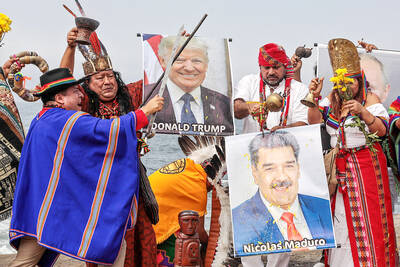
Shamans in Peru on Monday gathered for an annual New Year’s ritual where they made predictions for the year to come, including illness for US President Donald Trump and the downfall of Venezuelan President Nicolas Maduro. “The United States should prepare itself because Donald Trump will fall seriously ill,” Juan de Dios Garcia proclaimed as he gathered with other shamans on a beach in southern Lima, dressed in traditional Andean ponchos and headdresses, and sprinkling flowers on the sand. The shamans carried large posters of world leaders, over which they crossed swords and burned incense, some of which they stomped on. In this
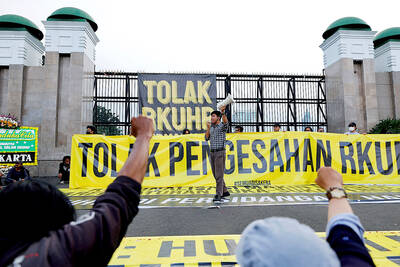
Indonesia yesterday began enforcing its newly ratified penal code, replacing a Dutch-era criminal law that had governed the country for more than 80 years and marking a major shift in its legal landscape. Since proclaiming independence in 1945, the Southeast Asian country had continued to operate under a colonial framework widely criticized as outdated and misaligned with Indonesia’s social values. Efforts to revise the code stalled for decades as lawmakers debated how to balance human rights, religious norms and local traditions in the world’s most populous Muslim-majority nation. The 345-page Indonesian Penal Code, known as the KUHP, was passed in 2022. It
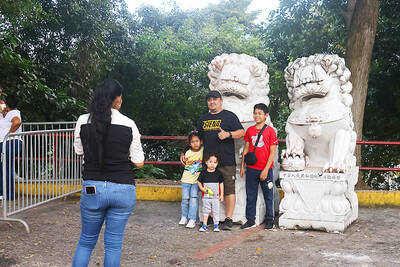
Near the entrance to the Panama Canal, a monument to China’s contributions to the interoceanic waterway was torn down on Saturday night by order of local authorities. The move comes as US President Donald Trump has made threats in the past few months to retake control of the canal, claiming Beijing has too much influence in its operations. In a surprising move that has been criticized by leaders in Panama and China, the mayor’s office of the locality of Arraijan ordered the demolition of the monument built in 2004 to symbolize friendship between the countries. The mayor’s office said in
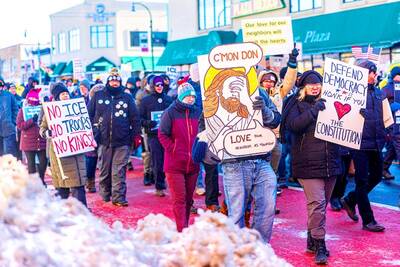
‘TRUMP’S LONG GAME’: Minnesota Governor Tim Walz said that while fraud was a serious issue, the US president was politicizing it to defund programs for Minnesotans US President Donald Trump’s administration on Tuesday said it was auditing immigration cases involving US citizens of Somalian origin to detect fraud that could lead to denaturalization, or revocation of citizenship, while also announcing a freeze of childcare funds to Minnesota and demanding an audit of some daycare centers. “Under US law, if an individual procures citizenship on a fraudulent basis, that is grounds for denaturalization,” US Department of Homeland Security Assistant Secretary Tricia McLaughlin said in a statement. Denaturalization cases are rare and can take years. About 11 cases were pursued per year between 1990 and 2017, the Immigrant Legal Resource


 RSS
RSS