


South Korean President Lee Jae-myung has said that new livestreamed briefings in which he has dressed down officials might be “more entertaining than Netflix,” as he seeks to boost transparency in contrast to his more autocratic predecessor.
Regular presidential policy briefings were long held behind closed doors, but Seoul has begun streaming them online as part of a push for more “direct democracy.”
The move is a stark departure from the previous conservative government under disgraced former South Korean president Yoon Suk-yeol, who introduced daily doorstep news briefings, but scrapped them after just six months when they became too combative.
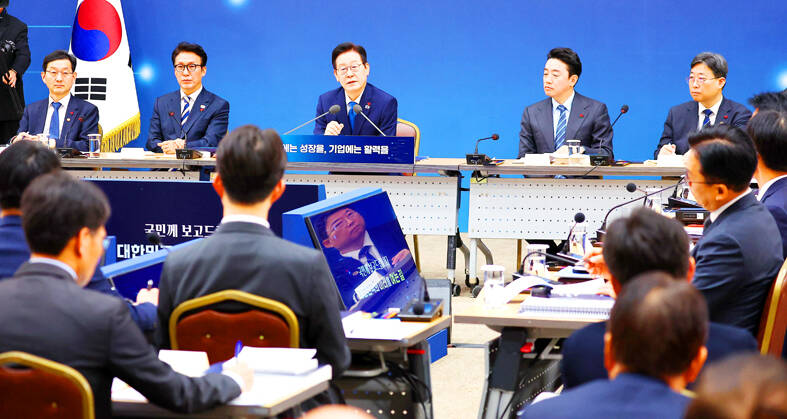
Photo: EPA
Yoon was ousted in April and is in prison following a brief but disastrous imposition of martial law.
Lee, who was elected in June, quipped during a session this week that some viewers might find the livestreamed briefings “more entertaining than Netflix.”
Some of the exchanges caused public amusement when they showed Lee scolding officials over their answers.
In one, Lee told a Cabinet meeting: “If you don’t know something, say you don’t know.”
“Trying to get out of a difficult situation by submitting false or distorted reports is the real problem,” he said.
Lee yesterday said that South Koreans were “the most democratically minded people in the entire world.”
“That’s why we should disclose as much information as possible,” he said.
However, the new arrangements have drawn some backlash, with one conservative newspaper describing the public tongue-lashing as akin to workplace “gapjil” — a Korean term for abusive or authoritarian behavior by those in positions of power.
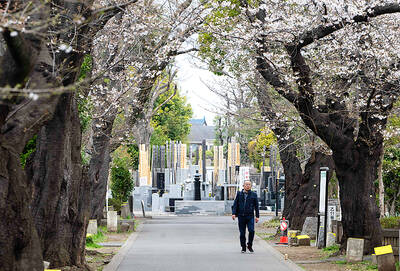
ROCKY RELATIONS: The figures on residents come as Chinese tourist numbers drop following Beijing’s warnings to avoid traveling to Japan The number of Chinese residents in Japan has continued to rise, even as ties between the two countries have become increasingly fractious, data released on Friday showed. As of the end of December last year, the number of Chinese residents had increased by 6.5 percent from the previous year to 930,428. Chinese people accounted for 22.6 percent of all foreign residents in Japan, making them by far the largest group, Japanese Ministry of Justice data showed. Beijing has criticized Tokyo in increasingly strident terms since Japanese Prime Minister Sanae Takaichi last year suggested that a military conflict around Taiwan could

A retired US colonel behind a privately financed rocket launch site in the Dominican Republic sees the project as a response to China’s dominance of the space race in Latin America. Florida-based Launch on Demand is slated to begin building a US$600 million facility in a remote region near the border with Haiti late this year. The project is designed to meet surging demand for the heavy-lift rockets needed to put clusters of satellites into orbit. It is also an answer to China’s growing presence in the region, said CEO Burton Catledge, a former commander of the US Air Force’s 45th Operations

Germany is considering Australia’s Ghost Bat robot fighter as it looks to select a combat drone to modernize its air force, German Minister of Defense Boris Pistorius said yesterday. Germany has said it wants to field hundreds of uncrewed fighter jets by 2029, and would make a decision soon as it considers a range of German, European and US projects developing so-called “collaborative combat aircraft.” Australia has said it will integrate the Ghost Bat, jointly developed by Boeing Australia and the Royal Australian Air Force, into its military after a successful weapons test last year. After inspecting the Ghost Bat in Queensland yesterday,
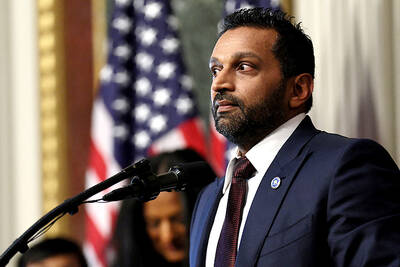
A pro-Iran hacking group claimed to breach FBI Director Kash Patel’s personal e-mail inbox and posted some of the contents online. The e-mails provided by the hacking group include travel details, correspondence with leasing agents in Washington and global entry, and loyalty account numbers. The e-mail address the hackers claim to have compromised has been previously tied to Patel’s personal details, and the leaked e-mails contain photos of Patel and others, in addition to correspondence with family members and colleagues. “The FBI is aware of malicious actors targeting Director Patel’s personal email information,” the agency said in a statement on


 RSS
RSS