


A raft of proposed measures from Israel’s ruling coalition targeting the media has sparked outrage, with critics saying the planned reforms would deliver a blow to press freedom.
Suggested changes to public broadcasting, coupled with a bid to give permanent powers to the Israeli government to ban foreign TV channels which are deemed a threat, come as Israeli Prime Minister Benjamin Netanyahu intends to seek another term next year.
Surveys show most Israelis believe the prime minister should be held accountable for the deadly attack on the country by Palestinian militant group Hamas on Oct. 7, 2023.
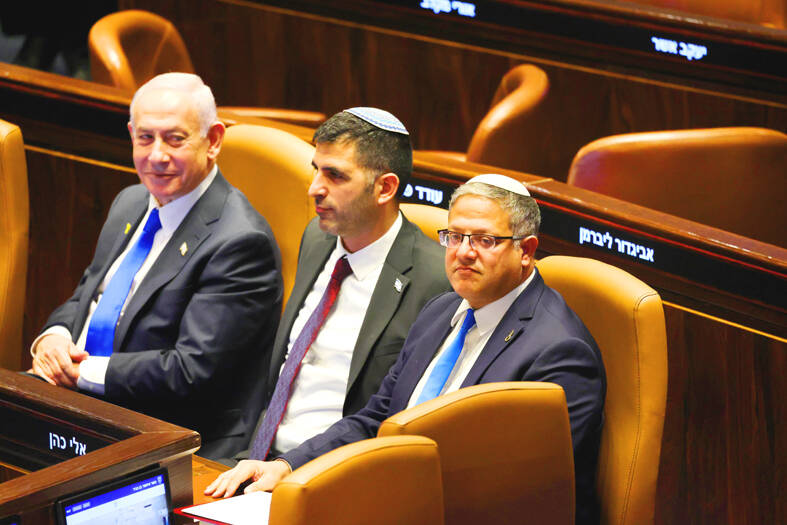
Photo: EPA
The government has also announced to much dismay the proposed closure of the popular public army radio station next year.
Months before Hamas’ attack, Netanyahu’s government — one of the most right-wing in the country’s history — proposed far-reaching judicial reforms that triggered mass protests as many feared a slide toward authoritarianism.
Israel’s top court struck down a key component of the overhaul in January last year.
Israeli Minister of Communications Shlomo Karhi is pushing a bill that would give the government significantly more control of public broadcasting.
The government’s own legal adviser also criticized the text.
In the crosshairs herself with impeachment proceedings, Israeli Attorney General Gali Baharav-Miara said the bill “endangers the very principle of press freedom.”
If passed, the law would create a new body to oversee public media that the government said would encourage competition and reduce bureaucracy.
However, Baharav-Miara said the concentration of power in the new authority’s hands and political appointments to the body are “likely to have a chilling effect on press independence.”
The Union of Journalists in Israel has filed an appeal to the Israeli Supreme Court against the text, which Reporters Without Borders (RSF) described as “a nail in the coffin of editorial independence.”
“This is not a reform. It is a campaign to incite hatred and silence the free press,” opposition leader Yair Lapid, a former prime minister, said on Monday last week, condemning “a hostile takeover of the media.”
Media freedom has been deteriorating in Israel, especially since the war in Gaza began in October 2023 following Hamas’ attack, according to RSF.
Israel dropped 11 places in RSF’s global press freedom index this year, from 101st to 112th out of 180 surveyed countries.
Government critics say it is not the only draft text that has caused concern.
The Knesset, Israel’s parliament, is also debating whether to make permanent a temporary law passed last year that gave the government the power to ban foreign TV channels if they are deemed a threat to the state.
The parliament approved the law in the middle of Israel’s war in Gaza, and it was mainly aimed at Qatari news channel al-Jazeera.
Using its new powers, the Israeli government banned the outlet in May last year, alleging it has ties with Hamas, which al-Jazeera has denied.
The current proposal would allow the government to ban a foreign TV outlet without a court order — and regardless of whether the state is at war.
The author of the amendment, Ariel Kelner, a Knesset member and part of Netanyahu’s right-wing Likud party, defended the changes.
“The production line of terrorism begins in minds, and especially in the media, which publish confidential information and poison hearts with hatred and anti-Semitic propaganda,” Kelner said.
However, International Federation of Journalists general secretary Anthony Bellanger said the law, if passed, “would be a serious blow to free speech and media freedom.”
Like the public broadcasting bill, Kelner’s amendment was approved in its first reading and faces a committee review before a final Knesset vote.
Another cause for concern is Israeli Minister of Defense Israel Katz’s decision to shut down the publicly funded military radio station known as Galei Tsahal, founded in 1950. It is Israel’s third-most listened to station, latest figures show.
The Israel Democracy Institute said that the government’s move is “contrary to the fundamental principles of the rule of law and undermines press freedom.”
Katz said the station would cease broadcasting by March next year, after he presents the move to the Cabinet this month.
Against this backdrop, the Israeli government continues to deny foreign journalists from independently entering the Gaza Strip, where more than two years of war have devastated the Palestinian territory.
The Foreign Press Association, which filed a petition to the Supreme Court demanding independent access, has denounced the situation as “beyond absurd.”

The Bolivian government on Friday struck a deal with protesting miners, but was still grappling with blockades and demonstrations by other workers across La Paz. Other groups are still blocking access roads into the city, which is also the seat of the government. Police on Thursday prevented the miners from entering the main square by using tear gas, while the demonstrators hurled stones and explosives with slingshots. Protests against the policies of Bolivian President Rodrigo Paz have convulsed the Andean nation since early this month, and roadblocks were choking routes into La Paz throughout Friday, the national road authority said. Miners demanded that Paz
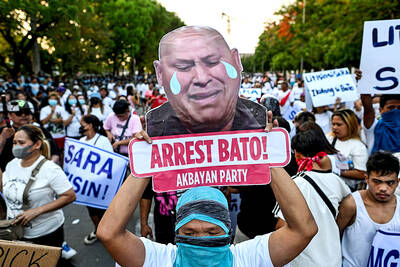
The Philippines said it has asked the country’s Supreme Court to allow it to arrest former Philippine president Rodrigo Duterte’s chief drug war enforcer to stand trial in an international tribunal. The International Criminal Court (ICC) last week unsealed an arrest warrant against Philippine Senator Ronald dela Rosa, accusing him along with Duterte and other “coperpetrators” of the “crime against humanity of murder.” Dela Rosa briefly sought refuge in the Philippine Senate last week while asking the Philippine Supreme Court to stop an ongoing attempt by government agents to arrest him. “By his own conduct, he has placed himself outside the protection of

A ship anchored off the United Arab Emirates (UAE) was seized and taken toward Iran and another — a cargo ship near Oman — sank after being attacked, authorities said on Thursday, as tensions escalated near the Strait of Hormuz. It was not immediately clear who was behind these incidents, but they happened as a senior Iranian official reiterated his country’s claim of control over the waterway and another said it had a right to seize oil tankers connected to the US. The turmoil in the strait has been a sticking point for weeks in talks between the US and Iran to

The researchers in Ireland looked at their computer screen, marveling at a medieval book tracked down in a Roman library. They flipped through its digitized pages and found their sought-after treasure: the oldest surviving English poem. “We were extremely surprised. We were speechless. We couldn’t believe our eyes when we first saw that,” said Elisabetta Magnanti, a visiting research fellow at Trinity College Dublin’s school of English. The poem was also within the main body of Latin text, she said, calling it “extraordinary.” Composed in Old English by a Northumbrian agricultural worker in the 7th century, Caedmon’s Hymn appears within some copies of


 RSS
RSS