


A ship anchored off the United Arab Emirates (UAE) was seized and taken toward Iran and another — a cargo ship near Oman — sank after being attacked, authorities said on Thursday, as tensions escalated near the Strait of Hormuz.
It was not immediately clear who was behind these incidents, but they happened as a senior Iranian official reiterated his country’s claim of control over the waterway and another said it had a right to seize oil tankers connected to the US.
The turmoil in the strait has been a sticking point for weeks in talks between the US and Iran to end the conflict. Iran’s grip on the vital waterway has jolted the world economy and spiked fuel prices far beyond the Middle East.
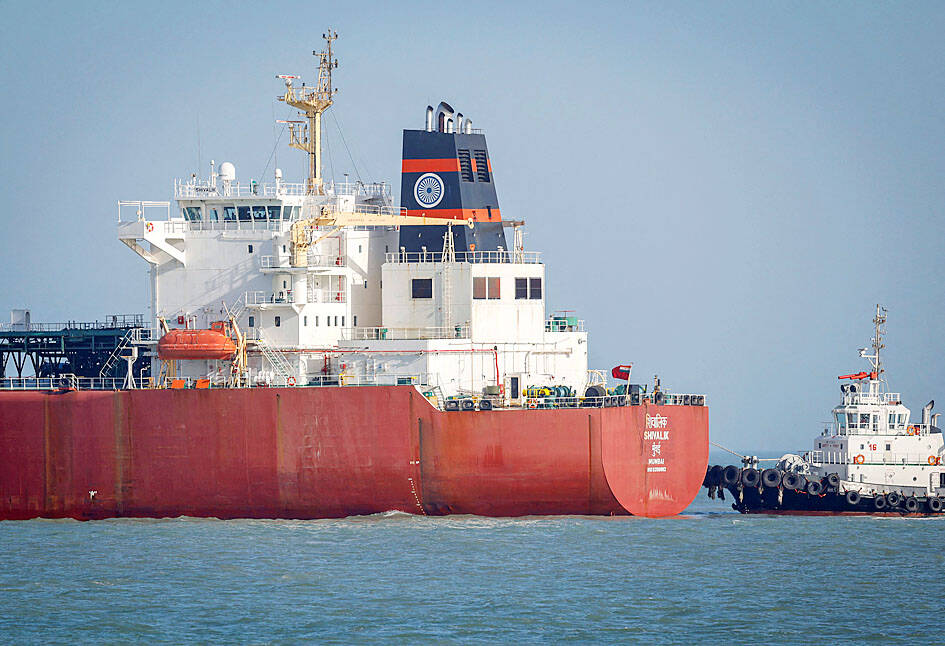
Photo: Reuters
The ongoing instability in the region came as US President Donald Trump met with Chinese President Xi Jinping (習近平) in Beijing. The White House said both sides had agreed that the Strait of Hormuz must remain open.
Just last week, tensions flared in the strait when US forces fired on and disabled Iranian oil tankers that they said were trying to breach its blockade of Iran’s ports.
The UK Maritime Trade Operations center said it received reports that the ship seized on Thursday was taken by unauthorized personnel while anchored 38 nautical miles (70km) northeast of the UAE port of Fujairah, an important oil export terminal that has been repeatedly attacked during the war with Iran.
The UK maritime center did not name the ship and said it is investigating. The British military said the vessel is heading toward Iranian waters.
Indian authorities on Thursday said that an Indian-flagged cargo ship sank off the coast of Oman after an attack sparked a fire aboard the vessel while it was en route from Somalia to Sharjah, another UAE port. They did not say who attacked the ship.
The attack on the Indian-flagged cargo ship Haji Ali occurred on Wednesday, said Mukesh Mangal, a senior official in India’s shipping ministry, adding that all 14 Indian crew members were rescued by Oman’s coast guard and were safe.
The Indian Ministry of External Affairs called the incident “unacceptable” and condemned continued attacks on commercial shipping and civilian mariners. It did not identify who carried out the attack.
Iranian semiofficial news agencies reported that Chinese ships began passing through the strait on Wednesday night under new Iranian protocols.
Reports said Tehran agreed to facilitate the passage of several Chinese vessels after requests from China’s foreign minister and Beijing’s ambassador to Iran. The ships began their passage as Trump arrived in China.
The seizure of a ship off the coast of the UAE happened hours after Israeli Prime Minister Benjamin Netanyahu announced he had quietly visited the country during the Israeli-US war with Iran, though the UAE swiftly denied it.
The Gulf nation normalized relations with Israel in 2020. Iran has criticized that agreement and has repeatedly suggested over the years that Israel maintained a military and intelligence presence in the UAE.
Netanyahu’s decision to go public with the sensitive meeting was likely an effort to drum up support for his flagging party ahead of Israeli elections, said Yoel Guzansky, a senior researcher at the Institute of National Security Studies in Tel Aviv.
“It’s amazing, it’s the deepest cooperation we’ve ever had … that during a war, Israel is defending an Arab state against Iran. It shows how complicated the Middle East is,” he said.
The UAE is trying to highlight its cooperation with Israel, but not with Netanyahu and his government, Guzansky said, because many in the UAE are against Israel’s policies in Gaza.
“They’re trying to differentiate between security cooperation and cooperating with this government,” said Guzansky, who previously worked for the national security council within the Israeli prime minister’s office.

Through the noise of rushing papers and whirring belts at a print factory in Kyoto, two creators watch their photo essay come to life in broadsheet form — part of an effort to win new audiences in the age of artificial intelligence (AI). Despite the decline of the publishing industry, self-publication and handmade “zine” magazines are growing in popularity in Japan, reflecting the nation’s enduring love of paper in the digital era. While speaking to Agence France-Presse at the plant, his hands black with ink, one of the creators, Kazuma Obara, said: “I think [paper] is a medium that engages all five
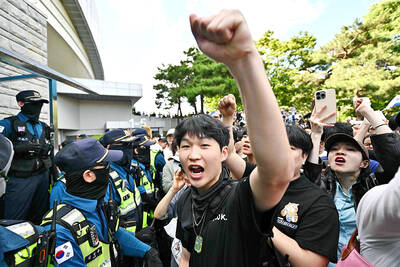
‘ABSURD MISTAKE’: The election commission said that there had been a failure to anticipate turnout after 14 polling stations ran short of ballot papers South Korean riot police yesterday cleared protesters from a Seoul polling station after a 35-hour blockade sparked by a shortage of ballot papers during local elections earlier this week. Wednesday’s election was the first nationwide vote since South Korean President Lee Jae-myung took office following the ouster of Yoon Suk-yeol over his short-lived martial law declaration. Lee’s ruling Democratic Party swept most races, but failed to flip the crucial Seoul mayoral seat. The South Korean National Election Commission apologized, blaming a failure to anticipate turnout after 14 polling stations in Seoul ran short of ballot papers. Some polling stations stayed open until 10pm to

Australian researchers have trained lab-grown brain cells on a silicon computer chip to play the 1990s shooter game Doom and said they are just scratching the surface of what the neurons could be capable of doing. It is the science-fiction work of biotech boffins at Cortical Labs, who researched and developed the technology that harnesses the workings of the brain’s networking system. Each so-called “biological computer” contains about 200,000 living human brain cells, grown from stem cells that were harvested from blood donations. Having mastered the simple computer game Pong, where a paddle is moved up and down to send a ball

France experienced its hottest spring on record, the French weather service said on Tuesday, after an exceptional early heat wave that also broke highs for the season in England and Wales. Meteo-France said the average nationwide temperature over March to May was 13.8°C — about 1.7°C above the norm, and surpassing records set in 2011 and 2020. “The warmest spring since records began in 1900,” it said in a bulletin. All three months were warmer than average, but the onset of an “unprecedented heatwave” late last month pushed the mercury to highs typically seen at the height of the summer. “Our country had never


 RSS
RSS