


Japanese Minister of Defense Shinjiro Koizumi has briefed NATO about joint patrols by Chinese and Russian aircraft and a recent incident that involved a Chinese aircraft locking its radar onto Japanese planes near Taiwan, Tokyo said yesterday.
NATO Secretary-General Mark Rutte and Japanese Minister of Defense Shinjiro Koizumi spoke in a 15-minute video conference, the Japanese Ministry of Defense said in a statement after the call.
The two shared their "grave concerns" about joint patrols by Chinese and Russian aircraft on Tuesday, it said.
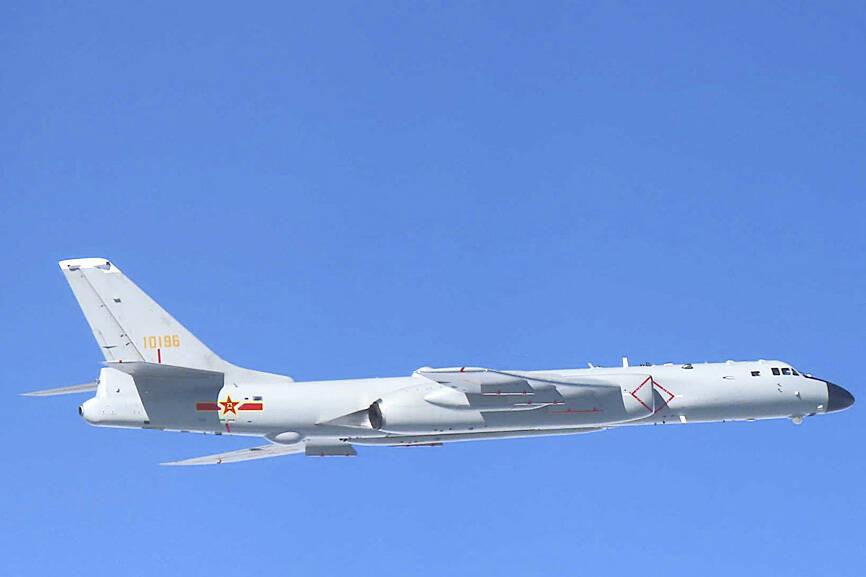
Photo: AFP / Japanese Ministry of Defense
The patrols came as Japan-China relations worsen after comments by Japanese Prime Minister Sanae Takaichi last month suggesting that Japan would intervene militarily in any Chinese attack on Taiwan.
"Both sides shared their grave concerns over this incident and concurred to closely communicate with each other," the ministry said.
According to Tokyo, two Russian Tu-95 nuclear-capable bombers on Tuesday flew from the Sea of Japan to rendezvous with two Chinese H-6 bombers in the East China Sea, then conducted a joint flight around the country.
Japan scrambled aircraft in response.
South Korea on Tuesday said that Russian and Chinese warplanes also entered its air defense zone, with Seoul also deploying fighter jets.
Beijing later on Tuesday confirmed that it had organized drills with Russia's military according to "annual cooperation plans."
Moscow described it as a routine exercise, saying it lasted eight hours and that some foreign fighter jets followed the Russian and Chinese aircraft.
Koizumi also briefed Rutte about another recent incident that involved Chinese aircraft locking its radar onto Japanese planes near Taiwan, the statement said.
On Sunday, the ministry said a Chinese J-15 military jet took off from the Chinese carrier Liaoning near Japan’s Okinawa on Saturday and “intermittently” locked its radar on Japanese F-15 jets on two occasions, for about three minutes in the late afternoon and for about 30 minutes in the evening.
Additional reporting by AP

ROCKY RELATIONS: The figures on residents come as Chinese tourist numbers drop following Beijing’s warnings to avoid traveling to Japan The number of Chinese residents in Japan has continued to rise, even as ties between the two countries have become increasingly fractious, data released on Friday showed. As of the end of December last year, the number of Chinese residents had increased by 6.5 percent from the previous year to 930,428. Chinese people accounted for 22.6 percent of all foreign residents in Japan, making them by far the largest group, Japanese Ministry of Justice data showed. Beijing has criticized Tokyo in increasingly strident terms since Japanese Prime Minister Sanae Takaichi last year suggested that a military conflict around Taiwan could

A retired US colonel behind a privately financed rocket launch site in the Dominican Republic sees the project as a response to China’s dominance of the space race in Latin America. Florida-based Launch on Demand is slated to begin building a US$600 million facility in a remote region near the border with Haiti late this year. The project is designed to meet surging demand for the heavy-lift rockets needed to put clusters of satellites into orbit. It is also an answer to China’s growing presence in the region, said CEO Burton Catledge, a former commander of the US Air Force’s 45th Operations

Germany is considering Australia’s Ghost Bat robot fighter as it looks to select a combat drone to modernize its air force, German Minister of Defense Boris Pistorius said yesterday. Germany has said it wants to field hundreds of uncrewed fighter jets by 2029, and would make a decision soon as it considers a range of German, European and US projects developing so-called “collaborative combat aircraft.” Australia has said it will integrate the Ghost Bat, jointly developed by Boeing Australia and the Royal Australian Air Force, into its military after a successful weapons test last year. After inspecting the Ghost Bat in Queensland yesterday,

A pro-Iran hacking group claimed to breach FBI Director Kash Patel’s personal e-mail inbox and posted some of the contents online. The e-mails provided by the hacking group include travel details, correspondence with leasing agents in Washington and global entry, and loyalty account numbers. The e-mail address the hackers claim to have compromised has been previously tied to Patel’s personal details, and the leaked e-mails contain photos of Patel and others, in addition to correspondence with family members and colleagues. “The FBI is aware of malicious actors targeting Director Patel’s personal email information,” the agency said in a statement on


 RSS
RSS