


Bolivia’s new government on Tuesday said that it had restored diplomatic relations with Israel, the latest sign of a geopolitical realignment under way in the South American country that was once among the most vocal critics of Israeli policies toward Palestinians.
Bolivian Minister of Foreign Affairs Fernando Aramayo met with Israeli Minister of Foreign Affairs Gideon Saar in Washington and signed a declaration agreeing to revive bilateral ties, which Bolivia’s previous government severed two years ago over Israel’s war against Hamas in Gaza.
The Bolivian Ministry of Foreign Affairs said that the two countries would reinstate ambassadors in the near future and dispatch officials on visits.
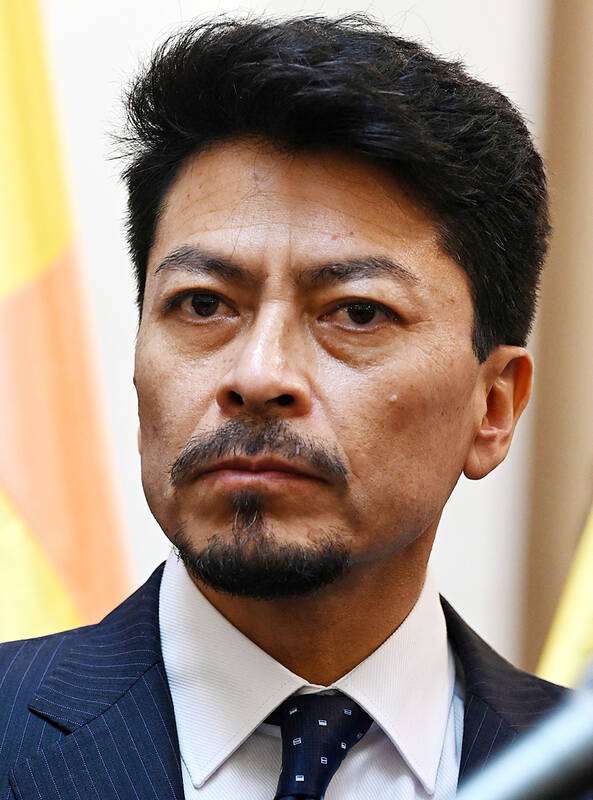
Photo: Reuters
As part of a new foreign policy strategy under Bolivian President Rodrigo Paz, the rapprochement “represents a return to trust, intelligent cooperation and the ties that have always existed, but which are now being revitalized with a modern perspective,” the Bolivian ministry said in a statement after the meeting late on Tuesday.
Aramayo, as well as Bolivian Minister of Economic Affairs Jose Gabriel Espinoza, this week met with US officials as their government works to improve relations with the US and unravel nearly two decades of anti-Western policies under the Movement Toward Socialism (MAS) party that left Bolivia economically isolated and diplomatically allied with China, Russia and Venezuela.
Paz’s government last week eased visa restrictions on American and Israeli travelers.
In announcing his meeting with Aramayo on Monday, Saar thanked Bolivia for scrapping Israeli visa controls and said he spoke to Paz after his Oct. 19 election victory to express “Israel’s desire to open a new chapter” in relations with Bolivia.
Paz entered office last month, ending the dominance of the MAS party founded by former Bolivian president Evo Morales. Not long after taking power, Morales sent Israel’s ambassador packing, and cozied up to Iran over their shared enmity toward the US and Israel.
When protests over Morales’ disputed 2019 re-election prompted him to resign under pressure from the military, an interim government took over and restored full diplomatic relations with the US and Israel as it sought to undo many of Morales’ popular policies.
However, the 2020 elections brought MAS back to power. Then-Bolivian president Luis Arce in 2023 once again cut ties with Israel in protest over its military actions in Gaza.

ROCKY RELATIONS: The figures on residents come as Chinese tourist numbers drop following Beijing’s warnings to avoid traveling to Japan The number of Chinese residents in Japan has continued to rise, even as ties between the two countries have become increasingly fractious, data released on Friday showed. As of the end of December last year, the number of Chinese residents had increased by 6.5 percent from the previous year to 930,428. Chinese people accounted for 22.6 percent of all foreign residents in Japan, making them by far the largest group, Japanese Ministry of Justice data showed. Beijing has criticized Tokyo in increasingly strident terms since Japanese Prime Minister Sanae Takaichi last year suggested that a military conflict around Taiwan could

A retired US colonel behind a privately financed rocket launch site in the Dominican Republic sees the project as a response to China’s dominance of the space race in Latin America. Florida-based Launch on Demand is slated to begin building a US$600 million facility in a remote region near the border with Haiti late this year. The project is designed to meet surging demand for the heavy-lift rockets needed to put clusters of satellites into orbit. It is also an answer to China’s growing presence in the region, said CEO Burton Catledge, a former commander of the US Air Force’s 45th Operations

Germany is considering Australia’s Ghost Bat robot fighter as it looks to select a combat drone to modernize its air force, German Minister of Defense Boris Pistorius said yesterday. Germany has said it wants to field hundreds of uncrewed fighter jets by 2029, and would make a decision soon as it considers a range of German, European and US projects developing so-called “collaborative combat aircraft.” Australia has said it will integrate the Ghost Bat, jointly developed by Boeing Australia and the Royal Australian Air Force, into its military after a successful weapons test last year. After inspecting the Ghost Bat in Queensland yesterday,
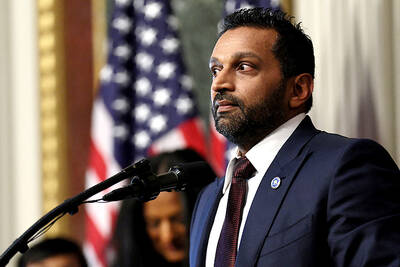
A pro-Iran hacking group claimed to breach FBI Director Kash Patel’s personal e-mail inbox and posted some of the contents online. The e-mails provided by the hacking group include travel details, correspondence with leasing agents in Washington and global entry, and loyalty account numbers. The e-mail address the hackers claim to have compromised has been previously tied to Patel’s personal details, and the leaked e-mails contain photos of Patel and others, in addition to correspondence with family members and colleagues. “The FBI is aware of malicious actors targeting Director Patel’s personal email information,” the agency said in a statement on


 RSS
RSS