

Chaos gripped major Indian airports yesterday, as passengers of the country’s biggest airline, IndiGo, scrambled to cope with widespread flight disruptions and cancelations triggered by newly enforced rules limiting working hours for crew and pilots.
Scenes of frustration played out, as passengers slept on airport floors, lined up for hours at customer service counters and waited without clear communication from the airline.
Yesterday was the fourth straight day of disruptions, as the low-cost carrier struggles with new regulations that mandate longer rest periods, and limit night flying hours to address concerns about fatigue and safety.
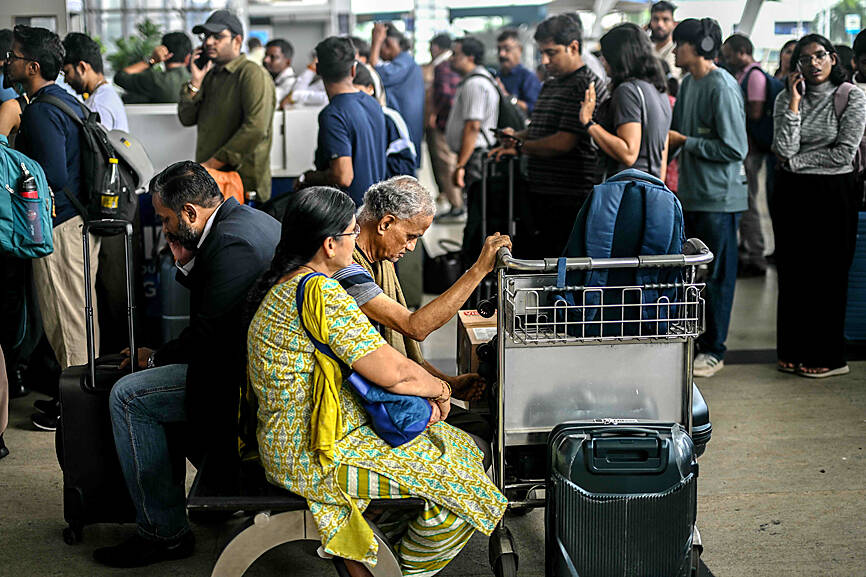
Photo: AFP
The first phase of the rules came into effect in July, while the second phase began last month. IndiGo struggled to adapt its rosters in time, resulting in widespread cancelations and disruptions.
More than 300 IndiGo flights on Thursday were grounded, while several hundred were delayed. A passenger advisory from Delhi airport stated that all domestic IndiGo flights would remain canceled until midnight.
Other major airlines, including Air India, have not faced similar issues so far.
IndiGo operates about 2,300 flights daily and controls nearly 65 percent of India’s domestic aviation market.
IndiGo CEO Pieter Elbers in an internal e-mail to employees this week apologized, and cited technology glitches, schedule changes, adverse weather conditions, heightened congestion and the implementation of the new rules as the reasons for flight disruptions.
The Indian Civil Aviation Ministry said the disruptions arose primarily through misjudgement and planning gaps as the airline implemented phase two of the new rules, adding that the airline acknowledged that the effect on crew strength exceeded its expectations.
IndiGo has sought temporary exemptions in implementing the new rules and told the government that corrective measures were underway. It has indicated the operations would be fully restored by Feb. 10 next year.
More cancelations are expected in the next couple of weeks, and the airline said it would reduce its flight operations from Monday to minimize disruptions.

Several areas of Thailand’s capital city Bangkok were inundated by continuous rain from Thursday afternoon to yesterday morning that has disrupted traffic and forced some residents to evacuate. Major canals in Bangkok filled with accumulated rainfall exceeding 20cm, officials said yesterday. Floodwaters spread across the city, particularly in the central and eastern parts, blocking roads and stopping traffic. The Thai Meteorological Department warned that the heavy rain would continue in most parts of the country through today, citing a strong low-pressure system over the central region and strengthening southwest monsoon conditions. More than 84,000 people in 21 provinces nationwide were
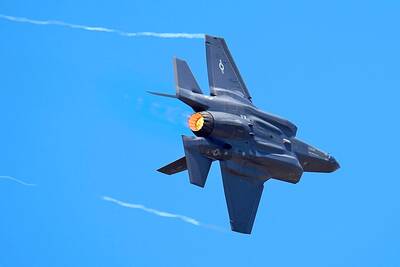
BAD TIMING: The disclosure of the incident, which is under investigation by at least two congressional committees, comes as Xi was to meet with Trump The Pentagon is investigating how parts of the US’ most advanced fighter jet ended up in Hong Kong, with a news outlet on Wednesday reporting that China has obtained the F-35 equipment. The F-35 Joint Program Office said in a statement that it and the US Department of Defense are aware of “a shipment issue” with F-35 components. “We are actively working with US authorities and industry partners to retrieve these components, investigate the incident and place safeguards to avoid a future occurrence,” the office said. UPS was shipping a cockpit canopy and weapons-bay door from an Australian military F-35 that was being

Yemen’s Saudi-led coalition early yesterday said it had intercepted two ballistic missiles and two drones launched by the Iran-backed Houthis toward the kingdom. The coalition said in posts on social media that the missiles were headed towards Khamis Mushait and the drones toward the capital, Riyadh, adding that it was monitoring the missile threat and drones launched at the kingdom, without providing further details. The Saudi Civil Defense had sent alerts overnight for Khamis Mushait and Abha, but not for Riyadh. The Houthis, who control the most populous parts of Yemen and much of the north, have been launching attacks

ON RIGHT TRACK: There have been positive results in exchanges of delegations, political work, and education and training, Vietnam’s deputy defense minister said Vietnam and North Korea will deepen their defense cooperation after some recent “positive results,” Vietnam’s Ministry of National Defence said after talks between the countries’ deputy ministers of defense in Hanoi this week. Vietnamese Deputy Minister of National Defense Nguyen Truong Thang held talks on Thursday with his North Korean counterpart, Ryo Chol-ung, who was part of a visiting defense delegation, the ministry said in a statement issued late on Thursday. “Within the overall framework of the traditional friendship between Vietnam and the DPRK [Democratic People’s Republic of Korea], defence cooperation has always been a key area receiving attention and active promotion


 RSS
RSS