


Scam centers in Myanmar blamed for swindling billions from victims across the world are expanding fast just months after a crackdown that was supposed to eradicate them, an investigation has found.
New buildings have been springing up inside the heavily guarded compounds around Myawaddy on the Thailand-Myanmar border at a dizzying pace, with others festooned with dishes for Elon Musk’s Starlink service, satellite images and drone footage show.
Starlink has gone from nowhere at the time of the crackdown in February to becoming Myanmar’s biggest Internet provider every day from July 3 until Oct. 1, according to data from the APNIC Asian regional Internet registry.
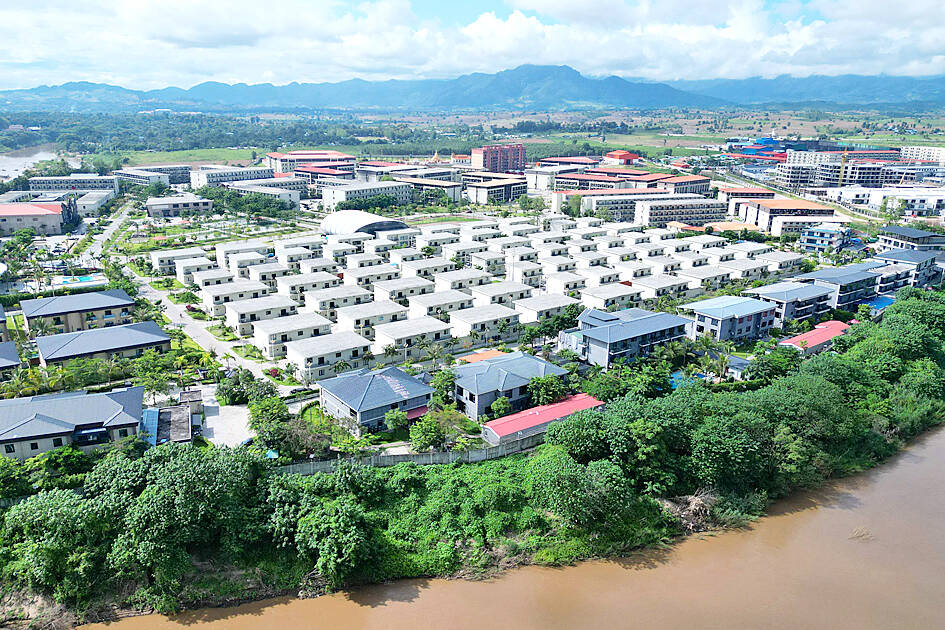
Photo: AFP
The US Congress Joint Economic Committee said it has begun an investigation into Starlink’s involvement with the centers.
It has the power to make Musk testify before it.
SpaceX, which owns Starlink, did not reply to requests for comment.
China, Thailand and Myanmar forced pro-junta Myanmar militias who protect the centers into promising to “eradicate” the compounds in February. They freed about 7,000 people — mostly Chinese citizens — from the brutal call center-style system, which the UN says runs on forced labor and human trafficking.
Many workers said that they were beaten and forced to work long hours by scam bosses who target victims across the globe with telephone, Internet and social media cons.
Starlink has topped the APNIC ranking of Myanmar Internet providers for all but one week since July 3, after first appearing at No. 56 in the list in late April.
Only weeks after the headline-grabbing releases, building work on several of the centers had started along the Moei River, which forms the frontier with Thailand.
Analysis of satellite images from Planet Labs PBC found dozens of buildings going up or being altered in the largest of the compounds, KK Park, between March and last month.
New roads and a roundabout have also been added, with the security checkpoint at its entrance greatly extended.
Drone footage also captured major construction going on, with cranes and laborers hard at work on what appeared to be large office blocks.
At least five new ferry crossings across the Moei River have also appeared to supply the centers from the Thai side, satellite images show.
Construction work has also been going on at several of the other 27 suspected scam centers in the Myawaddy cluster, analysis found, including what the US Department of the Treasury called the “notorious” Shwe Kokko centers, north of Myawaddy.
The US last month sanctioned nine people connected to Shwe Kokko and the Chinese criminal kingpin She Zhijiang (佘智江), founder of the multistory Yatai New City center there.
US Senator Maggie Hassan, the leading Democrat on the US Congressional committee, has called on Musk to block the Starlink service to the fraud centers.
“While most people have probably noticed the increasing number of scam texts, calls and e-mails, they may not know that transnational criminals halfway across the world may be perpetrating these scams by using Starlink Internet access,” Hassan said.
The senator wrote to Musk in July demanding answers to 11 questions about Starlink’s role.
Former California prosecutor Erin West, who now heads the Operation Shamrock group campaigning against the compounds, said: “It is abhorrent that an American company is enabling this to happen.”
While still a cybercrime prosecutor, she warned Starlink in July last year that the mostly Chinese crime syndicates that run the centers were using its dishes, but received no reply.
Americans are among the top targets of Southeast Asia scammers, the US Department of the Treasury said, losing an estimated US$10 billion last year, up 66 percent in 12 months.
Up to 120,000 people might be being “forced to carry out online scams” in the Myanmar centers, according to a UN report in 2023.
It said another 100,000 are likely being held in similar conditions in Cambodia.
‘GROSS NEGLIGENCE?’ Despite a spleen typically being significantly smaller than a liver, the surgeon said he believed Bryan’s spleen was ‘double the size of what is normal’ A Florida surgeon who is facing criminal charges after allegedly removing a patient’s liver instead of his spleen has said he is “forever traumatized” by that person’s death. In a deposition from November last year that was recently obtained by NBC, 44-year-old Thomas Shaknovsky described the death of 70-year-old William Bryan as an “incredibly unfortunate event that I regret deeply.” Bryan died after the botched surgery; and last month, a grand jury in Tallahassee indicted Shaknovsky on a charge of manslaughter. “I’m forever traumatized by it and hurt by it,” Shaknovsky added, also saying that wrong-site surgeries can happen “during

Kouri Richins, a Utah mother who published a children’s book about grief after the death of her husband is to serve a life sentence for his murder without the possibility of parole, a judge ruled on Wednesday. Richins was convicted in March of aggravated murder for lacing a cocktail given to her husband, Eric Richins, with five times the lethal dose of fentanyl at their home near Park City in 2022. A jury also found her guilty of four other felonies, including insurance fraud, forgery and attempted murder for trying to poison her husband weeks earlier on Feb. 14, 2022, with a

Former Chinese ministers of national defense Wei Fenghe(魏鳳和) and Li Shangfu (李尚福) were both sentenced to death with a two-year reprieve over graft charges, state news agency Xinhua reported on Thursday, underscoring the severity of the purge in the military. The armed forces have been one of the main targets of a broad corruption crackdown ordered by Chinese President Xi Jinping (習近平) after coming to power in 2012. The purges reached the elite Rocket Force, which oversees nuclear weapons as well as conventional missiles, in 2023. Earlier this year they escalated further, resulting in the removal of the top general in

‘PERSONAL MISTAKES’: Eileen Wang has agreed to plead guilty to the felony, which comes with a maximum sentence of 10 years in federal prison A southern California mayor has agreed to plead guilty to acting as an illegal agent for the Chinese government and has resigned from her city position, officials said on Monday. Eileen Wang (王愛琳), mayor of Arcadia, was charged last month with one count of acting in the US as an illegal agent of a foreign government. She was accused of doing the bidding of Chinese officials, such as sharing articles favorable to Beijing, without prior notification to the US government as required by law. The 58-year-old was elected in November 2022 to a five-person city council, from which the mayor is selected


 RSS
RSS