


James Watson — the Nobel laureate co-credited with the pivotal discovery of DNA’s double-helix structure, but whose career was later tainted by his repeated racist remarks — has died, his former lab said on Friday. He was 97.
The eminent biologist died on Thursday in hospice care on Long Island in New York, announced the Cold Spring Harbor Laboratory, where he was based for much of his career. Watson became among the 20th century’s most storied scientists for his 1953 breakthrough discovery of the double helix with researcher partner Francis Crick.
Along with Crick and Maurice Wilkins, he shared the 1962 Nobel Prize for their work — momentous research that gave rise to modern biology, and opened the door to new insights including on genetic code and protein synthesis.
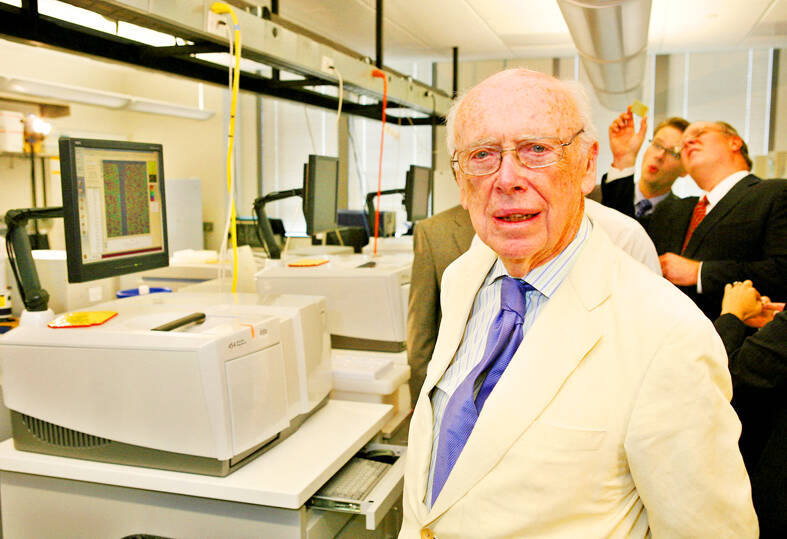
Photo: Reuters
That marked a new era of modern life, allowing for revolutionary technologies in medicine, forensics and genetics — ranging from criminal DNA testing or genetically manipulated plants.
Watson went on to do groundbreaking work in cancer research and mapping the human genome. However, he later came under fire and bowed out of public view for controversial remarks, including that Africans were not as smart as white people. Watson told the British weekly the Sunday Times he was “inherently gloomy about the prospect of Africa,” because “all our social policies are based on the fact that their intelligence is the same as ours — whereas all the testing says not really.”
Born on April 6, 1928, in Chicago, at the age of 15 James Dewey Watson won a scholarship to the University of Chicago.
In 1947 he received a degree in zoology before attending Indiana University in Bloomington, where he received his doctorate in zoology in 1950.
He became interested in the work of scientists working at the University of Cambridge in England with photographic patterns made by X-rays.
After moving to the University of Copenhagen, Watson began his investigation of the structure of DNA.
In 1951 he went to the Zoological Station at Naples, Italy, where he met researcher Maurice Wilkins and saw crystalline DNA’s X-ray diffraction pattern for the first time.
Before long, he met Francis Crick and started what would go down as a celebrated partnership.
Working with X-ray images obtained by Rosalind Franklin and Wilkins, researchers at King’s College in London, Watson and Crick had started their historic work of puzzling out the double helix.
Their first serious effort came up short.
However, their second attempt resulted in the pair presenting the double-helical configuration, a now iconic image that resembles a twisting ladder.
Their model also showed how the DNA molecule could duplicate itself, thus answering a fundamental question in the field of genetics.
Watson and Crick published their findings in the British journal Nature in April-May 1953 to great acclaim.
Watson taught at Harvard for 15 years before becoming director of what today is known as the Cold Spring Harbor Laboratory, which he transformed into a global hub of molecular biology research.
From 1988 to 1992, Watson was one of the directors of the Human Genome Project at the US National Institutes of Health, where he oversaw the mapping of the genes in the human chromosomes.
However, his comments on race and obesity — he was also known to make sexist remarks — triggered his retirement in 2007.
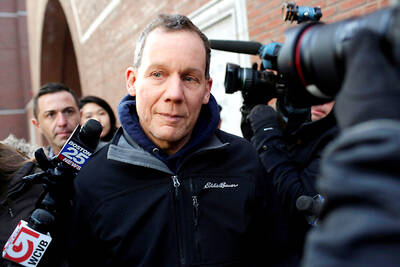
An American scientist convicted of lying to US authorities about payments from China while he was at Harvard University has rebuilt his research lab in Shenzhen, China, to pursue technology the Chinese government has identified as a national priority: embedding electronics into the human brain. Charles Lieber, 67, is among the world’s leading researchers in brain-computer interfaces. The technology has shown promise in treating conditions such as amyotrophic lateral sclerosis and restoring movement in paralyzed people. It also has potential military applications: Scientists at the Chinese People’s Liberation Army have investigated brain interfaces as a way to engineer super soldiers by boosting
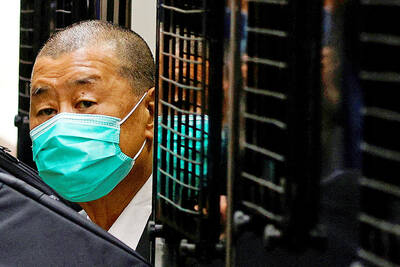
Jailed media entrepreneur Jimmy Lai (黎智英) has been awarded Deutsche Welle’s (DW) freedom of speech award for his contribution to Hong Kong’s pro-democracy movement. The German public broadcaster on Thursday said Lai would be presented in absentia with the 12th iteration of the award on June 23 at the DW Global Media Forum in Bonn. Deutsche Welle director-general Barbara Massing praised the 78-year-old founder of the now-shuttered news outlet Apple Daily for standing “unwaveringly for press freedom in Hong Kong at great personal risk.” “With Apple Daily, he gave journalists a platform for free reporting and a voice to the democracy movement in
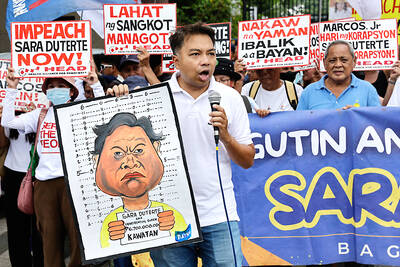
PHILIPPINE COMMITTEE: The head of the committee that made the decision said: ‘If there is nothing to hide, there is no reason to hide, there is no reason to obstruct’ A Philippine congressional committee on Wednesday ruled that there was “probable cause” to impeach Philippine Vice President Sara Duterte after hearing allegations of unexplained wealth, misuse of state funds and threats to have the president assassinated. The unanimous decision of the 53-member committee in the Philippine House of Representatives sends the two impeachment complaints to deliberations and voting by the entire lower chamber, which has more than 300 lawmakers. The complaints centered on Duterte’s alleged illegal use and mishandling of intelligence funds from the vice president’s office, and from her time as education secretary under Philippine President Ferdinand Marcos Jr. Duterte and the

Burmese President Min Aung Hlaing yesterday cut all prisoners’ sentences by one-sixth, a blanket measure that a source close to deposed leader Aung San Suu Kyi said would further shorten her detention. Aung San Suu Kyi has been sequestered since a 2021 military coup, but the senior member of her dissolved National League for Democracy (NLD) party said that while her term had been reduced, her remaining sentence is still unclear. “We also don’t know exactly how many years she has left,” the source told reporters, speaking on condition of anonymity for security reasons. The military toppled Aung San Suu Kyi’s elected government


 RSS
RSS