


The Central Weather Administration (CWA) yesterday said it is expected to issue a sea warning for Typhoon Fung-wong this afternoon and a land warning tomorrow.
As of 1pm, the storm was about 1,070km southeast of Oluanpi (鵝鑾鼻), Taiwan’s southernmost point, and was moving west-northwest at 28 to 32kph, according to CWA data.
The storm had a radius of 250km, with maximum sustained winds of 173kph and gusts reaching 209kph, the CWA added.
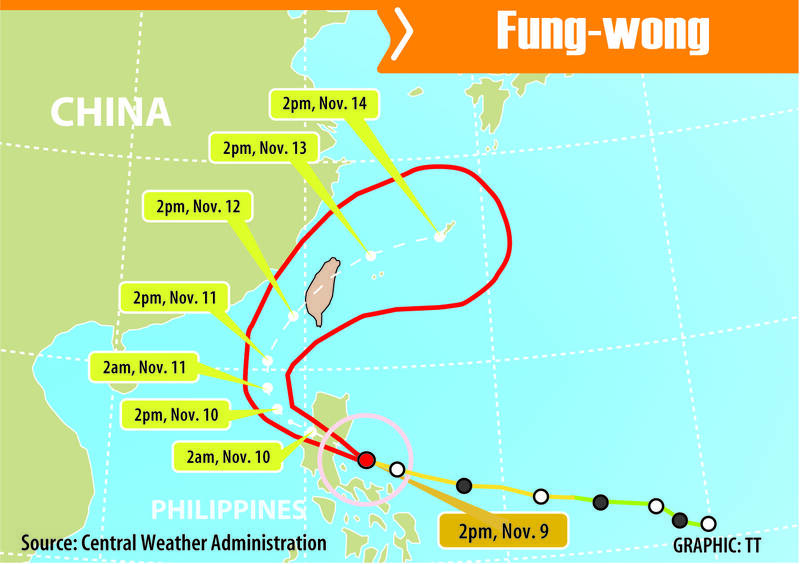
The storm is forecast to pass near Luzon in the Philippines before entering the South China Sea and potentially turning northward toward Taiwan, the CWA said.
CWA forecaster Chang Chun-yao (張峻堯) said that according to current data forecasts, the typhoon’s center is expected to make landfall in Taiwan between Wednesday evening and early morning on Thursday.
The exact location of landfall requires further observation, he said, adding the central and southern regions have a higher probability, but areas like Taoyuan, Hsinchu and Miaoli County cannot be ruled out.
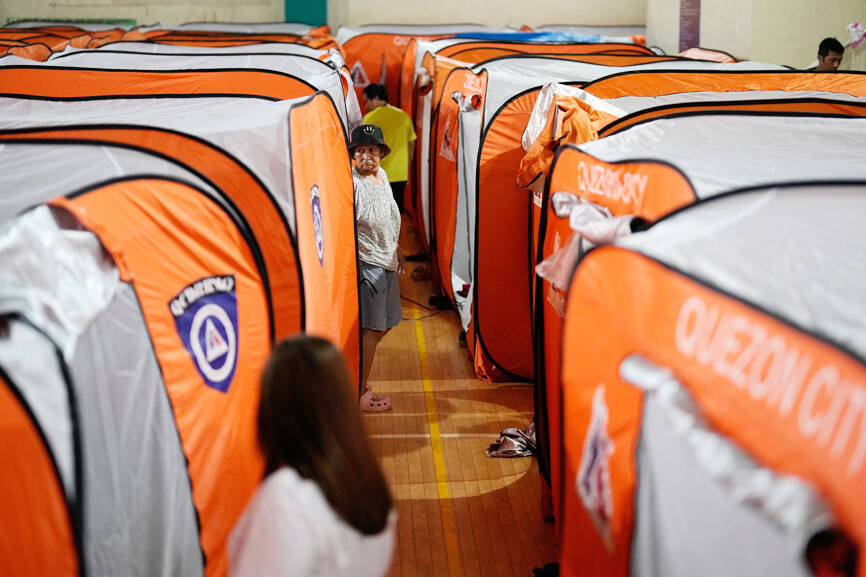
Photo: AP
Independent meteorologist Daniel Wu (吳德榮) said Fung-wong might weaken as it approaches Taiwan. Still, its interaction with the northeast seasonal winds could produce potentially disastrous levels of rainfall in northern and eastern Taiwan this week.
Meanwhile, Fung-wong battered the Philippines’ northeastern coast ahead of landfall yesterday, leaving at least two people dead and forcing more than a million people to evacuate from areas at high risk of flash floods, landslide and tidal surges, officials said.
It approached from the Pacific while the Philippines was still dealing with the devastation wrought by Typhoon Kalmaegi, which left at least 224 people dead in central provinces on Tuesday before pummeling Vietnam, where at least five were killed.
A villager drowned in flash floods in the Philippine province of Catanduanes and another died in Catbalogan city in eastern Samar province when she was pinned by debris, officials said.
Philippine President Ferdinand Marcos Jr declared a state of emergency due to the extensive devastation caused by Kalmaegi and the expected calamity from Fung-wong, while Philippine Defense Secretary Gilberto Teodoro urged residents in the storm’s path to heed evacuation orders, warning that refusing to comply was dangerous and unlawful.
More than 1 million people were moved away from high-risk villages in northeastern provinces, including in Bicol, a coastal region vulnerable to Pacific cyclones and mudflows from Mayon, one of the country’s most active volcanoes.
More than 30 million people could be exposed to hazards posed by Fung-wong in the country, the Philippine Office of Civil Defense said.
Additional reporting by AP and Reuters

‘NO SECURITY RISK’: The Railway Bureau reassured the public that the technicians’ activities were limited to technical guidance and did not involve sensitive systems The Railway Bureau yesterday said it had invited eight Chinese technicians to assist with an airport MRT construction project. The bureau issued the confirmation after an Internet user said Chinese nationals had entered the construction zone of Taiwan Taoyuan International Airport’s Terminal 3 project. They asked why “individuals from an enemy state” were allowed access to such a major national infrastructure project, which raised serious concerns over Taiwan’s industrial safety, sensitive systems and information security. The bureau’s Northern Region Engineering Branch Office said subcontractor Taiwan Handle Industrial Co (台灣手把工業) of the Taoyuan airport MRT’s “Contract No. CU05 Project A14 Station Civil, MEP &

A US uncrewed surface vessel (USV) encountered multiple Chinese warships during an autonomous transit of the Taiwan Strait, US defense company Seasats said in a statement on Wednesday. Seasats announced that a Lightfish USV had completed the first autonomous transit of the Taiwan Strait. Over five days, the USV traversed the entire length of the Strait while constantly monitoring surface vessel traffic, the company said. The Lightfish encountered multiple Chinese warships, one of which was a Chinese People’s Liberation Army Navy (PLAN) Type 056 corvette, it said. The Chinese vessels were operating “well within Taiwan’s exclusive economic zone without transmitting their identity via the
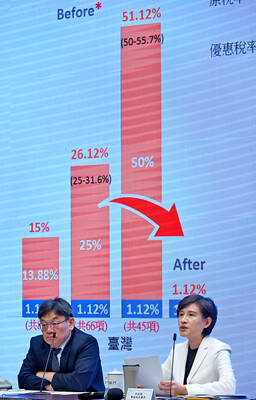
GREATER REACH? Auto parts and wood products would face tariffs of up to 15%, matching those targeting the EU, Japan and South Korea, Vice Premier said The US has announced that preferential tariff treatment for Taiwan’s non-semiconductor Section 232 goods would take effect retroactively from May 1, the Executive Yuan said yesterday. The US government yesterday posted a notice on the Federal Register’s public inspection Web site previewing tariff concessions for Taiwan under a memorandum of understanding (MOU) on Taiwan-US investment after two months of negotiations. The MOU signed on Jan. 15 stipulated three major preferential tariff arrangements: a 15 percent “reciprocal” tariff rate for Taiwan without stacking most-favored nation (MFN) rates; preferential Section 232 treatment for semiconductors and related products; and preferential Section 232 treatment for non-semiconductor

TIT-FOR-TAT: The US allegedly revoked the visa of a Chinese national working at Xinhua News Agency in the US in response to Beijing’s expulsion of Vivian Wang The Presidential Office yesterday condemned China for expelling a New York Times correspondent from Beijing following the newspaper’s interview with President William Lai (賴清德), saying the move highlighted Beijing’s suppression of press freedom and its threat to international news media. Taiwan has noted a series of recent incidents in which Beijing used similar tactics to “threaten and pressure international media outlets and journalists,” Presidential Office spokeswoman Karen Kuo (郭雅慧) said in a statement. “This concerns not only press freedom and freedom of expression, but also the safety of journalists, and Taiwan and relevant partners are paying close attention to the situation,” she


 RSS
RSS