


Swedes are stocking up on food items in case of war, as more conflict in Europe no longer feels like a distant possibility, and authorities encourage measures to boost readiness.
At a civil preparedness fair in southwest Stockholm, 71-year-old Sirkka Petrykowska said that she is taking the prospect of hostilities seriously and preparing as much as she can.
“I have bought a camping stove. I have taken a course on preservation in an old-fashioned way, where you can preserve vegetables, meat and fruit that lasts for 30 years without a refrigerator,” Petrykowska said.
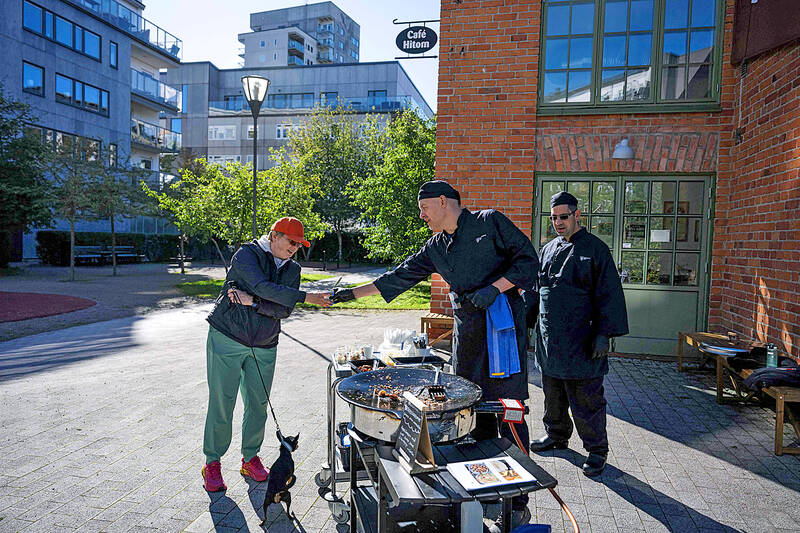
Photo: AFP
“I’ve set aside blankets for warmth, I bought a gas burner for heating. I’ve also stocked up at my countryside home,” she continued.
Late last month, Sweden held its annual Preparedness Week, where authorities seek to raise awareness as part of the country’s “total defense” strategy.
The country revived the strategy in 2015 following Russia’s annexation of Crimea, and more measures were introduced — including the appointment of a minister for civil defense — after Moscow’s full-scale invasion of Ukraine in 2022.
The idea is to mobilize all of society, from authorities to citizens and businesses, to collectively resist armed aggression while maintaining essential functions.
The focus, as it often is in Sweden, is on individual responsibility.
Everyone is encouraged to stockpile enough food to live independently for at least seven days without external aid in the event of a crisis.
That means “resources can initially be directed for instance to elderly and sick people,” the Swedish Food Agency says on its Web site.
“Meanwhile, society has time readjust so that everyone can get help,” it says.
The Swedish Civil Contingencies Agency (MSB) has published a list of recommended foods that are high in fat and protein, and easy to store.
It includes pesto, dried meat or fish, jam, chocolate, mashed potatoes, powdered milk and biscuits.
“In a war scenario, people will be more physically active than under normal circumstances,” Swedish Food Agency emergency planning officer Oskar Qvarfort said, adding that on average the increased need would be about 100 calories.
Martin Svennberg, a business developer from Stockholm, has taken the advice to heart and stockpiled ample food reserves in his basement for his family.
Stacked in boxes in a cramped storage unit are 100kg of flour, dozens of cans of various foods, and an array of freeze-dried meals, enough to last them three months.
For him, the food is not just for sustenance, but also for moral support, which is essential in such situations, he said.
“Stocking up on food that you like and that you eat in normal life, I think that is really important,” he said.
“I mean when you go to your mom’s place or dad’s place and you get the food that they made for you as a kid, you get that sense of relief and nostalgia. The same thing goes for food in a crisis,” Svennberg said.
According to an MSB survey of 2,000 people, 86 percent of Swedes believe the country is worth defending in the event of a military attack, and 76 percent would be willing to defend it as part of Swedish civil defense.
The agency has twice sent out a brochure to all Swedish households informing them of how to act in a crisis, once in 2018 and then last year.
The survey, published in March, showed that 39 percent of people felt “worried” when receiving last year’s edition, compared with 24 percent in 2018.
Sweden also faces logistical challenges owing to its large size, with many areas sparsely populated.
“A large part of food production is concentrated in the south ... and the majority of imports also primarily arrive in these regions,” Qvarfort said.
Food transportation would be “a real challenge” in the event of an armed conflict, he said, adding that Ukraine is facing the same issue.

‘CROSSING THE LINE’: China’s embassy in Seoul criticized US Forces Korea Commander General Xavier Brunson, asking if his ‘hostile’ remarks were authorized by Washington South Korea and the US are in talks over recent public remarks by the commander of US Forces Korea, Seoul’s presidential office said yesterday, after the comments drew sharp criticism from China. In a recent podcast interview, US Forces Korea Commander General Xavier Brunson described South Korea as “the dagger in the heart of Asia” from China’s east coast, prompting the Chinese embassy in Seoul to say that he had “truly crossed the line.” The interview came amid growing speculation that Washington might seek to expand the role of US Forces Korea in countering the growing regional influence of China, a key

Through the noise of rushing papers and whirring belts at a print factory in Kyoto, two creators watch their photo essay come to life in broadsheet form — part of an effort to win new audiences in the age of artificial intelligence (AI). Despite the decline of the publishing industry, self-publication and handmade “zine” magazines are growing in popularity in Japan, reflecting the nation’s enduring love of paper in the digital era. While speaking to Agence France-Presse at the plant, his hands black with ink, one of the creators, Kazuma Obara, said: “I think [paper] is a medium that engages all five

Australian researchers have trained lab-grown brain cells on a silicon computer chip to play the 1990s shooter game Doom and said they are just scratching the surface of what the neurons could be capable of doing. It is the science-fiction work of biotech boffins at Cortical Labs, who researched and developed the technology that harnesses the workings of the brain’s networking system. Each so-called “biological computer” contains about 200,000 living human brain cells, grown from stem cells that were harvested from blood donations. Having mastered the simple computer game Pong, where a paddle is moved up and down to send a ball

France experienced its hottest spring on record, the French weather service said on Tuesday, after an exceptional early heat wave that also broke highs for the season in England and Wales. Meteo-France said the average nationwide temperature over March to May was 13.8°C — about 1.7°C above the norm, and surpassing records set in 2011 and 2020. “The warmest spring since records began in 1900,” it said in a bulletin. All three months were warmer than average, but the onset of an “unprecedented heatwave” late last month pushed the mercury to highs typically seen at the height of the summer. “Our country had never


 RSS
RSS