


It has black button eyes and long, thin whiskers that tremble when it looks around curiously.
Unlike most rats, this one has a name, Plume, and gets to enjoy the rare privilege of wandering around Paris on the shoulder of its owner, a local politician.
Gregory Moreau, a Paris district deputy mayor, is on a mission to reconcile residents with the capital’s population of rats which, it is said, outnumber the inner city’s 2 million human residents by a big margin.
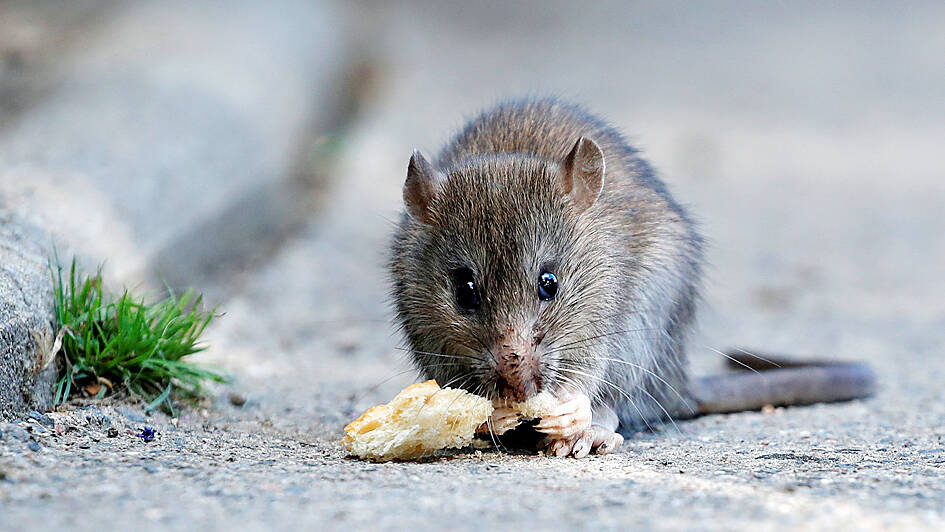
Photo: Reuters
“Hello, have you ever seen a rat?” Moreau asked an unsuspecting woman carrying two shopping bags around a market in Belleville, a bustling eastern Parisian neighborhood. “Look what I’m carrying on my shoulder.”
The woman eyed the rodent skeptically, then broke out in a smile.
“Is that Ratatouille?” she asked, a reference to the titular character of the Disney animated film about a rat that can cook.
Myths and tales about rats have been part of Paris folklore for centuries, giving the rodents an overwhelmingly unfavorable rap.
“Rats have a bad image because they spread the plague in the 14th century,” said Moreau, who is a member of the PA animal rights party and a qualified physics theorist.
These days, he said, the role of rats in the transmission of illnesses is negligible, except perhaps for leptospirosis, a bacterial infection transmitted from animals to humans that occurs mostly in the countryside.
Moreau never tires of campaigning, including by distributing leaflets with pictures of cute-looking rats in front of the Eiffel Tower, and by urging passersby to recognize the usefulness of the rodents.
“They eat about 100 tonnes of waste in Paris every day,” he said, thus preventing the city’s sewer system from clogging up.
When challenged about complaints of too many rats in playgrounds and parks, Moreau acknowledges a need for rodent control, but said there are gentler methods than traditional rat poison, which he calls both cruel and ultimately inefficient because rodents become immune to its toxicity and often learn to avoid the bait in the first place.
Moreau said it makes more sense to avoid leaving food waste in the streets, which is a problem in Paris, especially around fast-food outlets.
“If the rats don’t find food they don’t multiply as much,” he said.
Predictably, the rat-friendly deputy mayor has encountered opposition, most ferociously from Geoffroy Boulard, district mayor in a chic western neighborhood of Paris.
Boulard has been viewed as the capital’s top rodent-hater ever since newspaper Le Parisien published a picture of him holding four dead rats dangling by their tails.
Boulard’s anti-rat credentials even earned him an invitation to last year’s inaugural edition of the National Urban Rat Summit in New York.
“Anyone claiming that we should coexist with rats lives in a fantasy world,” Boulard said.
Any let-up in the fight would “threaten public health,” said Boulard, who has installed traps in his district that attract rats with food before killing them via an app-controlled mechanism.
The traps, costing 800 euros (US$938) each, kill about 800 rats per year — only a tiny part of the rat population — but Boulard says fewer reports of rat sightings from concerned citizens on a designated Web site suggest that his approach is working.

Crowds in Bangladesh are flocking to snap photographs with an unlikely social media star — an albino buffalo with flowing blond hair nicknamed “Donald Trump” that is due to be sacrificed within days. Owner Zia Uddin Mridha, 38, said his brother named the 700kg bull over its flowing helmet of hair resembling the signature look of the US president. “My younger brother picked this name because of the buffalo’s extraordinary hair,” he said at his farm in Narayanganj, just outside the capital, Dhaka. Mridha said that a constant stream of curious visitors — social media fans, onlookers and children — have come throughout

It began as a satirical online project. Now millions of young people in India are flocking to it as an outlet for their frustration. A parody political party called the Cockroach Janta Party, with the insect as its symbol, has exploded across India’s social media by turning absurdist humor into protest. Memes and short videos mocking corruption, joblessness and political dysfunction have flooded social media sites, where millions of users are embracing the cockroach — known for its ability to survive harsh conditions — as a tongue-in-cheek symbol of endurance. The online movement’s rise has been unusually rapid. The Cockroach Janta Party (CJP)
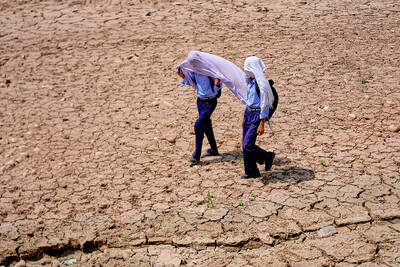
HOTTER: While Indians are accustomed to summer heat, climate change has caused northwestern India to warm faster than other parts of the country, an academic said Roads and markets have emptied during afternoons and some farmers have switched to nighttime work to avoid scorching temperatures as a heat wave grips large parts of India. The India Meteorological Department forecast maximum temperatures for yesterday of about 45°C in the capital, New Delhi, where authorities have opened temporary “cooling zones” to help people cope. The weather department warned that conditions would likely persist across several northern regions in the coming days, with temperatures staying well above seasonal averages. Authorities urged people to stay indoors during the hottest hours and take precautions against heat-related illnesses. India declares a heat wave whenever maximum temperatures

BIGGER ROLE: Beijing has said it maintains an impartial stance on the war in Ukraine, but by training Russian troops, China is far more involved than previously known China’s armed forces secretly trained about 200 Russian military personnel in China late last year, and some have since returned to fight in Ukraine, according to three European intelligence agencies and documents seen by Reuters. While China and Russia have held a number of joint military exercises since Moscow’s full-scale invasion of Ukraine in 2022, Beijing has repeatedly said that it is neutral in the conflict and presents itself as a peace mediator. The covert training sessions, which predominantly focused on the use of drones, were outlined in a dual-language Russian-Chinese agreement signed by senior Russian and Chinese officers in Beijing on


 RSS
RSS