


The Philippine defense and military chiefs rejected a call from protestors for the country’s armed forces to withdraw support from Philippine President Ferdinand Marcos Jr in response to public outrage over allegations of massive corruption in flood control projects that have implicated several congressmen and public works officials and sparked pockets of street protests.
Philippine Secretary of National Defense Gilbert Teodoro Jr and Armed Forces of the Philippines Chief of Staff General Romeo Brawner Jr issued a joint statement late on Friday expressing their rejection of “all attempts to patronize the Armed Forces of the Philippines by certain groups that insinuate or suggest unconstitutional, unilateral interventions.”
They did not elaborate, but underscored that the 160,000-member military was non-partisan, professional and “abides by the constitution through the chain-of-command.”
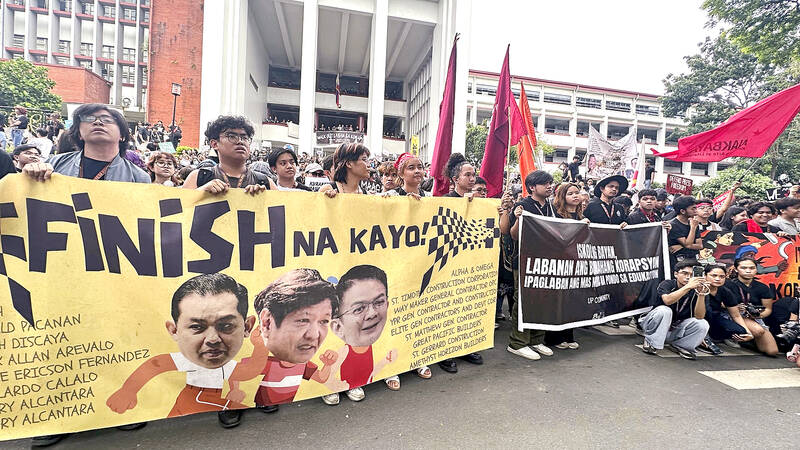
Photo: AP
The Philippines House of Representatives, Senate and Marcos’ administration have been investigating alleged substandard and non-existent flood control projects in separate televised inquiries.
Dozens of Philippine legislators, senators, construction companies and public works engineers were identified and accused of pocketing huge kickbacks that financed lavish lifestyles and high-stakes casino gambling.
The corruption scandal has been especially sensitive in the poverty-stricken Southeast Asian country, which is prone to deadly typhoons and flooding that devastate entire towns and villages multiple times each year.
Unlike recent violent protests in Nepal and Indonesia, street rallies against alleged abuses in the Philippines have been smaller and relatively peaceful. Outrage is largely vented online, including by Catholic church leaders, business executives and retired generals.
During a recent rally, a speaker called on the military to withdraw its loyalty from Marcos and called on Filipinos to stage a non-violent “people power” revolt similar to army-backed uprisings that ousted former Philippine presidents Ferdinand Marcos — the current president’s late father and namesake — and Joseph Estrada in 1986 and 2001 respectively.
Two high-ranking national security and defense officials said there was no currently monitored threat of secessionism within the military and the police forces. They spoke on condition of anonymity because of a lack of authority to discuss the delicate issue publicly.
Drastic movements in the military and other uniformed service are very unlikely due to strong loyalty and patriotism ... to Constitution, the flag and the president,” a condidential intelligence assessment said.
The Philippines has spent an estimated 545 billion pesos (US$9.53 billion) for thousands of flood mitigation projects in the past three years. The projects were under government review to determine which ones are substandard or non-existent, as Marcos said he has found during recent inspections he led in some flood-prone provinces, including in Bulacan, a densely populated province north of Manila.
Marcos formed an independent commission to investigate the massive anomalies he described as “horrible,” prompting him to withhold funding for flood control projects at least for next year and accept the resignation of Philippine Secretary of Public Works and Highways Manuel M. Bonoan.

Four contenders are squaring up to succeed Antonio Guterres as secretary-general of the UN, which faces unprecedented global instability, wars and its own crushing budget crisis. Chile’s Michelle Bachelet, Argentina’s Rafael Grossi, Costa Rica’s Rebeca Grynspan and Senegal’s Macky Sall are each to face grillings by 193 member states and non-governmental organizations for three hours today and tomorrow. It is only the second time the UN has held a public question-and-answer, a format created in 2016 to boost transparency. Ultimately the five permanent members of the UN’s top body, the Security Council, hold the power, wielding vetoes over who leads the

South Korea’s air force yesterday apologized for a 2021 midair collision involving two fighter jets, a day after auditors said the pilots were taking selfies and filming during the flight and held them responsible for the accident. “We sincerely apologize to the public for the concern caused by the accident that occurred in 2021,” an air force spokesman told a news conference, adding that one of the pilots involved had been suspended from flying duties, received severe disciplinary action and has since left the military. The apology followed a report released on Wednesday by the South Korean Board of Audit and Inspection,

Young Chinese, many who fear age discrimination in their workplace after turning 35, are increasingly starting “one-person companies” that have artificial intelligence (AI) do most of the work. Smaller start-ups are already in vogue in Silicon Valley and elsewhere, with rapidly advancing AI tools seen as a welcome teammate even as they threaten layoffs at existing firms. More young people in China are subscribing to the model, as cities pledge millions of dollars in funding and rent subsidies for such ventures, in alignment with Beijing’s political goal of “technological self-reliance.” “The one-person company is a product of the AI era,” said Karen Dai

About 240 Indians claiming descent from a Biblical tribe landed at Tel Aviv airport on Thursday as part of a government operation to relocate them to Israel. The newcomers passed under a balloon arch in blue and white, the colors of the Israeli flag, as dozens of well-wishers welcomed them with a traditional Jewish song. They were the first “bnei Menashe” (“sons of Manasseh”) to arrive in Israel since the government in November last year announced funding for the immigration of about 6,000 members of the community from the states of Manipur and Mizoram in northeast India. The community claims to descend from


 RSS
RSS