


Veteran Thai politician Anutin Charnvirakul won a vote in Parliament yesterday to become the country’s next prime minister, according to an unofficial running tally broadcast live on television.
Anutin, leader of the Bhumjaithai party, won more than 247 votes — the required majority — from the House of Representative’s 492 active members. His total must be certified after voting is completed.
He and his government are expected to take office in a few days after obtaining a formal appointment from King Maha Vajiralongkorn.
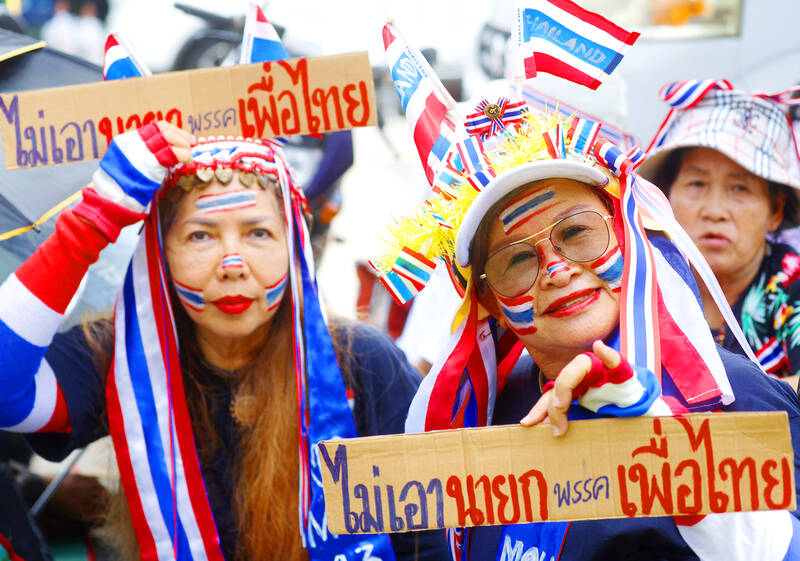
Photo: EPA
Anutin succeeds Paetongtarn Shinawatra, who was dismissed by court order as Thai prime minister last week after being found guilty of ethics contraventions over a politically compromising phone call with neighboring Cambodia’s Senate President Hun Sen.
The dispute erupted into a deadly five-day armed conflict in July.
Anutin had served in Paetongtarn’s Cabinet, but he resigned and withdrew his party from her coalition government after news of the leaked phone call caused a public uproar.

Photo: Reuters
Only five candidates, nominated during the general election in 2023, were eligible under Thailand’s constitutional rules.
The Pheu Thai Party, currently leading a caretaker government, attempted to dissolve Parliament on Tuesday, but the acting prime minister said their request was rejected by the king’s Privy Council.
Anutin had served in the Pheu Thai-led coalition government that took power in 2023 and before that in the military-backed, but elected government under former prime minister Prayuth Chan-ocha.
Anutin is best known for successfully lobbying for the decriminalization of cannabis, a policy that is now being more strictly regulated for medical purposes. He also played a high-profile role as minister of health during the COVID-19 pandemic, when he was accused of tardiness in obtaining adequate vaccine supplies to fight the virus.
His party has promised to dissolve Parliament within four months in exchange for support from the People’s Party.
People’s Party leader Natthaphong Ruengpanyawut said it would remain in the opposition, leaving the new government potentially a minority one.
An Anutin-led government would have to commit to organizing a referendum on the drafting of a new constitution by an elected constituent assembly, People’s Party said.
The party has long sought changes to the constitution — which was imposed during a military government — to make it more democratic.
The People’s Party, then named the Move Forward Party, won the most seats in the 2023 election, but was kept from power when a joint vote of the House and the Senate failed to approve its candidate for prime minister.
Senators, who were appointed by a military government and were strong supporters of Thailand’s royalist conservative establishment, voted against the progressive party, because they opposed its policy of seeking reforms to the monarchy.
The Senate no longer holds the right to take part in the vote for prime minister.
After Move Forward was blocked from taking power, Pheu Thai had one of its candidates, real-estate executive Srettha Thavisin, approved as prime minister to lead a coalition government. However, he served just a year before the Constitutional Court dismissed him from office for ethical contraventions.
Srettha’s replacement, Paetongtarn, former prime minister Thaksin Shinawatra’s daughter, also lasted just a year in office. Even before she was forced out, her government was greatly weakened when Anutin’s Bhumjaithai Party abandoned her coalition. Its withdrawal left Pheu Thai with just a tiny and unstable majority in Parliament.

An American scientist convicted of lying to US authorities about payments from China while he was at Harvard University has rebuilt his research lab in Shenzhen, China, to pursue technology the Chinese government has identified as a national priority: embedding electronics into the human brain. Charles Lieber, 67, is among the world’s leading researchers in brain-computer interfaces. The technology has shown promise in treating conditions such as amyotrophic lateral sclerosis and restoring movement in paralyzed people. It also has potential military applications: Scientists at the Chinese People’s Liberation Army have investigated brain interfaces as a way to engineer super soldiers by boosting
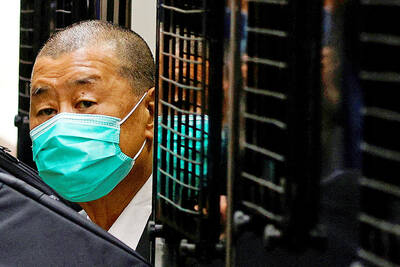
Jailed media entrepreneur Jimmy Lai (黎智英) has been awarded Deutsche Welle’s (DW) freedom of speech award for his contribution to Hong Kong’s pro-democracy movement. The German public broadcaster on Thursday said Lai would be presented in absentia with the 12th iteration of the award on June 23 at the DW Global Media Forum in Bonn. Deutsche Welle director-general Barbara Massing praised the 78-year-old founder of the now-shuttered news outlet Apple Daily for standing “unwaveringly for press freedom in Hong Kong at great personal risk.” “With Apple Daily, he gave journalists a platform for free reporting and a voice to the democracy movement in
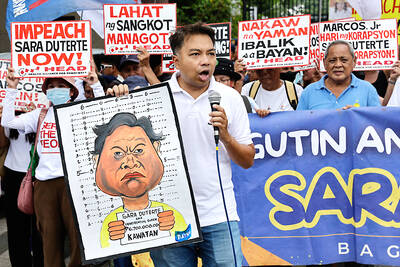
PHILIPPINE COMMITTEE: The head of the committee that made the decision said: ‘If there is nothing to hide, there is no reason to hide, there is no reason to obstruct’ A Philippine congressional committee on Wednesday ruled that there was “probable cause” to impeach Philippine Vice President Sara Duterte after hearing allegations of unexplained wealth, misuse of state funds and threats to have the president assassinated. The unanimous decision of the 53-member committee in the Philippine House of Representatives sends the two impeachment complaints to deliberations and voting by the entire lower chamber, which has more than 300 lawmakers. The complaints centered on Duterte’s alleged illegal use and mishandling of intelligence funds from the vice president’s office, and from her time as education secretary under Philippine President Ferdinand Marcos Jr. Duterte and the

Burmese President Min Aung Hlaing yesterday cut all prisoners’ sentences by one-sixth, a blanket measure that a source close to deposed leader Aung San Suu Kyi said would further shorten her detention. Aung San Suu Kyi has been sequestered since a 2021 military coup, but the senior member of her dissolved National League for Democracy (NLD) party said that while her term had been reduced, her remaining sentence is still unclear. “We also don’t know exactly how many years she has left,” the source told reporters, speaking on condition of anonymity for security reasons. The military toppled Aung San Suu Kyi’s elected government


 RSS
RSS