


A US federal judge on Sunday halted the administration of US President Donald Trump from deporting a group of migrant Guatemalan children already boarded onto planes and potentially hundreds more in government shelters after their lawyers made a predawn emergency appeal.
The dramatic scene was reminiscent of other last-minute court challenges to Trump-era deportation efforts.
A little after 1am on Sunday, the National Immigration Law Center, a pro-immigrant advocacy group, filed an emergency motion with the US District Court in Washington to halt the removal of 10 unaccompanied migrant children from Guatemala.
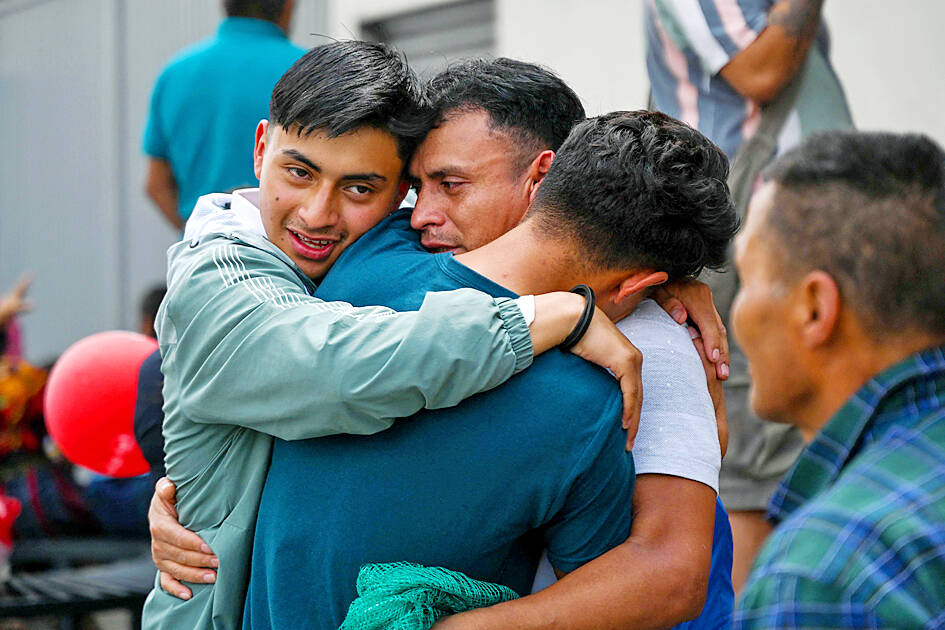
Photo: AFP
At a rare hearing over a holiday weekend, District Judge Sparkle Sooknanan said she had been awakened at 2:35am and alerted to the case. Sooknanan issued a temporary restraining order halting removal of the children, ages 10 to 17, for 14 days.
Sooknanan expanded the order to include any Guatemalan unaccompanied minors in the custody of the US Department of Health and Human Services. The complaint said this group could number hundreds of children.
A government lawyer on Sunday evening confirmed that the children that it had planned to fly to Guatemala had been taken off the planes and were being returned to the custody of the US Office of Refugee Resettlement.
Trump launched an immigration crackdown after returning to the White House in January, including an effort to track down and deport unaccompanied migrant children.
His administration struck an agreement with Guatemala that would allow unaccompanied children to be sent back to the nation and planned to start deportations at the weekend, one current and two former US officials said.
The plans were first reported by CNN on Friday last week.
Migrant children who arrive at the US border without a parent or guardian are classified as unaccompanied and sent to federal government-run shelters until they can be placed with a family member or foster home, a process outlined in federal law.
Guatemalan President Bernardo Arevalo in July said that his government was working with the US to repatriate unaccompanied children.
During the emergency hearing on Sunday, Sooknanan pressed the US Department of Justice for assurances that Guatemalan children had not been deported already.
“We’re here to try to figure out as quickly as we can what is happening,” said Sooknanan, an appointee of former US president Joe Biden.
Justice department attorney Drew Ensign said no children had been removed, but that some had been loaded onto planes. Ensign said he believed one plane might have taken off, but later returned under the judge’s order.
An attorney with the National Immigration Law Center, Efren Olivares, told the judge that some children still appeared to be aboard planes in Harlingen and El Paso, Texas. Ensign said they would be moved back to department of health and human services shelters.
Ensign said all of the children’s parents or guardians in Guatemala had requested their return via the Guatemalan government, although Olivares contested that.
White House Deputy Chief of Staff Stephen Miller criticized Sooknanan for blocking the deportations.
“The minors have all self-reported that their parents are back home in Guatemala,” Miller wrote on social media. “But a Democrat judge is refusing to let them reunify with their parents.”

An American scientist convicted of lying to US authorities about payments from China while he was at Harvard University has rebuilt his research lab in Shenzhen, China, to pursue technology the Chinese government has identified as a national priority: embedding electronics into the human brain. Charles Lieber, 67, is among the world’s leading researchers in brain-computer interfaces. The technology has shown promise in treating conditions such as amyotrophic lateral sclerosis and restoring movement in paralyzed people. It also has potential military applications: Scientists at the Chinese People’s Liberation Army have investigated brain interfaces as a way to engineer super soldiers by boosting
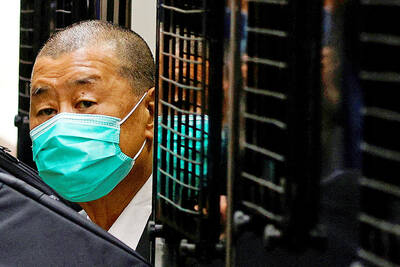
Jailed media entrepreneur Jimmy Lai (黎智英) has been awarded Deutsche Welle’s (DW) freedom of speech award for his contribution to Hong Kong’s pro-democracy movement. The German public broadcaster on Thursday said Lai would be presented in absentia with the 12th iteration of the award on June 23 at the DW Global Media Forum in Bonn. Deutsche Welle director-general Barbara Massing praised the 78-year-old founder of the now-shuttered news outlet Apple Daily for standing “unwaveringly for press freedom in Hong Kong at great personal risk.” “With Apple Daily, he gave journalists a platform for free reporting and a voice to the democracy movement in
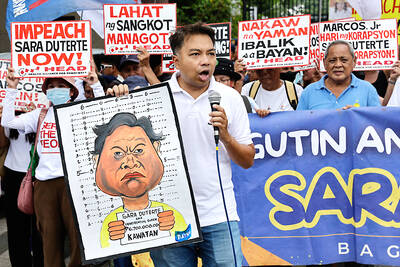
PHILIPPINE COMMITTEE: The head of the committee that made the decision said: ‘If there is nothing to hide, there is no reason to hide, there is no reason to obstruct’ A Philippine congressional committee on Wednesday ruled that there was “probable cause” to impeach Philippine Vice President Sara Duterte after hearing allegations of unexplained wealth, misuse of state funds and threats to have the president assassinated. The unanimous decision of the 53-member committee in the Philippine House of Representatives sends the two impeachment complaints to deliberations and voting by the entire lower chamber, which has more than 300 lawmakers. The complaints centered on Duterte’s alleged illegal use and mishandling of intelligence funds from the vice president’s office, and from her time as education secretary under Philippine President Ferdinand Marcos Jr. Duterte and the

Burmese President Min Aung Hlaing yesterday cut all prisoners’ sentences by one-sixth, a blanket measure that a source close to deposed leader Aung San Suu Kyi said would further shorten her detention. Aung San Suu Kyi has been sequestered since a 2021 military coup, but the senior member of her dissolved National League for Democracy (NLD) party said that while her term had been reduced, her remaining sentence is still unclear. “We also don’t know exactly how many years she has left,” the source told reporters, speaking on condition of anonymity for security reasons. The military toppled Aung San Suu Kyi’s elected government


 RSS
RSS