


New images released by North Korean state media yesterday showed North Korean leader Kim Jong-un kneeling before portraits of soldiers killed fighting for Russia against Ukraine, as well as hugging an emotional survivor of the conflict.
The images of an elaborate ceremony showed Kim presenting medals, placing them beside portraits of the fallen and consoling the returned soldiers, as Pyongyang’s leadership hailed the soldiers as “heroes” who sacrificed their youth and lives.
South Korean and Western intelligence agencies said that the North sent more than 10,000 soldiers to Russia last year along with artillery shells, missiles and long-range rocket systems.
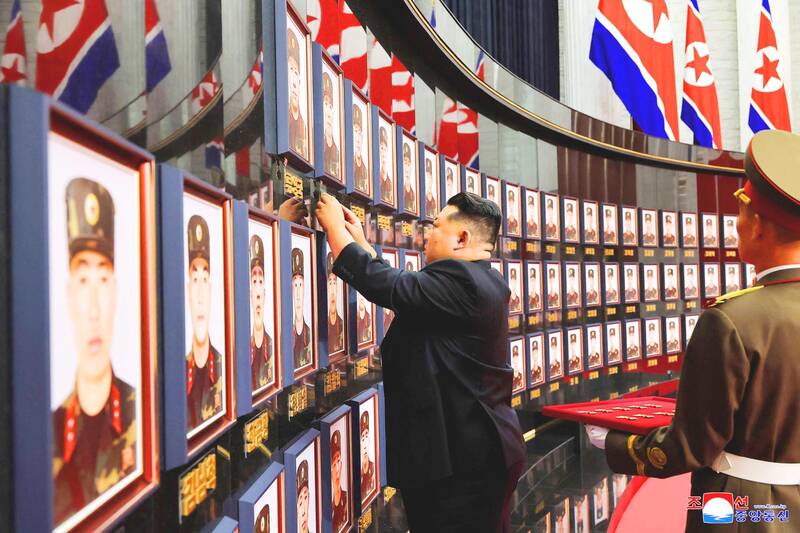
Photo: AFP, KCNA VIA KNS
About 600 North Korean soldiers have been killed and thousands more wounded fighting for Russia, Seoul has said.
At the ceremony held at the Workers’ Party headquarters in Pyongyang, portraits of the fallen soldiers, along with their names, were displayed on stage, the images showed.
Kim praised the “admirable” troops “who returned home with great honor” after enduring the “hail of bullets and bombs of the life-and-death war in the foreign country,” the Korean Central News Agency (KCNA) reported.
In one of the images released by KCNA, an emotional Kim was seen embracing a returned solider who appeared overwhelmed, burying his face in the leader’s chest during the ceremony.
The leader was also seen kneeling before a portrait of a fallen soldier to pay his respects, and placing medals and flowers beside the images of the dead.
Kim personally awarded the title of “DPRK [North Korea] hero,” to commanding officers who fought in overseas operations and “performed distinguished feats,” KCNA said, adding that the leader also laid a flower at the memorial wall and met with bereaved families to console them and share “the pain of loss.”
North Korea only confirmed it had deployed troops to support Russia’s war in Ukraine in April, and said that its soldiers had been killed in combat.
US President Donald Trump has held high-profile talks with Russian and Ukrainian leaders in recent days in a bid to end the conflict, but there has been little tangible progress since then.
Russian President Vladimir Putin hailed North Korean troops sent to fight in Ukraine as “heroic” in a letter to Kim, Pyongyang’s state media said last week.
Washington has said there is evidence that Russia is stepping up support for North Korea, including providing help on advanced space and satellite technology, in return for its assistance in fighting Ukraine.

‘CROSSING THE LINE’: China’s embassy in Seoul criticized US Forces Korea Commander General Xavier Brunson, asking if his ‘hostile’ remarks were authorized by Washington South Korea and the US are in talks over recent public remarks by the commander of US Forces Korea, Seoul’s presidential office said yesterday, after the comments drew sharp criticism from China. In a recent podcast interview, US Forces Korea Commander General Xavier Brunson described South Korea as “the dagger in the heart of Asia” from China’s east coast, prompting the Chinese embassy in Seoul to say that he had “truly crossed the line.” The interview came amid growing speculation that Washington might seek to expand the role of US Forces Korea in countering the growing regional influence of China, a key

SEEKING ORDER: Rodrigo Paz said that ‘anyone who wants to destroy the nation will have to deal with this president and the full force of the constitution’ Bolivian President Rodrigo Paz on Wednesday said that the nation was at a “breaking point” after nearly a month of protests that have caused shortages of food, fuel and medicine. Paz, who took office six months ago amid the worst economic crisis there in four decades, is battling a groundswell of fury over his policies. The political capital, La Paz, has been besieged by low-income workers and members of the indigenous majority calling for his resignation. “The country needs order and is reaching breaking point,” the 58-year-old said at a public event in La Paz, renewing his appeal for dialogue. On Tuesday, the Bolivian

Australian researchers have trained lab-grown brain cells on a silicon computer chip to play the 1990s shooter game Doom and said they are just scratching the surface of what the neurons could be capable of doing. It is the science-fiction work of biotech boffins at Cortical Labs, who researched and developed the technology that harnesses the workings of the brain’s networking system. Each so-called “biological computer” contains about 200,000 living human brain cells, grown from stem cells that were harvested from blood donations. Having mastered the simple computer game Pong, where a paddle is moved up and down to send a ball

Through the noise of rushing papers and whirring belts at a print factory in Kyoto, two creators watch their photo essay come to life in broadsheet form — part of an effort to win new audiences in the age of artificial intelligence (AI). Despite the decline of the publishing industry, self-publication and handmade “zine” magazines are growing in popularity in Japan, reflecting the nation’s enduring love of paper in the digital era. While speaking to Agence France-Presse at the plant, his hands black with ink, one of the creators, Kazuma Obara, said: “I think [paper] is a medium that engages all five


 RSS
RSS