


An overnight Ukrainian drone attack sparked a fire at an oil depot in Sochi, the Russian resort that hosted the 2014 Winter Olympic Games, about 400km from the Ukrainian border, Russian authorities said yesterday.
Ukraine has regularly hit Russian oil and gas infrastructure in response to attacks on its own territory since Russia began its full-scale invasion in February 2022.
“Sochi suffered a drone attack by the Kyiv regime last night,” the governor of Russia’s Krasnodar region, Veniamin Kondratiev, said on Telegram.
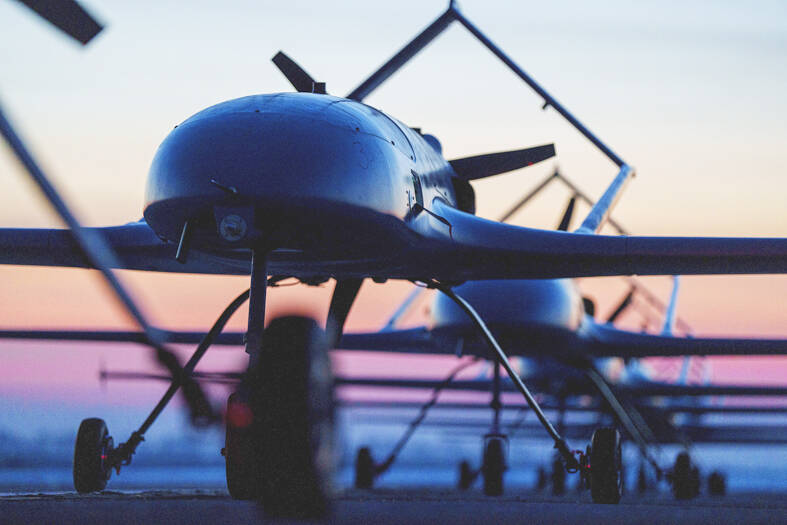
Photo: AP
He said drone wreckage hit an “oil tank, which caused a fire.”
Sochi Mayor Andrei Proshunin said there were no victims and that “the situation is totally under control,” adding that firefighters were continuing to extinguish the blaze.
Images broadcast by Russian media showed flames and a thick plume of black smoke rising from the site.
Air traffic was briefly suspended at Sochi airport, but resumed shortly afterward, Russia’s air transport regulator Rosaviatsia said.
Ukraine authorities had not commented on the fire.
Airstrikes on Sochi are relatively rare compared with some other Russian cities.
However, Ukrainian drone attacks killed two people there late last month, according to local authorities.
Kyiv said it would intensify its airstrikes against Russia in response to an increase in Russian attacks on its territory in recent weeks, which have killed dozens of civilians.
The Russian Ministry of Defense said that three Ukrainian drones had been intercepted in the Leningrad region, which includes the Baltic seaport of Saint Petersburg.
Overnight strikes by Russia inside Ukraine’s south and north also left several people injured, Ukrainian authorities said.
One missile wounded seven people in a residential district of Mykolaiv, a city near the Black Sea in southern Ukraine, according to Ukrainian Prime Minister Yulia Svyrydenko.
Three other people were injured in the northeastern Kharkiv region, she added, while local authorities also reported injuries in the Zaporizhzhia and Kherson regions in the south.
“The Russians continue to wage war not against Ukrainian forces, but against Ukrainian civilians,” Svyrydenko said.
Last week, US President Donald Trump gave Russian President Vladimir Putin a 10-day ultimatum — until Friday — to end the conflict in Ukraine.
However, the airstrikes and fighting have not abated, and the Kremlin has rejected the idea of a lasting ceasefire in Ukraine, which it sees as a gift to Kyiv’s troops.
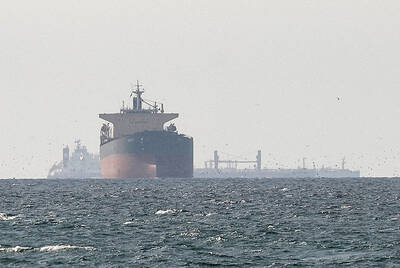
A ship that appears to be taking on the identity of a scrapped gas carrier exited the Strait of Hormuz on Friday, showing how strategies to get through the waterway are evolving as the Middle East war progresses. The vessel identifying as liquefied natural gas (LNG) carrier Jamal left the Strait on Friday morning, ship-tracking data show. However, the same tanker was also recorded as having beached at an Indian demolition yard in October last year, where it is being broken up, according to market participants and port agent’s reports. The ship claiming to be Jamal is likely a zombie vessel that
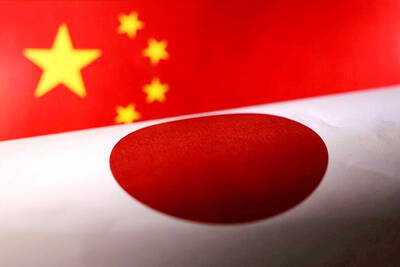
Japan is to downgrade its description of ties with China from “one of its most important” in an annual diplomatic report, according to a draft reviewed by Reuters, as relations with Beijing worsen. This year’s Diplomatic Bluebook, which Japanese Prime Minister Sanae Takaichi’s government is expected to approve next month, would instead describe China as an important neighbor and the relationship as “strategic” and “mutually beneficial.” The draft cites a series of confrontations with Beijing over the past year, including export controls on rare earths, radar lock-ons targeting Japanese military aircraft and increased pressure around Taiwan. The shift in tone underscores a deterioration
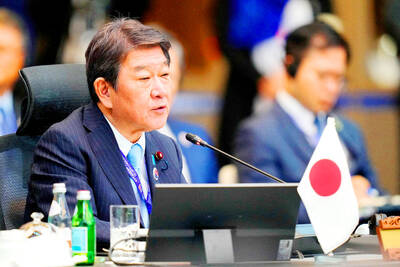
LAW CONSTRAINTS: The US has been pressing allies to send warships to open the Strait, but Tokyo’s military actions are limited under its postwar pacifist constitution Japan could consider deploying its military for minesweeping in the Strait of Hormuz if a ceasefire is reached in the war on Iran, Japanese Minister of Foreign Affairs Toshimitsu Motegi said yesterday. “If there were to be a complete ceasefire, hypothetically speaking, then things like minesweeping could come up,” Motegi said. “This is purely hypothetical, but if a ceasefire were established and naval mines were creating an obstacle, then I think that would be something to consider.” Japan’s military actions are limited under its postwar pacifist constitution, but 2015 security legislation allows Tokyo to use its Self-Defense Forces overseas if an attack,

German Chancellor Friedrich Merz’s conservative Christian Democratic Union (CDU) yesterday faced a regional election battle in Rhineland-Palatinate, now held by the center-left Social Democratic Party (SPD). Merz’s CDU has enjoyed a narrow poll lead over the SPD — their coalition partners at the national level — who have ruled the mid-sized state for 35 years. Polling third is the far-right Alternative for Germany (AfD), which spells a greater threat to the two centrist parties in several state elections in September in the country’s ex-communist east. The picturesque state of Rhineland-Palatinate, bordering France, Belgium and Luxembourg and with a population of about 4 million,


 RSS
RSS