


Thailand and Cambodia yesterday reaffirmed their shaky ceasefire violation after days of fighting along their border, as China stepped in to negotiate with the two countries.
The ceasefire reached in Malaysia was supposed to take effect at midnight on Monday, but was quickly tested. Thailand’s army accused Cambodia of launching attacks in multiple areas early on Tuesday, but Cambodia said there was no firing. The Thai army then reported exchanges of gunfire into yesterday morning, but said there was no use of heavy artillery.
“Such act of aggression constitutes once again a clear violation of the ceasefire agreement by Cambodian forces and their apparent lack of good faith,” the Thai Ministry of Foreign Affairs said in a statement yesterday morning.
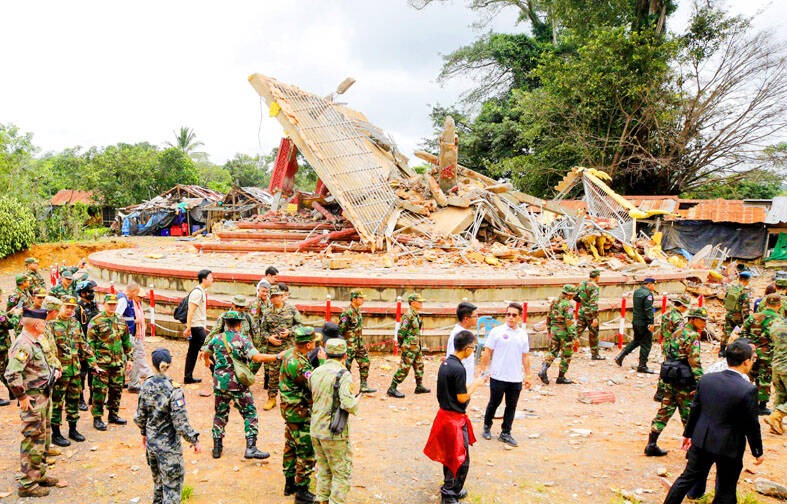
Photo: AFP
However, by yesterday afternoon, both sides appeared to have reaffirmed their commitment to a ceasefire, with representatives appearing smiling in a photograph with Chinese Vice Minister of Foreign Affairs Sun Weidong (孫衛東) at a meeting in Shanghai.
“Cambodia and Thailand reiterated to China their commitment to the ceasefire consensus and expressed appreciation for China’s positive role in de-escalating the situation,” a statement from the Chinese Ministry of Foreign Affairs said.
China said the informal meeting was its “latest diplomatic effort” and it was playing a “constructive role in resolving their border dispute,” the statement said.
The fighting on Tuesday night occurred in Phu Makhuea, a mountain in a disputed area next to Thaikand’s Sisaket province.
Cambodian Prime Minister Hun Manet and Acting Thai Prime Minister Phumtham Wechayachai on Monday agreed to an “unconditional” halt in fighting, which has killed at least 41 people.
The meeting was hosted by Malaysian Prime Minister Anwar Ibrahim as annual chair of the ASEAN. He called the ceasefire a “vital first step towards de-escalation and the restoration of peace and security.”
The ceasefire was brokered with US pressure and US Secretary of State Marco Rubio said that Washington applauded the declaration.
Hun Manet on Tuesday said that Trump had called to offer congratulations for the peace move and posted on social media that Trump pledged the US would join the monitoring process along with Malaysia to ensure the ceasefire is implemented.
Cambodia and Thailand have clashed in the past over their 800km border. The fighting began on Thursday last week after a land mine explosion along the border wounded five Thai soldiers. Tensions had been growing since May when a Cambodian soldier was killed in a confrontation that created a diplomatic rift and roiled Thailand’s domestic politics.
While some residents near the border have started returning home, many remain behind in evacuation shelters, uncertain of their fate.
Vendor Kanchana Sukjit, 33, said she fled home near the Ta Muen Thom temple with a few belongings and her small white-colored dog, Nam Khaeng, which means ice in Thai. The temple had been one of the main flash points in the conflict over the past week.
“I’m stressed when I read the news, like when reports said they were going to fire [a long-range rocket], because my home is right next to a military camp. I was quite stressed that day because I was afraid that my home would get caught in a crossfire,” she said.
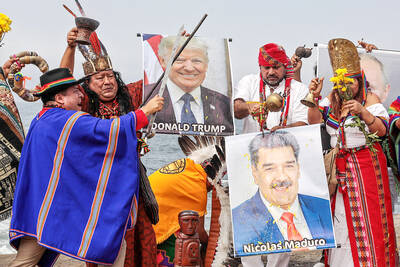
Shamans in Peru on Monday gathered for an annual New Year’s ritual where they made predictions for the year to come, including illness for US President Donald Trump and the downfall of Venezuelan President Nicolas Maduro. “The United States should prepare itself because Donald Trump will fall seriously ill,” Juan de Dios Garcia proclaimed as he gathered with other shamans on a beach in southern Lima, dressed in traditional Andean ponchos and headdresses, and sprinkling flowers on the sand. The shamans carried large posters of world leaders, over which they crossed swords and burned incense, some of which they stomped on. In this

The death of a former head of China’s one-child policy has been met not by tributes, but by castigation of the abandoned policy on social media this week. State media praised Peng Peiyun (彭珮雲), former head of China’s National Family Planning Commission from 1988 to 1998, as “an outstanding leader” in her work related to women and children. The reaction on Chinese social media to Peng’s death in Beijing on Sunday, just shy of her 96th birthday, was less positive. “Those children who were lost, naked, are waiting for you over there” in the afterlife, one person posted on China’s Sina Weibo platform. China’s
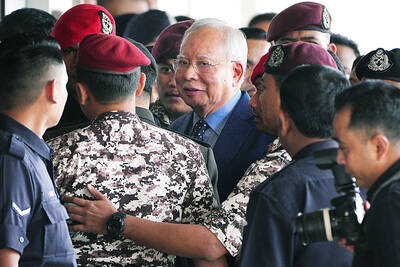
‘NO COUNTRY BUMPKIN’: The judge rejected arguments that former prime minister Najib Razak was an unwitting victim, saying Najib took steps to protect his position Imprisoned former Malaysian prime minister Najib Razak was yesterday convicted, following a corruption trial tied to multibillion-dollar looting of the 1Malaysia Development Berhad (1MDB) state investment fund. The nation’s high court found Najib, 72, guilty on four counts of abuse of power and 21 charges of money laundering related to more than US$700 million channeled into his personal bank accounts from the 1MDB fund. Najib denied any wrongdoing, and maintained the funds were a political donation from Saudi Arabia and that he had been misled by rogue financiers led by businessman Low Taek Jho. Low, thought to be the scandal’s mastermind, remains

Australian Prime Minister Anthony Albanese yesterday announced plans for a national bravery award to recognize civilians and first responders who confronted “the worst of evil” during an anti-Semitic terror attack that left 15 dead and has cast a heavy shadow over the nation’s holiday season. Albanese said he plans to establish a special honors system for those who placed themselves in harm’s way to help during the attack on a beachside Hanukkah celebration, like Ahmed al-Ahmed, a Syrian-Australian Muslim who disarmed one of the assailants before being wounded himself. Sajid Akram, who was killed by police during the Dec. 14 attack, and


 RSS
RSS