


Search and recovery teams continued scouring the site of one of India’s worst aviation disasters for a third day after the Air India flight fell from the sky and killed at least 270 people in Gujarat state, officials said yesterday.
The London-bound Boeing 787 on Thursday struck a medical college hostel in a residential area of the northwestern city of Ahmedabad minutes after takeoff, killing 241 people on board and at least 29 on the ground. One passenger survived.
Recovery teams working until late on Friday found at least 25 more bodies in the debris, officials said.
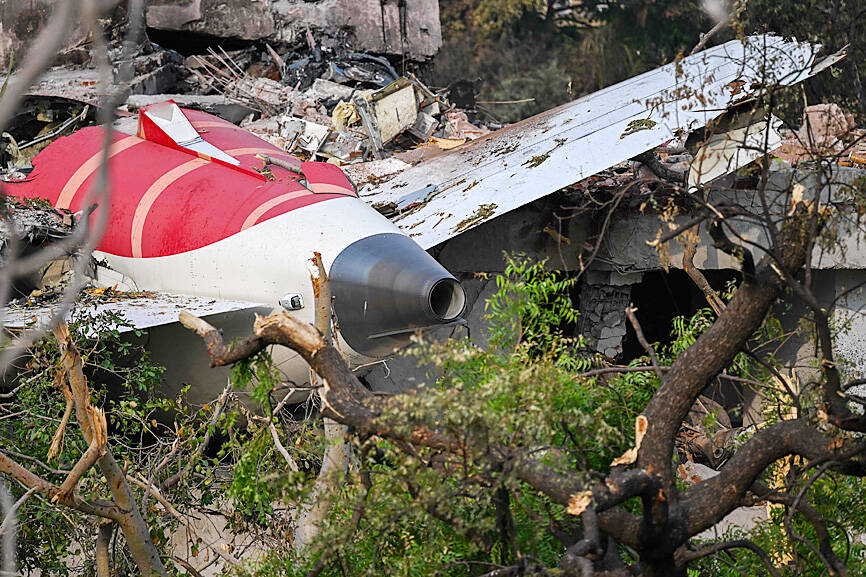
Photo: AFP
Dhaval Gameti, a doctor at the Civil Hospital in Ahmedabad, said the facility had received 270 bodies.
The lone surviving passenger was still under observation for some of his wounds, Gameti said.
“He is doing very well and will be ready to be discharged any time soon,” Gameti said yesterday.
Hundreds of relatives of the crash victims have provided DNA samples at the hospital. Most bodies were charred or mutilated, making them unrecognizable.
Some relatives yesterday expressed frustration that the process was taking too long.
Authorities say it normally takes up to 72 hours to complete DNA matching, and they are expediting the process.
“Where are my children? Did you recover them?” asked Rafiq Abdullah, whose nephew, daughter-in-law and two grandchildren were on the flight. “I will have to ask questions. Government is not answering these questions.”
Another relative persistently asked hospital staff when his relative’s body would be handed over to the family for last rites.
“Give us the body,” the relative said.
Investigators on Friday recovered the plane’s digital flight data recorder, or the black box, which was recovered from a rooftop near the crash site and is expected to lead to clues about the cause of the accident.
The Indian Aircraft Accident Investigation Bureau said it had started working with “full force” to extract the data.
The device is expected to reveal information about the engine and control settings, while the voice recorder would provide cockpit conversations, said Paul Fromme, a mechanical engineer with the UK-based Institution of Mechanical Engineers.
Aviation safety consultant Jeff Guzzetti, a former crash investigator for the US National Transportation Safety Board and Federal Aviation Administration, said investigators should be able to answer some important questions about what caused the crash as soon as next week as long as the flight data recorder is in good shape.
Investigators likely are looking at whether wing flaps were set correctly, the engine lost power, alarms were going off inside the cockpit and if the plane’s crew correctly logged information about the hot temperature outside and the weight of the fuel and passengers, Guzzetti said.
Mistakes in the data could result in the wing flaps being set incorrectly, he said.
Thursday’s Air India crash involved a 12-year-old Boeing 787. Boeing planes have been plagued by safety issues on other types of aircraft.

When a hiker fell from a 55m waterfall in wild New Zealand bush, rescuers were forced to evacuate the badly hurt woman without her dog, which could not be found. After strangers raised thousands of dollars for a search, border collie Molly was flown to safety by a helicopter pilot who was determined to reunite the pet and the owner. A week earlier, an emergency rescue helicopter found the woman with bruises and lacerations after a fall at a rocky spot at the waterfall on the South Island’s West Coast. She was airlifted on March 24, but they were forced to

HIGH HOPES: The power source is expected to have a future, as it is not dependent on the weather or light, and could be useful for places with large desalination facilities A Japanese water plant is harnessing the natural process of osmosis to generate renewable energy that could one day become a common power source. The possibility of generating power from osmosis — when water molecules pass from a less salty solution to a more salty one — has long been known. However, actually generating energy from that has proved more complicated, in part due the difficulty of designing the membrane through which the molecules pass. Engineers in Fukuoka, Japan, and their private partners think they might have cracked it, and have opened what is only the world’s second osmotic power plant. It generates

Hundreds of Filipinos and tourists flocked to a sun-bleached field north of Manila yesterday, on Good Friday, to witness one of the country’s most blood-soaked displays of religious fervor, undeterred by rising fuel prices. Scores of bare-chested flagellants with covered faces walked barefoot through the dusty streets of Pampanga Province’s San Fernando as they flogged their backs with bamboo whips in the scorching heat. Agence France-Presse (AFP) journalists said they saw devotees deliberately puncturing their skin with glass shards attached to a small wooden paddle to ensure their bleeding during the ritual, a way to atone for sins and seek miracles from

Chinese dissident artist Gao Zhen (高兟), famous for making provocative satirical sculptures of former Chinese leader Mao Zedong (毛澤東), was tried on Monday over accusations of “defaming national heroes and martyrs,” his wife and a rights group said. Gao, 69, who was detained in 2024 during a visit from the US, faces a maximum three-year prison sentence, said his wife, Zhao Yaliang (趙雅良), and Shane Yi, a researcher at the Chinese Human Rights Defenders group which operates outside the nation. The closed-door, one-day trial took place at Sanhe City People’s Court in Hebei Province neighboring the capital, Beijing, and ended without a


 RSS
RSS