


Indonesian private tutor Patricia has been learning German for two years, armed with a dream of leaving for Europe and driven by a lack of opportunities, economic stagnation and little hope at home.
She is one of thousands of Indonesians on social media promoting a popular hashtag that translates as “let’s just escape for now.”
Anger at the quality of life in Southeast Asia’s biggest economy — a nation of 280 million known for pervasive corruption and nepotism — has stirred student protests, and driven young and middle-aged professionals to seek jobs abroad.
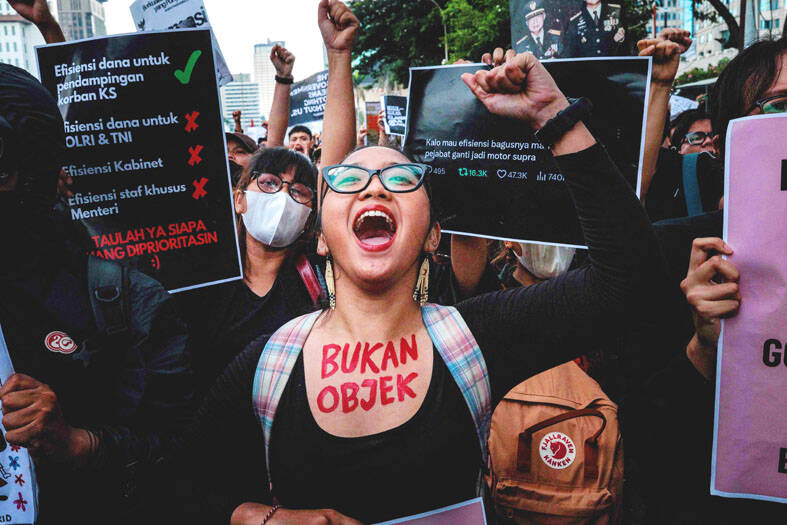
Photo: AFP
“After working for so many years, my income remains about the same ... meanwhile my needs are increasing,” said the 39-year-old in the capital, Jakarta, who declined to give her surname. “I don’t own a house or car ... if I keep working like this, it will probably never be enough.”
In the past month, the hashtag has picked up steam. It has racked up thousands of mentions and reached more than 65 million accounts, analytics firm Brand24 said.
The outpouring has coincided with student-led protests against wide-ranging government budget cuts by Indonesian President Prabowo Subianto.
Savings have been channeled into a new multibillion-dollar sovereign wealth fund — that reports to the former general.
There were nearly 7.5 million unemployed people in Indonesia in August last year, according to the latest data from the statistics agency.
That has stoked anger against a perceived poor quality of life, as the divide between the emerging nation’s rich and poor grows wider, and the middle class is squeezed.
“After many strange policies and the change of president, I have shifted to feeling like I have to move abroad. It has become a primary necessity,” said Chyntia Utami, a 26-year-old technology worker in Jakarta. “I really feel it. I don’t get social assistance, and I have limited money to spend. Working is just about surviving day by day, month by month, not working with passion.”
Some Indonesians are taking more physically demanding jobs abroad to escape.
Randy Christian Saputra, 25, left an office job at a multinational consulting firm to do manual labor on a tomato farm in Australia.
“I’m tired of the system in Indonesia. If we look abroad, they usually have a better system,” he said.
Poor living standards in Jakarta encourage others to leave.
“The longer I stay in Jakarta, the harder it is because of pollution or traffic jams. It has more to do with the living standard,” said Favian Amrullah, a 27-year-old software engineer, who is leaving for a start-up in Amsterdam next month. “I am exhausted, and feeling hopeless.”
Some foreign companies are trying to capitalize on the trend, including Japanese recruitment firms posting online seeking to attract the most talented.
Experts said social media offers Indonesians an outlet where they feel heard.
“This showed the public’s emotion,” said Ika Karlina Idris, associate professor at Monash University Indonesia.
She said the hashtag highlighted “the public’s concerns about jobs and nepotism,” as well as at “haphazard public policies.”
The uproar sparked criticism from some government ministers. One even told those who wish to leave they should not return.
“Just run away, if necessary, don’t come back,” Indonesian Deputy Minister of Manpower Immanuel Ebenezer told a reporter last month.
He did not immediately respond to a request for comment.
Pro-Prabowo influencers have also spread disinformation, aiming to undermine the credibility of protesters. A fact check team found more than a dozen TikTok videos pushing the baseless claim that student protesters are “paid,” which attracted more than 8 million views.
Pro-government and pro-Prabowo content creators then posted reaction videos amplifying the misinformation on YouTube and TikTok, garnering more than 2 million views.
Patricia remains undeterred, applying for a volunteer post in Germany in the hope that she can find a paid job once there.
“I want to fight there for a better job, life, a better income,” she said. “When I have a place there ... no, I won’t be returning to Indonesia.”

Crowds in Bangladesh are flocking to snap photographs with an unlikely social media star — an albino buffalo with flowing blond hair nicknamed “Donald Trump” that is due to be sacrificed within days. Owner Zia Uddin Mridha, 38, said his brother named the 700kg bull over its flowing helmet of hair resembling the signature look of the US president. “My younger brother picked this name because of the buffalo’s extraordinary hair,” he said at his farm in Narayanganj, just outside the capital, Dhaka. Mridha said that a constant stream of curious visitors — social media fans, onlookers and children — have come throughout

It began as a satirical online project. Now millions of young people in India are flocking to it as an outlet for their frustration. A parody political party called the Cockroach Janta Party, with the insect as its symbol, has exploded across India’s social media by turning absurdist humor into protest. Memes and short videos mocking corruption, joblessness and political dysfunction have flooded social media sites, where millions of users are embracing the cockroach — known for its ability to survive harsh conditions — as a tongue-in-cheek symbol of endurance. The online movement’s rise has been unusually rapid. The Cockroach Janta Party (CJP)

BIGGER ROLE: Beijing has said it maintains an impartial stance on the war in Ukraine, but by training Russian troops, China is far more involved than previously known China’s armed forces secretly trained about 200 Russian military personnel in China late last year, and some have since returned to fight in Ukraine, according to three European intelligence agencies and documents seen by Reuters. While China and Russia have held a number of joint military exercises since Moscow’s full-scale invasion of Ukraine in 2022, Beijing has repeatedly said that it is neutral in the conflict and presents itself as a peace mediator. The covert training sessions, which predominantly focused on the use of drones, were outlined in a dual-language Russian-Chinese agreement signed by senior Russian and Chinese officers in Beijing on
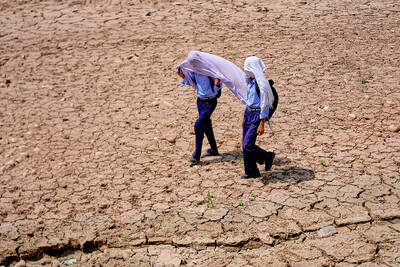
HOTTER: While Indians are accustomed to summer heat, climate change has caused northwestern India to warm faster than other parts of the country, an academic said Roads and markets have emptied during afternoons and some farmers have switched to nighttime work to avoid scorching temperatures as a heat wave grips large parts of India. The India Meteorological Department forecast maximum temperatures for yesterday of about 45°C in the capital, New Delhi, where authorities have opened temporary “cooling zones” to help people cope. The weather department warned that conditions would likely persist across several northern regions in the coming days, with temperatures staying well above seasonal averages. Authorities urged people to stay indoors during the hottest hours and take precautions against heat-related illnesses. India declares a heat wave whenever maximum temperatures


 RSS
RSS