


The British Museum said it had closed a number of exhibits after a fired information technology (IT) contractor “shut down” some of its systems, in one of several unrelated incidents targeting European museums on Saturday.
The London venue, one of the UK capital’s biggest tourist draws and best known for housing the Rosetta Stone and the Parthenon Marbles, said police had arrested the suspect.
“An IT contractor who was dismissed last week trespassed into the museum and shut down several of our systems,” a museum spokesman said. “We are working hard to get the museum back to being fully operational, but with regret our temporary exhibitions have been closed today and will remain so over the weekend.”
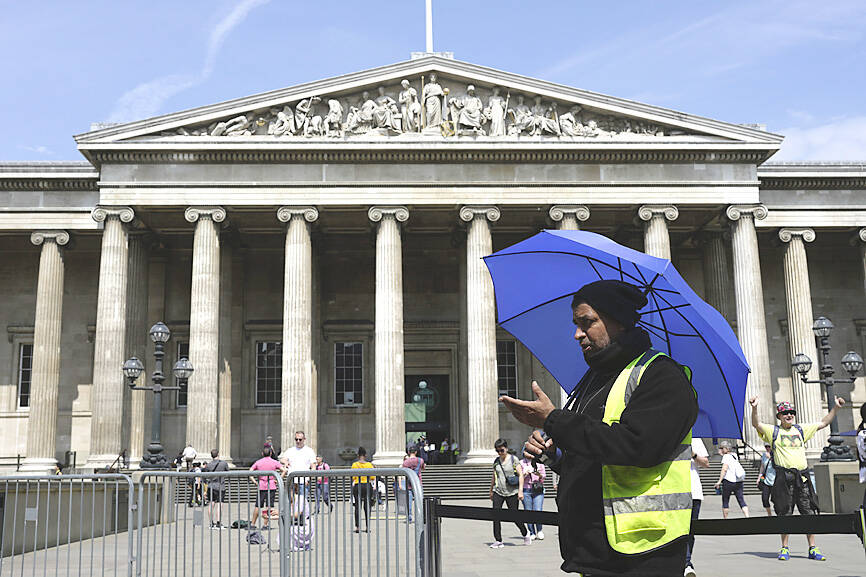
Photo: AP
Meanwhile in the Netherlands, the Drents Museum in Assen said it was closed for the weekend after robbers used explosives to break in and steal three antique bracelets and a gold helmet.
Police were alerted to an explosion early on Saturday, with the thieves stealing the golden helmet of Cotofenesti, dating from the mid-fifth century BC, the museum said on its Web site.
The helmet — the centerpiece of a temporary exhibition — was on loan from Romania’s National History Museum in Bucharest.
In Paris, the world-famous Orsay Museum was forced to disable its own ticketing system for several hours on Friday after falling victim to a fraudulent scheme involving “mirror sites,” it said on Saturday.
The museum, home to works by Vincent van Gogh and other master painters, was on Friday alerted that visitors trying to buy tickets online were being redirected without realizing it to bogus ticket sales Web sites.
After suspending online ticketing services for some of Friday, operations were back to normal Saturday, it said.
A spokesperson for London’s Metropolitan Police said officers responded to the British Museum late on Thursday following reports that a man on-site had “caused damage” to its security and IT systems.
Police arrested the man in his 50s at the scene on suspicion of burglary and criminal damage.
He has been bailed “pending further enquiries,” the spokesperson added.
Part of the museum’s permanent collection was also closed on Friday following the incident, Britain’s Press Association news agency reported.
A message on the museum’s Web site on Saturday said that it was “open, but due to an IT infrastructure issue some galleries have had to be closed.”
The incident is the latest embarrassing security lapse for the museum after allegations emerged in 2023 that a former employee was suspected of selling items stolen from its vast collection.
About 1,800 objects were disclosed as missing or stolen in August 2023.
The museum dismissed a staff member suspected of involvement in what it called “an inside job,” and alerted police who have interviewed a person but made no arrests.
Hundreds of the items have since been recovered.
Following a furor around that scandal, Hartwig Fischer, the director of the museum at the time, resigned.
After a temporary head was appointed, Nicholas Cullinan — who was previously in charge of the National Portrait Gallery — took over the role last year.

Crowds in Bangladesh are flocking to snap photographs with an unlikely social media star — an albino buffalo with flowing blond hair nicknamed “Donald Trump” that is due to be sacrificed within days. Owner Zia Uddin Mridha, 38, said his brother named the 700kg bull over its flowing helmet of hair resembling the signature look of the US president. “My younger brother picked this name because of the buffalo’s extraordinary hair,” he said at his farm in Narayanganj, just outside the capital, Dhaka. Mridha said that a constant stream of curious visitors — social media fans, onlookers and children — have come throughout

It began as a satirical online project. Now millions of young people in India are flocking to it as an outlet for their frustration. A parody political party called the Cockroach Janta Party, with the insect as its symbol, has exploded across India’s social media by turning absurdist humor into protest. Memes and short videos mocking corruption, joblessness and political dysfunction have flooded social media sites, where millions of users are embracing the cockroach — known for its ability to survive harsh conditions — as a tongue-in-cheek symbol of endurance. The online movement’s rise has been unusually rapid. The Cockroach Janta Party (CJP)

HOTTER: While Indians are accustomed to summer heat, climate change has caused northwestern India to warm faster than other parts of the country, an academic said Roads and markets have emptied during afternoons and some farmers have switched to nighttime work to avoid scorching temperatures as a heat wave grips large parts of India. The India Meteorological Department forecast maximum temperatures for yesterday of about 45°C in the capital, New Delhi, where authorities have opened temporary “cooling zones” to help people cope. The weather department warned that conditions would likely persist across several northern regions in the coming days, with temperatures staying well above seasonal averages. Authorities urged people to stay indoors during the hottest hours and take precautions against heat-related illnesses. India declares a heat wave whenever maximum temperatures
BIGGER ROLE: Beijing has said it maintains an impartial stance on the war in Ukraine, but by training Russian troops, China is far more involved than previously known China’s armed forces secretly trained about 200 Russian military personnel in China late last year, and some have since returned to fight in Ukraine, according to three European intelligence agencies and documents seen by Reuters. While China and Russia have held a number of joint military exercises since Moscow’s full-scale invasion of Ukraine in 2022, Beijing has repeatedly said that it is neutral in the conflict and presents itself as a peace mediator. The covert training sessions, which predominantly focused on the use of drones, were outlined in a dual-language Russian-Chinese agreement signed by senior Russian and Chinese officers in Beijing on


 RSS
RSS