


The decorated Green Beret who died by suicide in a blazing Cybertruck outside a Trump hotel in Las Vegas had post-traumatic stress disorder (PTSD), investigators said on Friday, saying they had found no links to “terrorist” groups.
Matthew Livelsberger, 37, a member of the elite US special forces, shot himself on New Year’s Day in the rented Tesla vehicle filled with fuel containers and fireworks, which exploded. Seven people nearby in the valet area of the glass-fronted Trump International Hotel were wounded in the blast.
“Although this incident is more public and more sensational than usual, it ultimately appears to be a tragic case of suicide involving a heavily decorated combat veteran who was struggling with PTSD and other issues,” FBI Special Agent Spencer Evans told a news conference on Friday.
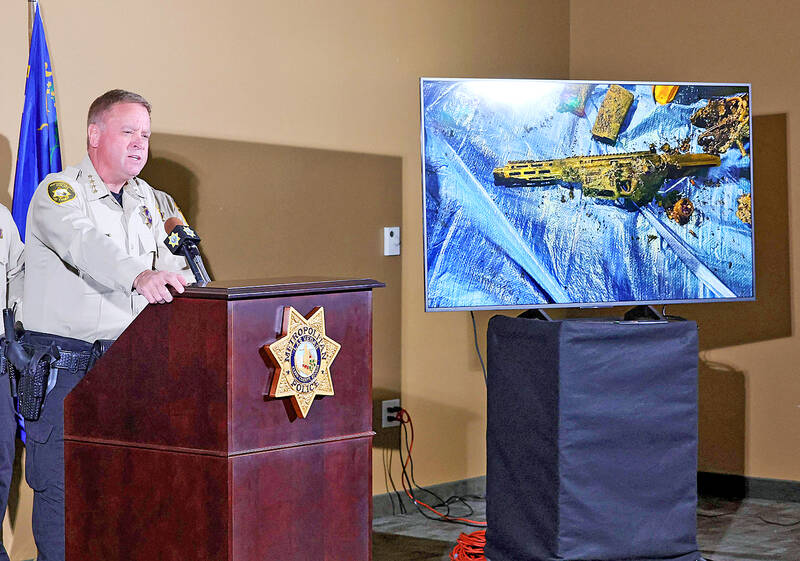
Photo: AFP
Investigators said that they were still examining Livelsberger’s devices, but that so far they had found two letters on his phone in which he spoke of the “burden” of having taken lives, among other issues.
Though the truck exploded outside the Trump-branded hotel in Las Vegas, part-owned by US president-elect Donald Trump’s family business, Livelsberger “held no animosity” toward the Republican, Evans said.
He said investigators have “not identified any connection between this subject and any other terrorist organization.”
Some personal and family issues might have contributed to the incident, he said.
Livelsberger’s body was burned beyond recognition, but Las Vegas Sheriff Kevin McMahill said authorities had confirmed via dental records and DNA that he was indeed the person who died inside the Cybertruck.
He said investigators were still working to establish the exact sequence of events in the Cybertruck, but for now it appeared that Livelsberger shooting himself dead and the blast which ignited the truck were “simultaneous.”
Evans also said again that investigators have found no link between the blast and the deadly attack in New Orleans which also took place on Wednesday.
In that attack, a US army veteran loyal to the Islamic State rammed a crowd of New Year’s revelers with a truck, killing 14 before being shot dead by police.
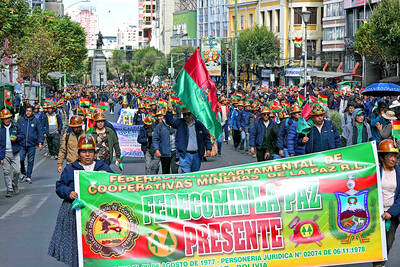
The Bolivian government on Friday struck a deal with protesting miners, but was still grappling with blockades and demonstrations by other workers across La Paz. Other groups are still blocking access roads into the city, which is also the seat of the government. Police on Thursday prevented the miners from entering the main square by using tear gas, while the demonstrators hurled stones and explosives with slingshots. Protests against the policies of Bolivian President Rodrigo Paz have convulsed the Andean nation since early this month, and roadblocks were choking routes into La Paz throughout Friday, the national road authority said. Miners demanded that Paz
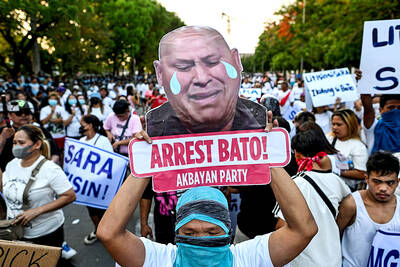
The Philippines said it has asked the country’s Supreme Court to allow it to arrest former Philippine president Rodrigo Duterte’s chief drug war enforcer to stand trial in an international tribunal. The International Criminal Court (ICC) last week unsealed an arrest warrant against Philippine Senator Ronald dela Rosa, accusing him along with Duterte and other “coperpetrators” of the “crime against humanity of murder.” Dela Rosa briefly sought refuge in the Philippine Senate last week while asking the Philippine Supreme Court to stop an ongoing attempt by government agents to arrest him. “By his own conduct, he has placed himself outside the protection of

A ship anchored off the United Arab Emirates (UAE) was seized and taken toward Iran and another — a cargo ship near Oman — sank after being attacked, authorities said on Thursday, as tensions escalated near the Strait of Hormuz. It was not immediately clear who was behind these incidents, but they happened as a senior Iranian official reiterated his country’s claim of control over the waterway and another said it had a right to seize oil tankers connected to the US. The turmoil in the strait has been a sticking point for weeks in talks between the US and Iran to
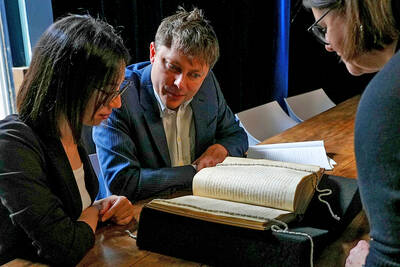
The researchers in Ireland looked at their computer screen, marveling at a medieval book tracked down in a Roman library. They flipped through its digitized pages and found their sought-after treasure: the oldest surviving English poem. “We were extremely surprised. We were speechless. We couldn’t believe our eyes when we first saw that,” said Elisabetta Magnanti, a visiting research fellow at Trinity College Dublin’s school of English. The poem was also within the main body of Latin text, she said, calling it “extraordinary.” Composed in Old English by a Northumbrian agricultural worker in the 7th century, Caedmon’s Hymn appears within some copies of


 RSS
RSS