


A Canadian man detained by China for more than 1,000 days said he was put into solitary confinement for months and interrogated for up to nine hours every day, treatment he said amounted to psychological torture.
Michael Kovrig, speaking to Canadian Broadcasting Corp in an interview released on Monday, also said that he had missed the birth of his daughter and only met her for the first time when she was two-and-a-half years old.
Kovrig and fellow Canadian Michael Spavor were taken into custody in December 2018 shortly after Canadian police detained Meng Wanzhou (孟晚舟), chief financial officer of Chinese telecoms equipment giant Huawei, on a US warrant. Both men were accused of spying.
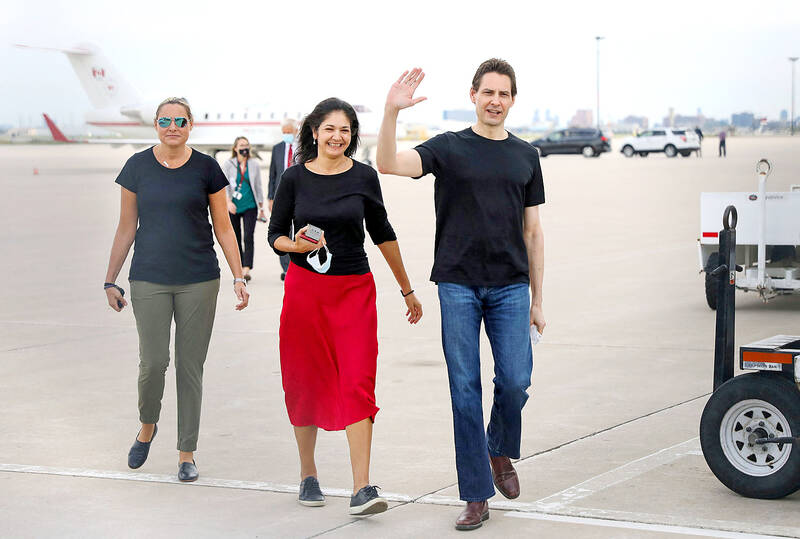
Photo: Reuters
“I still carry a lot of pain around with me and that can be heavy at times,” Kovrig said in his first substantial comments since he and Spavor were released in September 2021.
Kovrig said that UN guidelines say prisoners should not be put into solitary confinement for more than 15 consecutive days.
“More than that is considered psychological torture. I was there for nearly six months,” said Kovrig, a former diplomat who had been working as an adviser with a think tank when arrested.
Kovrig said there was no daylight in the solitary cell, where the fluorescent lights were kept on 24 hours a day. At one point, his food ration was cut to three bowls of rice a day.
“It was psychologically absolutely, the most grueling, painful thing I’ve ever been through,” he said. “It’s a combination of solitary confinement, total isolation and relentless interrogation for six to nine hours every day. They are trying to bully and torment and terrorize and coerce you ... into accepting their false version of reality.”
Kovrig and Spavor were released on the same day that the US Department of Justice dropped its extradition request for Meng and she returned to China.
The Chinese embassy in Ottawa, responding to Kovrig’s interview, said he and Spavor had been suspected of engaging in activities endangering China’s national security.
Chinese judicial authorities handled the cases in strict accordance with the law, it said in a statement.
Bilateral ties are chilly. China this month opened a one-year anti-dumping investigation into imports of rapeseed from Canada, just weeks after Ottawa announced 100 percent tariffs on Chinese electric vehicles.
Kovrig’s partner was six months pregnant at the time of his arrest. She played their daughter recordings of his voice and showed pictures of her father so she would recognize him when they finally met.
“I’ll never forget that sense of wonder, of everything being new and wonderful again, and pushing my daughter on a swing that had her saying to her mother: ‘Mummy, I’m so happy,’” he said.
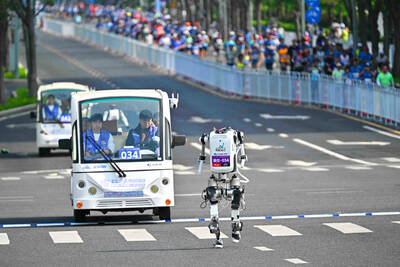
A humanoid robot that won a half-marathon race for robots in Beijing on Sunday ran faster than the human world record in a show of China’s technological leaps. The winner from Honor, a Chinese smartphone maker, completed the 21km race in 50 minutes and 26 seconds, said a WeChat post by the Beijing Economic-Technological Development Area, also known as Beijing E-Town, where the race began. That was faster than the human world record holder, Ugandan Jacob Kiplimo, who finished the same distance in about 57 minutes in March at the Lisbon road race. The performance by the robot marked a significant step forward
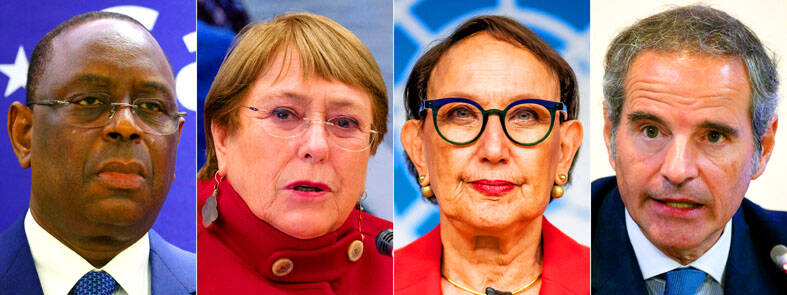
Four contenders are squaring up to succeed Antonio Guterres as secretary-general of the UN, which faces unprecedented global instability, wars and its own crushing budget crisis. Chile’s Michelle Bachelet, Argentina’s Rafael Grossi, Costa Rica’s Rebeca Grynspan and Senegal’s Macky Sall are each to face grillings by 193 member states and non-governmental organizations for three hours today and tomorrow. It is only the second time the UN has held a public question-and-answer, a format created in 2016 to boost transparency. Ultimately the five permanent members of the UN’s top body, the Security Council, hold the power, wielding vetoes over who leads the
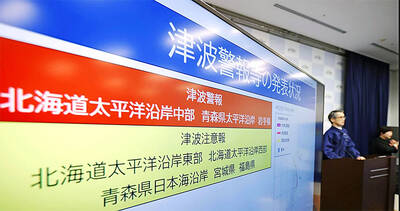
An earthquake registering a preliminary magnitude of 7.7 off northern Japan on Monday prompted a short-lived tsunami alert and the advisory of a higher risk of a possible mega-quake for coastal areas there. The Cabinet Office and the Japan Meteorological Agency said there was a 1% chance for a mega-quake, compared to a 0.1% chance during normal times, in the next week or so following the powerful quake near the Chishima and Japan trenches. Officials said the advisory was not a quake prediction but urged residents in 182 towns along the northeastern coasts to raise their preparedness while continuing their daily lives. Prime
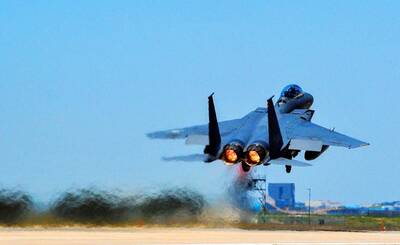
South Korea’s air force yesterday apologized for a 2021 midair collision involving two fighter jets, a day after auditors said the pilots were taking selfies and filming during the flight and held them responsible for the accident. “We sincerely apologize to the public for the concern caused by the accident that occurred in 2021,” an air force spokesman told a news conference, adding that one of the pilots involved had been suspended from flying duties, received severe disciplinary action and has since left the military. The apology followed a report released on Wednesday by the South Korean Board of Audit and Inspection,


 RSS
RSS