


Protests in Indonesia over rising living costs and inequality intensified overnight, prompting Indonesian President Prabowo Subianto to cancel a planned trip to China, while demonstrators reportedly targeted the homes of the finance minister and several lawmakers.
Rioters entered Indonesian Minister of Finance Sri Mulyani Indrawati’s residence near Jakarta early yesterday, but were repelled by armed forces personnel, Kompas reported.
Items were taken from the homes of lawmaker Ahmad Sahroni and two others, according to Detik.com.

Photo: AFP
The reports of looting could not be independently verified, and the finance ministry has not responded to requests for comment.
The protests were sparked by outrage over lawmakers’ housing allowances — nearly 10 times the monthly minimum wage — and fueled by tax hikes, mass layoffs, and inflation that have disproportionately hit lower-income Indonesians. The death of a motorcycle taxi driver, Affan Kurniawan, who was run over by a police vehicle during a rally, further inflamed tensions.
Prabowo scrapped plans on Saturday night to attend a security summit in China, underlining the government’s growing concern about the demonstrations that have rocked the nation in the past week and hurt stocks and the rupiah.
The president has ordered firm measures against “anarchic acts,” Indonesian National Police Chief Listyo Sigit Prabowo said on television on Saturday, speaking alongside Indonesian military commander Agus Subiyanto.
“The rights to peaceful assembly should be respected and protected. But we cannot deny that there are signs of actions outside the law, even against the law, even leaning towards treason and terrorism,” Prabowo said yesterday in a speech at the presidential palace in Jakarta, instructing security forces to crack down on the unrest.
Embassies in Jakarta, including those of the US, Japan, Australia and Singapore, issued warnings for their citizens in Indonesia to avoid crowds and protest areas.
The situation is “indeed very concerning,” said Rajeev De Mello, global macro portfolio manager at Gama Asset Management. “We expect this to translate into heightened volatility for the rupiah and broader Indonesian assets, as markets reassess both political risk and policy continuity.”
In a move to ease tensions, Indonesia’s Democratic Party of Struggle and Gerindra issued separate statements over the weekend pledging to scrap or review a controversial monthly housing allowance of 50 million rupiah (US$3,030) along with other perks deemed excessive.
Prabowo yesterday in his speech said that parliament would revoke hefty lawmaker allowances and place a moratorium on overseas visits, adding that political parties are also taking firm action against their erring parliament members effective today.
“A worsening economy, spending cuts, corruption — no one believes that anything good is being done to fix those issues and the feeling is Parliament has lost touch with the people,” said Vedi Hadiz, director of the Asia Institute at the University of Melbourne. “These are the organic grievances of the people.”
While calm prevailed in Jakarta’s Chinatown — a historic flashpoint for unrest that fueled the 1998 riots and led to the fall of former Indonesian president Suharto — businesses took precautions. Armored personnel carriers were stationed outside major shopping centers, and a nearby BMW showroom, ransacked during the 1998 violence, pulled its cars from display. In downtown Jakarta, a Toyota showroom also removed vehicles from public view.
Police also blocked road access to the Sudirman Central Business District, the location of the Indonesian Stock Exchange building and headquarters of several international banks.
Protests in major cities have turned deadly, with at least three people killed in Makassar, and dozens of buildings and public facilities destroyed, despite the president’s earlier plea for calm. In response to the escalating violence, TikTok announced it has “voluntarily” suspended its Live feature.
While citizens have the right to expression and assembly, “demonstrations currently taking place in several regions tend to violate” the law, police chief Listyo said, citing the burning of buildings and public facilities and the attacks on police headquarters.
Indonesia’s equity benchmark has retreated from a record and was the world’s worst-performing primary index on Friday after it dropped 1.5 percent.

An American scientist convicted of lying to US authorities about payments from China while he was at Harvard University has rebuilt his research lab in Shenzhen, China, to pursue technology the Chinese government has identified as a national priority: embedding electronics into the human brain. Charles Lieber, 67, is among the world’s leading researchers in brain-computer interfaces. The technology has shown promise in treating conditions such as amyotrophic lateral sclerosis and restoring movement in paralyzed people. It also has potential military applications: Scientists at the Chinese People’s Liberation Army have investigated brain interfaces as a way to engineer super soldiers by boosting

Indonesian police have arrested 13 people after shocking images of alleged abuse against small children at a daycare center went viral, sparking outrage across the nation, officials said on Monday. Police on Friday last week raided Little Aresha, a daycare center in Yogyakarta on Java island, following a report from a former employee. CCTV footage circulating on social media showed children, most younger than two, lying on the floor wearing only diapers, their hands and feet bound with rags. The police have confirmed that the footage is authentic. Police said they also found 20 children crammed into a room just 3m by 3m. “So

A grieving mother has ended her life at a clinic in Switzerland four years after the death of her only child. Wendy Duffy, 56, a physically healthy woman, died at the Pegasos clinic in Basel after struggling to cope with the death of her 23-year-old son, Marcus. The former care worker, from the West Midlands, England, had previously attempted to take her own life. The case comes as assisted dying would not become law in England and Wales after proposed legislation, branded “hopelessly flawed” by opponents, ran out of time. Ruedi Habegger, the founder of Pegasos, described Duffy’s death as
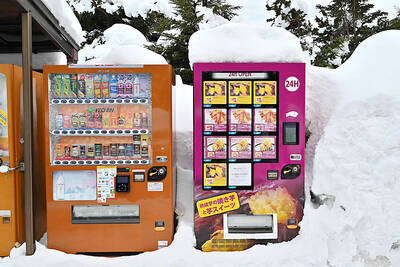
From post offices and parks to stations and even the summit of Mount Fuji, Japan’s vending machines are ubiquitous, but with the rapid pace of inflation cooling demand for their drinks, operators are being forced to rethink the business. Last month beverage giant DyDo Group Holdings announced it would remove about 20,000 vending machines — about 7 percent of their stock nationwide — by January next year, to “reconstruct a profitable network.” Pokka Sapporo Food & Beverage, based in Nagoya, also said last month it would sell its 40,000-machine operation to Osaka-based Lifedrink Co. “The strength of the vending machine


 RSS
RSS