


Malaysia is inviting countries that buy its palm oil to adopt orangutans, but leave them in their natural habitat, local media reported, tweaking a plan that originally sought to send some abroad.
In a scheme modeled on China’s “panda diplomacy,” Malaysia in May announced that it would send the great apes as gifts to palm oil-purchasing countries, sparking an outcry among conservationists.
The International Union for Conservation of Nature lists orangutans as critically endangered, as they have lost habitat to logging and agricultural expansion, particularly palm oil plantations.
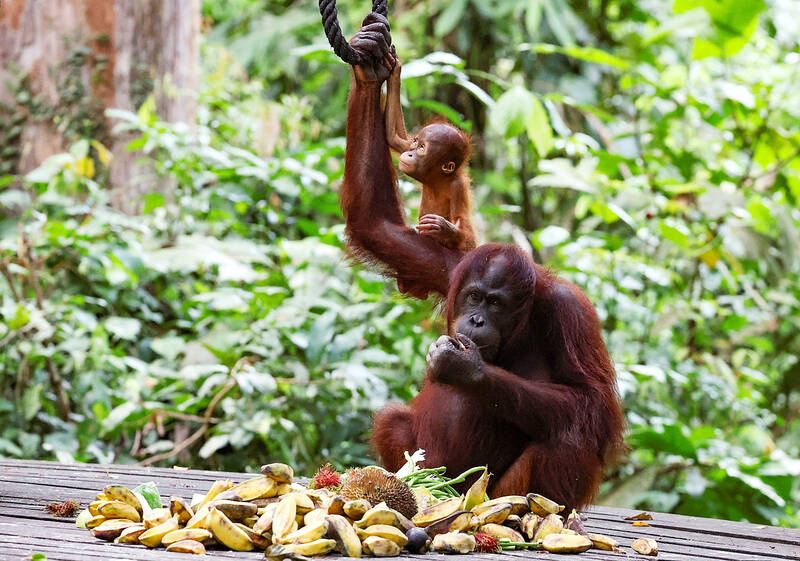
Photo: Reuters
On Sunday, Malaysian Plantation and Commodities Minister Johari Abdul Ghani said any orangutans that were adopted would stay in Malaysia, the official Bernama news agency and other local media reported.
“All conservation activities will be carried out in forest areas or forest patches in oil palm plantations with high conservation value,” Bernama quoted him as saying.
These “areas provide space for orangutans to move freely, find food and reproduce without interference from humans or other activities,” he said.
Buyers of Malaysian palm oil from around the world can “sponsor” one or more orangutans, and the funds collected are to be used to implement conservation programs for the animals, the Star newspaper quoted the minister as saying.
The programs include “collaborating with a team of rangers, comprising experts, to monitor the presence, safety and condition of these wild animals,” he said.
Beijing’s panda diplomacy, to which the scheme has been widely compared, has long served as a source of soft power, with pandas loaned to foreign zoos under strict conditions, including returning any offspring to join China’s breeding program.

A US YouTuber who caused outrage for filming himself kissing a statue commemorating Korean wartime sex slaves has been sentenced to six months in prison, a court in Seoul said yesterday. Johnny Somali, 25, gained notoriety several years ago for recording himself doing a series of provocative stunts in South Korea and Japan, and streaming them on platforms such as YouTube and Twitch. South Korean authorities indicted Somali — whose real name is Ramsey Khalid Ismael — in 2024 on public order violations and obstruction of business, and banned him from leaving the country. “The court has sentenced him to six months in

Former Lima mayor Rafael Lopez Aliaga, a Peruvian presidential hopeful, gathered hundreds of supporters in Lima on Tuesday and gave authorities 24 hours to annul the first round of the country’s election over allegations of fraud. Lopez Aliaga is locked in a tight three-way race with two other candidates for second place in Sunday’s vote. The election runner-up wins a ticket to June’s presidential run-off against front-runner Keiko Fujimori. “I am giving them 24 hours to declare this electoral fraud null and void,” said Lopez Aliaga, surrounded by a crowd of several hundred supporters. “If it is not declared null and void tomorrow,

PAPAL RETORT: Pope Leo told reporters that he has ‘no fear, neither of the Trump administration nor speaking out loudly about the message of the Gospel’ US President Donald Trump has feuded with Pope Leo XIV over the Iran conflict — setting off an unholy row that could have serious political implications for the Republican leader back in the US. Trump has drawn barbs even from some allies over the attacks on the US-born pontiff, who has criticized the Trump administration over its immigration crackdown, the intervention in Venezuela and the Iran war. The president risks alienating the religious right in November’s crucial US midterm elections. So far the unprecedented clash between the leader of the most powerful military on Earth and the head of the world’s 1.4 billion

A 16-year-old boy has been charged with murder and aggravated sexual abuse in Florida in the death of his 18-year-old stepsister on a Carnival Cruise ship, the US Department of Justice said on Monday. Timothy Hudson was initially charged in February and subsequently indicted on March 10, but the breadth of the case was not known until a seal was lifted on Friday last week, weeks after US District Judge Beth Bloom in Miami said that he would be prosecuted as an adult at the request of the government. Anna Kepner had been traveling on the Carnival Horizon ship in November last


 RSS
RSS