


Communist Party of Vietnam General Secretary To Lam is seeking to combine his party role with the state presidency, officials said, in a move that would align Vietnam’s political structure more closely to China’s, where President Xi Jinping (習近平) heads the party and state.
Next week about 1,600 delegates are to gather in Hanoi to commence a week-long communist party congress, held every five years to select new leaders and set policy goals for the single-party state.
Lam, 68, bade for both top positions at a party meeting last month, seeking initial party approval ahead of the congress, three people briefed by the delegates and another three officials familiar with the matter said.
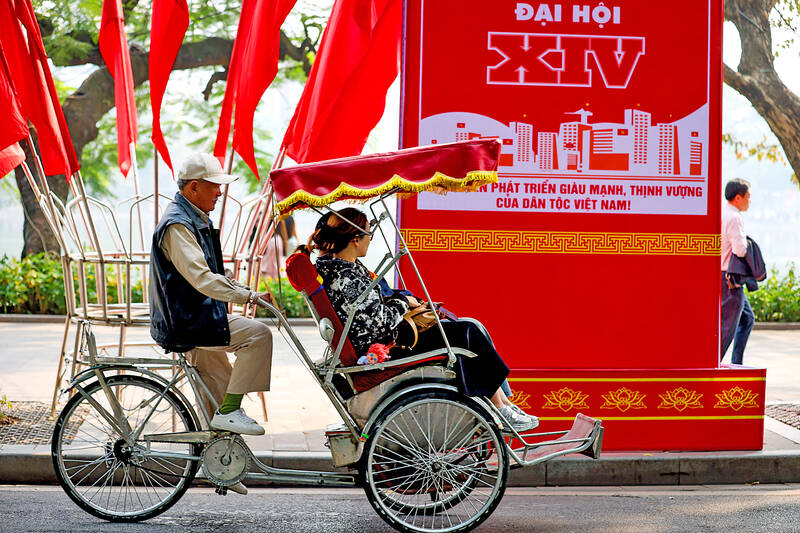
Photo: EPA
While the sources said the party meeting backed Lam to remain party chief, the three people briefed by delegates gave differing accounts on the question of the presidency, a largely ceremonial role, but one currently held by the military.
Two said Lam won support for his bid, while the third said the conclusion was unclear. In any case, the final decision rests with delegates who are to be elected at the congress.
The party’s secretariat did not immediately reply to a request for comment.
The combination of the two top jobs for the next five years would mark a significant departure from Vietnam’s traditional power-sharing model. Only in exceptional periods after the death of incumbents have the positions been merged, including in 2024, when Lam held both positions for about three months.
Should Lam succeed, the military, a powerful faction within the party, would give up the presidency in exchange for maintaining a broad autonomy over the promotion of its senior officers, two sources said.
One official said military leaders are negotiating “safeguards” to limit Lam’s authority. The Ministry of National Defense was not immediately available for comment.
In possible signs of early concessions, some controversial economic policies pursued under Lam’s first term were revised or faced unexpected hurdles ahead of the congress, including on credit growth and a high-speed railway.
Supporters of combining the two roles say that all other communist countries — China, North Korea, Cuba and Laos — vest both positions in a single leader, adding that the move would bolster Lam’s economic reform agenda and strengthen his standing in meetings with foreign leaders.
Skeptics see the change as emboldening a leader seen as a risk-taker who has already vastly expanded the powers of the security apparatus.
The merger would be “the natural outcome of streamlining Vietnam’s political structure,” said Carl Thayer, a senior expert on Vietnam at the Australian Defence Force Academy, adding that Lam has already effectively taken over some of the president’s powers with frequent overseas trips last year.
Starting on Monday next week, the weeklong congress is to elect 200 members of the new central committee, with a large number of newcomers expected to join, raising questions about whether they would confirm decisions made by the roughly 140 delegates who voted last month.
The central committee will elect the party chief and the politburo.
Lam in July last year said the new politburo would have 17 to 19 members, but the size would depend on delegates’ votes on a pre-arranged shortlist.
The politburo will then nominate the president, prime minister and speaker of the parliament, whose appointments lawmakers must confirm.

SPEAKING OUT: After Siranudh Scott’s allegations surfaced, celebrities and public figures took to social media to share their own experiences of sexual misconduct and abuse A high-profile alleged sexual abuse case within a wealthy Thai beer brewing family has prompted a wave of painful accounts from survivors of unconnected abuse in the conservative nation. Siranudh Scott, a member of the billionaire Thai family that founded the ubiquitous Singha beer brand, posted an emotional video this month accusing his elder brother Sunit of repeatedly abusing him when he was a teenager. Sunit, who is in his 30s, later denied the allegations in a video posted online, but Singha parent Boonrawd dismissed him from his executive role with the company on Tuesday last week. “I felt I needed to speak

SEEKING ORDER: Rodrigo Paz said that ‘anyone who wants to destroy the nation will have to deal with this president and the full force of the constitution’ Bolivian President Rodrigo Paz on Wednesday said that the nation was at a “breaking point” after nearly a month of protests that have caused shortages of food, fuel and medicine. Paz, who took office six months ago amid the worst economic crisis there in four decades, is battling a groundswell of fury over his policies. The political capital, La Paz, has been besieged by low-income workers and members of the indigenous majority calling for his resignation. “The country needs order and is reaching breaking point,” the 58-year-old said at a public event in La Paz, renewing his appeal for dialogue. On Tuesday, the Bolivian
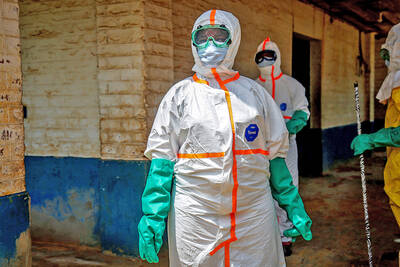
COMMUNITY CONFLICT: Concerns about disease spread from corpses has run up against friends and families’ desire to bury their dead as infection spreads in the area Angry residents of a town at the epicenter of the Ebola outbreak in the Democratic Republic of the Congo (DR Congo) attacked and burned a tent that was part of a health center where people are being treated for the virus, the staff there said Saturday. It was the second such attack in the region in a week. No one was hurt in the attack, according to reports but as patients ran out to escape the fire, 18 people with suspected Ebola infections fled the facility and are unaccounted for, a hospital director said. Angry residents arrived at the clinic in the
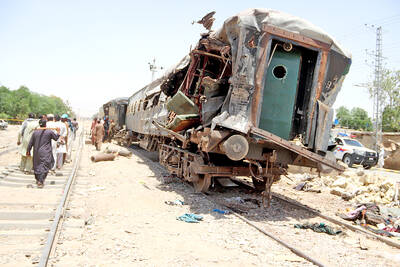
INSURGENT ACTION: A local independence movement in Balochistan, alleged by Pakistan’s government to be backed by India, claimed responsibility for the strike A suicide bomber detonated an vehicle-borne IED near a railway as a passenger train passed through the southwestern Pakistani city of Quetta yesterday, killing at least 23 people and wounding over 70, officials said. The explosion caused two of the train cars to overturn and catch fire, according to footage shared online. The attack happened in an area where security forces are usually stationed, badly damaging several nearby buildings and smashing more than a dozen vehicles parked along the road, according to witnesses and images circulating on social media. Doctors at local hospitals said they had received the wounded, with 20 in critical


 RSS
RSS