


North Korea’s top diplomat said her country is “ready to greet” Russian President Vladimir Putin, North Korean state media reported yesterday, in the latest sign of deepening ties between the two authoritarian states.
Traditional allies Russia and North Korea have recently boosted ties, with North Korean leader Kim Jong-un making a rare overseas trip to Russia in September last year to meet Putin.
The West has accused Moscow and Pyongyang of working together to support Russia’s invasion of Ukraine, with North Korea believed to have sent hundreds of thousands of artillery shells and weapons to its ally.
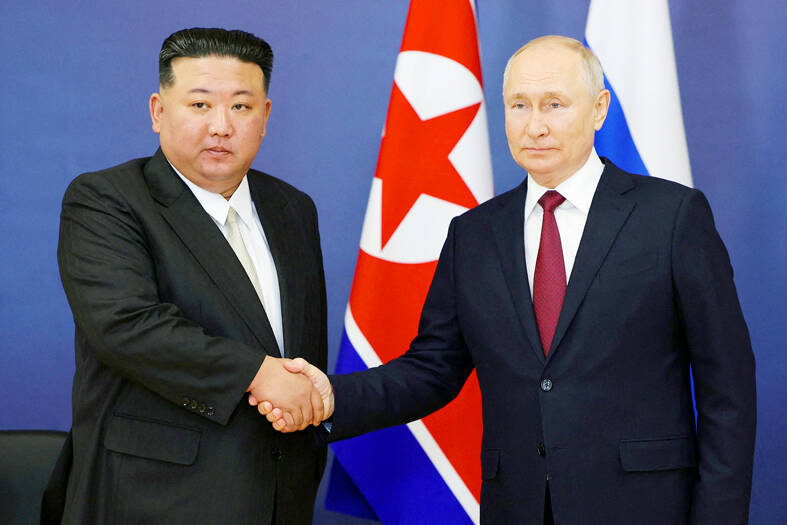
Photo: AFP
North Korean Minister of Foreign Affairs Choe Son-hui was in Moscow last week for meetings with Putin and her Russian counterpart, Sergei Lavrov.
The North Korean “government warmly welcomes President Putin to visit Pyongyang and is ready to greet the Korean people’s closest friend with the greatest sincerity,” Choe told Putin, a statement from the foreign minister’s assistant office said, carried by the state-run Korean Central News Agency.
Putin expressed “his willingness to visit the DPRK at an early date,” the statement said, referring to North Korea’s official name, the Democratic People’s Republic of Korea.
The statement added that Russia had expressed “deep thanks... for extending full support and solidarity to the stand of the Russian government and people on the special military operation in Ukraine.”
Increasing military and economic cooperation between Russia and North Korea has triggered concerns in Washington and Seoul.
Top Russian officials, including Moscow’s defense and foreign ministers, visited North Korea last year, fanning concern among Kyiv’s allies over a potential arms deal.
This month, the White House accused Pyongyang of sending ballistic missiles and launchers to Russia in what it called a “significant and concerning escalation” of support for Moscow’s war effort.
South Korea has accused Pyongyang of having provided more than 1 million artillery rounds to Moscow in exchange for advice on military satellite technology.
North Korea succeeded in putting a spy satellite into orbit last year, with Seoul saying North Korea had received Russian help.

SPEAKING OUT: After Siranudh Scott’s allegations surfaced, celebrities and public figures took to social media to share their own experiences of sexual misconduct and abuse A high-profile alleged sexual abuse case within a wealthy Thai beer brewing family has prompted a wave of painful accounts from survivors of unconnected abuse in the conservative nation. Siranudh Scott, a member of the billionaire Thai family that founded the ubiquitous Singha beer brand, posted an emotional video this month accusing his elder brother Sunit of repeatedly abusing him when he was a teenager. Sunit, who is in his 30s, later denied the allegations in a video posted online, but Singha parent Boonrawd dismissed him from his executive role with the company on Tuesday last week. “I felt I needed to speak

SEEKING ORDER: Rodrigo Paz said that ‘anyone who wants to destroy the nation will have to deal with this president and the full force of the constitution’ Bolivian President Rodrigo Paz on Wednesday said that the nation was at a “breaking point” after nearly a month of protests that have caused shortages of food, fuel and medicine. Paz, who took office six months ago amid the worst economic crisis there in four decades, is battling a groundswell of fury over his policies. The political capital, La Paz, has been besieged by low-income workers and members of the indigenous majority calling for his resignation. “The country needs order and is reaching breaking point,” the 58-year-old said at a public event in La Paz, renewing his appeal for dialogue. On Tuesday, the Bolivian
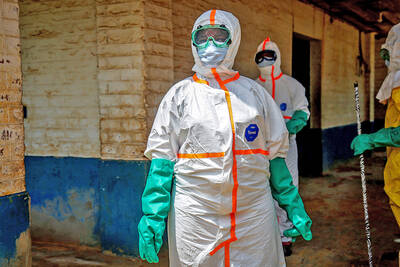
COMMUNITY CONFLICT: Concerns about disease spread from corpses has run up against friends and families’ desire to bury their dead as infection spreads in the area Angry residents of a town at the epicenter of the Ebola outbreak in the Democratic Republic of the Congo (DR Congo) attacked and burned a tent that was part of a health center where people are being treated for the virus, the staff there said Saturday. It was the second such attack in the region in a week. No one was hurt in the attack, according to reports but as patients ran out to escape the fire, 18 people with suspected Ebola infections fled the facility and are unaccounted for, a hospital director said. Angry residents arrived at the clinic in the

Forecasters in Europe yesterday warned of exceptional heat as record temperatures driven by a “heat dome” push temperatures well above seasonal norms across the continent. The surge follows a record-breaking Monday, with France logging its hottest day in the month of May on record, its weather agency said, and the UK also posting unprecedented highs. A so-called “heat dome” of warm air from northern Africa trapped under a high-pressure system over western Europe is behind the high temperatures not usually seen until high summer. Restrictions on outdoor work were imposed in parts of Italy, beaches in southwest France filled earlier than usual and


 RSS
RSS