


British Prime Minister Rishi Sunak triggered a diplomatic spat with Greece over the repatriation of the Parthenon marbles by canceling at the last-minute a one-on-one in London.
“I express my annoyance for the fact that the British Prime Minister canceled our scheduled meeting just hours before it was due to take place,” Greek Prime Minister Kyriakos Mitsotakis said in a Monday-night statement.
Their appointment had been set for midday yesterday.
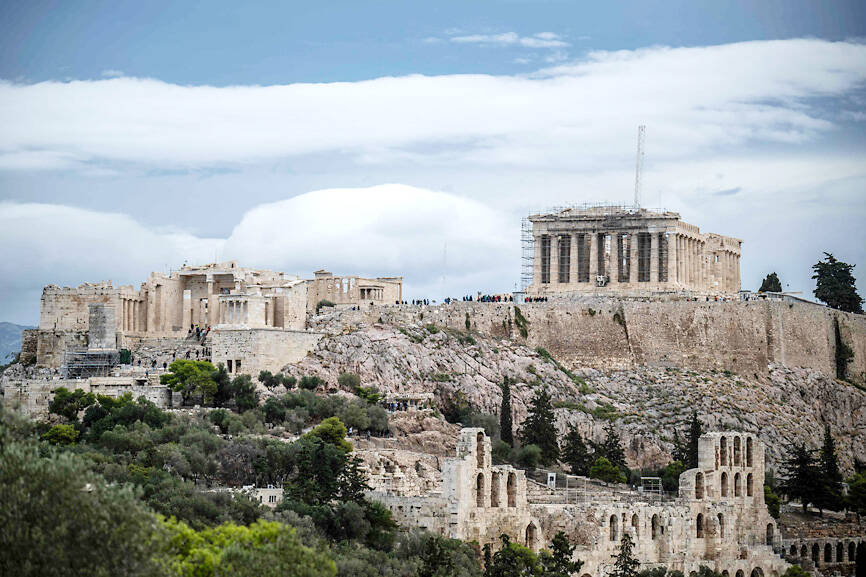
Photo: AFP
It became impossible for the meeting between the two leaders to go ahead on account of Mitsotakis’ commentary regarding the historical antiquities, said one senior Conservative Party source, who asked to remain anonymous when discussing private matters.
“If I told you that you would cut the Mona Lisa in half, and you will have half of it at the Louvre and half of it at the British Museum, do you think your viewers would appreciate the beauty of the painting?” Mitsotakis had said on the BBC on Sunday, by way of reference to the sculptures’ removal from Athens’ acropolis, where others like them still stand.
The sculptures are housed in London’s British Museum and both countries claim them as their own. In recent years the sides had been moving closer to resolving the centuries-long feud by brokering an arrangement whereby they could be seen in Athens, from where they were taken by British diplomat Lord Elgin in the early 19th century.
Mitsotakis insisted in his statement that what he told the press did not contain anything that deviated from his previous stance.
“Greece’s positions on the issue of the Parthenon sculptures are well known,” he said. “I was hoping to have the opportunity to discuss them with my British counterpart as well, along with the major challenges of the international situation: Gaza, Ukraine, Climate crisis, migration.”
The Greeks received a call at about 6pm just as Mitsotakis’ meeting with UK opposition-party leader Keir Starmer was ending, said one person familiar with how the cancelation played out.
The Financial Times earlier reported that Starmer was privately not prepared to change the law concerning the sculptures, but would not stand in the way of a loan deal if one mutually acceptable to both the British Museum and the Greek government could be agreed.
Sunak trails the Labour leader by about 20 percentage points in polls ahead of an election expected next year. Starmer and Mitsotakis discussed the marbles during their meeting and both sides presented their arguments, one person said.
Mitsotakis’ comments were no different than what he has said in the past and reflect the Greeks’ fixed positions on the issue, a senior Greek official said, adding that in any case the matter does not concern the British government, but the British Museum.
Josh Lambkin from the Parthenon Project, which is working with the British Museum and Acropolis Museum in an effort to broker a deal, criticized Sunak’s decision.
“It’s a shame the British prime minister feels he can’t discuss the subject of the Elgin Marbles with the Greek prime minister, especially given how much both countries stand to gain from a sensible resolution on this matter,” he said.
The cancelation also risks a relationship that might have helped Sunak improve cooperation among European nations coping with a surge of asylum seekers.?
“If the prime minister isn’t able to meet with a European ally with whom Britain has important economic ties, this is further proof he isn’t able to provide the serious economic leadership our country requires,” a Labour Party spokesperson said.

Through the noise of rushing papers and whirring belts at a print factory in Kyoto, two creators watch their photo essay come to life in broadsheet form — part of an effort to win new audiences in the age of artificial intelligence (AI). Despite the decline of the publishing industry, self-publication and handmade “zine” magazines are growing in popularity in Japan, reflecting the nation’s enduring love of paper in the digital era. While speaking to Agence France-Presse at the plant, his hands black with ink, one of the creators, Kazuma Obara, said: “I think [paper] is a medium that engages all five

‘CROSSING THE LINE’: China’s embassy in Seoul criticized US Forces Korea Commander General Xavier Brunson, asking if his ‘hostile’ remarks were authorized by Washington South Korea and the US are in talks over recent public remarks by the commander of US Forces Korea, Seoul’s presidential office said yesterday, after the comments drew sharp criticism from China. In a recent podcast interview, US Forces Korea Commander General Xavier Brunson described South Korea as “the dagger in the heart of Asia” from China’s east coast, prompting the Chinese embassy in Seoul to say that he had “truly crossed the line.” The interview came amid growing speculation that Washington might seek to expand the role of US Forces Korea in countering the growing regional influence of China, a key

Australian researchers have trained lab-grown brain cells on a silicon computer chip to play the 1990s shooter game Doom and said they are just scratching the surface of what the neurons could be capable of doing. It is the science-fiction work of biotech boffins at Cortical Labs, who researched and developed the technology that harnesses the workings of the brain’s networking system. Each so-called “biological computer” contains about 200,000 living human brain cells, grown from stem cells that were harvested from blood donations. Having mastered the simple computer game Pong, where a paddle is moved up and down to send a ball

France experienced its hottest spring on record, the French weather service said on Tuesday, after an exceptional early heat wave that also broke highs for the season in England and Wales. Meteo-France said the average nationwide temperature over March to May was 13.8°C — about 1.7°C above the norm, and surpassing records set in 2011 and 2020. “The warmest spring since records began in 1900,” it said in a bulletin. All three months were warmer than average, but the onset of an “unprecedented heatwave” late last month pushed the mercury to highs typically seen at the height of the summer. “Our country had never


 RSS
RSS