


An extreme drought in parts of the Amazon has led to a dramatic drop in river water levels, exposing dozens of usually submerged rock formations with carvings of human forms that might date back 2,000 years.
Livia Ribeiro, a longtime resident of the Amazon’s largest city, Manaus, said that she heard about the rock engravings from friends and wanted to check them out.
“I thought it was a lie ... I had never seen this. I’ve lived in Manaus for 27 years,” said Ribeiro, an administrator, after viewing the dazzling relics.
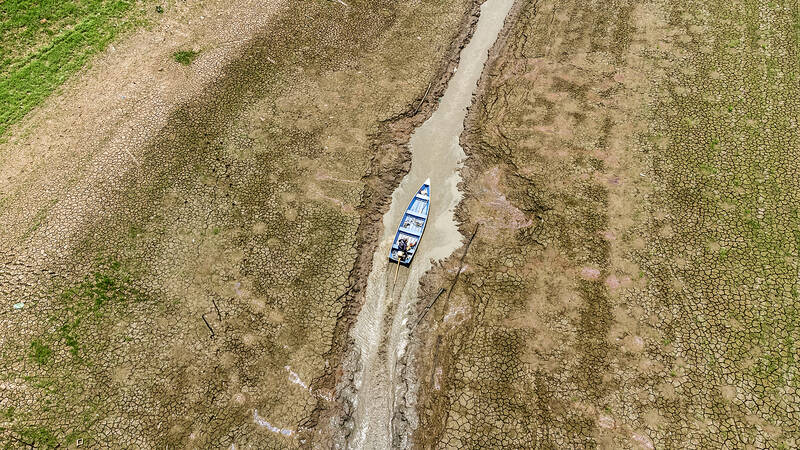
Photo: EPA-EFE
The rock carvings are not usually visible because they are covered by the waters of the Rio Negro, whose flow recorded its lowest level in 121 years last week.
The surfacing of the engravings on the riverbank have delighted scientists and the public alike, but also raised unsettling questions.
“We come, we look at [the engravings] and we think they are beautiful, but at the same time, it is worrying... I also think about whether this river will exist in 50 or 100 years,” Ribeiro said.
Drought in Brazil’s Amazon has drastically reduced river levels in the past few weeks, affecting a region that depends on a maze of waterways for transportation and supplies.
The Brazilian government has sent emergency aid to the area, where normally bustling riverbanks are dry, littered with stranded boats.
The dry season has worsened this year due to El Nino, an irregular climate pattern over the Pacific Ocean that disrupts normal weather, adding to the effect of climate change, experts say.
The engravings comprise an archaeological site of “great relevance,” said Jaime Oliveira, an archeologist at the Brazilian Institute of Historical Heritage (IPHAN).
They are at a site known as Praia das Lajes and were first seen in 2010, during another period of drought not as severe as the current one.
The rock carvings appear against a backdrop of dense jungle, with the low brownish waters of the Negro River flowing nearby.
Most of the engravings are of human faces, some of them rectangular and others oval, with smiles or grim expressions.
“The site expresses emotions, feelings, it is an engraved rock record, but it has something in common with current works of art,” Oliveira said.
For Beatriz Carneiro, historian and member of IPHAN, Praia das Lajes has an “inestimable” value in understanding the first people who inhabited the region, a field still little explored.
“Unhappily it is now reappearing with the worsening of the drought,” Carneiro said. “Having our rivers back [flooded] and keeping the engravings submerged will help preserve them, even more than our work.”

An American scientist convicted of lying to US authorities about payments from China while he was at Harvard University has rebuilt his research lab in Shenzhen, China, to pursue technology the Chinese government has identified as a national priority: embedding electronics into the human brain. Charles Lieber, 67, is among the world’s leading researchers in brain-computer interfaces. The technology has shown promise in treating conditions such as amyotrophic lateral sclerosis and restoring movement in paralyzed people. It also has potential military applications: Scientists at the Chinese People’s Liberation Army have investigated brain interfaces as a way to engineer super soldiers by boosting

Indonesian police have arrested 13 people after shocking images of alleged abuse against small children at a daycare center went viral, sparking outrage across the nation, officials said on Monday. Police on Friday last week raided Little Aresha, a daycare center in Yogyakarta on Java island, following a report from a former employee. CCTV footage circulating on social media showed children, most younger than two, lying on the floor wearing only diapers, their hands and feet bound with rags. The police have confirmed that the footage is authentic. Police said they also found 20 children crammed into a room just 3m by 3m. “So

A grieving mother has ended her life at a clinic in Switzerland four years after the death of her only child. Wendy Duffy, 56, a physically healthy woman, died at the Pegasos clinic in Basel after struggling to cope with the death of her 23-year-old son, Marcus. The former care worker, from the West Midlands, England, had previously attempted to take her own life. The case comes as assisted dying would not become law in England and Wales after proposed legislation, branded “hopelessly flawed” by opponents, ran out of time. Ruedi Habegger, the founder of Pegasos, described Duffy’s death as

From post offices and parks to stations and even the summit of Mount Fuji, Japan’s vending machines are ubiquitous, but with the rapid pace of inflation cooling demand for their drinks, operators are being forced to rethink the business. Last month beverage giant DyDo Group Holdings announced it would remove about 20,000 vending machines — about 7 percent of their stock nationwide — by January next year, to “reconstruct a profitable network.” Pokka Sapporo Food & Beverage, based in Nagoya, also said last month it would sell its 40,000-machine operation to Osaka-based Lifedrink Co. “The strength of the vending machine


 RSS
RSS