


Three years after Beirut’s massive port blast, attempts to prosecute those responsible are mired in political intrigue, the final death toll remains disputed and many Lebanese have less faith than ever in their disintegrating state institutions.
As the country marked the anniversary yesterday, relatives of some of those killed are still struggling to get their loved ones recognized as blast victims, reflecting the ongoing chaos since the Aug. 4, 2020, explosion.
The blast killed at least 218 people, according to an Associated Press count, wounded more than 6,000, devastated large swaths of Beirut and caused billions of dollars in damage.

Photo: AP
Among those not recognized as a blast victim is a five-month-old boy, Qusai Ramadan, a child of Syrian refugees.
His parents say he was killed when the explosion toppled the ceiling and a cupboard in his hospital room, crushing him.
The parents have been unable to get the infant added to the official death list, a move that could have made them eligible for compensation.
They accused the authorities of discriminating against people who are not Lebanese.
Meanwhile, the blast anniversary brought renewed calls for an international investigation of those responsible, including top officials who allowed hundreds of tonnes of highly flammable ammonium nitrate, a material used in fertilizers, to be improperly stored for years at a warehouse in the port.
Lebanese and international organizations, survivors and families of the people killed sent such an appeal to the UN Rights Council, saying that “on [the] third anniversary of the explosion, we are no closer to justice and accountability for the catastrophe.”
Maan, a Lebanese group advocating for victims and survivors, put the death toll at 236, significantly higher than the government’s count of 191. The authorities stopped counting the dead a month after the blast, even as some of the severely wounded died in the subsequent period.
Among those listed by Maan Initiative is Qusai, the Syrian infant.
Qusai had been undergoing treatment for a severe liver condition and was transferred to a government hospital near the port about a week before the explosion. Hospital staff said the infant needed a liver transplant and was in critical condition.
On the day of the blast, Qusai’s aunt Noura Mohammed was sitting at his bedside while his mother rested at home.
The aunt said the staff ordered everyone to evacuate immediately after the explosion, and that she found the infant dead, crushed by fallen debris, when she returned.
Hospital officials said Qusai died an hour after the explosion, with the death certificate listing cardio respiratory arrest as the cause. The family buried him a day later.
“We asked them [the authorities] to register my son among the victims of the blast,” his mother, Sarah Jassem Mohammed, said in an interview in a small tent in an orchard in the northern Lebanese village of Markabta where she lives with her husband, two sons and one daughter. “They refused.”
Meanwhile, many in Lebanon have been losing faith in the domestic investigation and some have started filing cases abroad against companies suspected of bringing in the ammonium nitrate.
The chemicals had been shipped to Lebanon in 2013. Senior political and security officials knew of their presence and potential danger, but did nothing.
Lebanese and non-Lebanese alike have seen justice delayed, with the investigation stalled since December 2021.
Lebanon’s political class has repeatedly intervened in the work of the judiciary.
In January, Lebanon’s top prosecutor, Ghassan Oueidat, ordered the release of all suspects detained in the investigation.
“The political class have used every tool at their disposal — both legal and extra-legal — to undermine, obstruct and block the domestic investigation into the blast,” said Aya Majzoub, deputy head for the Middle East and North Africa at rights group Amnesty International.
Makhoul Mohammed, 40, a Syrian citizen, was lightly injured in the blast in his Beirut apartment while his daughter Sama, who was six at the time, lost her left eye.
Mohammed, who settled in Canada last year, said he plans to sue those responsible for the explosion in a Canadian court.
“The [domestic] investigation will not lead to results as long as this political class is running the country,” he said.
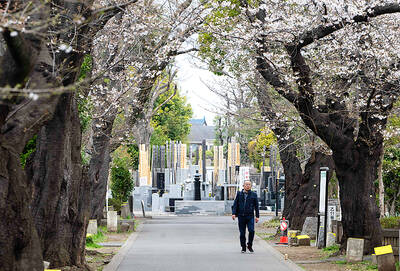
ROCKY RELATIONS: The figures on residents come as Chinese tourist numbers drop following Beijing’s warnings to avoid traveling to Japan The number of Chinese residents in Japan has continued to rise, even as ties between the two countries have become increasingly fractious, data released on Friday showed. As of the end of December last year, the number of Chinese residents had increased by 6.5 percent from the previous year to 930,428. Chinese people accounted for 22.6 percent of all foreign residents in Japan, making them by far the largest group, Japanese Ministry of Justice data showed. Beijing has criticized Tokyo in increasingly strident terms since Japanese Prime Minister Sanae Takaichi last year suggested that a military conflict around Taiwan could

A retired US colonel behind a privately financed rocket launch site in the Dominican Republic sees the project as a response to China’s dominance of the space race in Latin America. Florida-based Launch on Demand is slated to begin building a US$600 million facility in a remote region near the border with Haiti late this year. The project is designed to meet surging demand for the heavy-lift rockets needed to put clusters of satellites into orbit. It is also an answer to China’s growing presence in the region, said CEO Burton Catledge, a former commander of the US Air Force’s 45th Operations
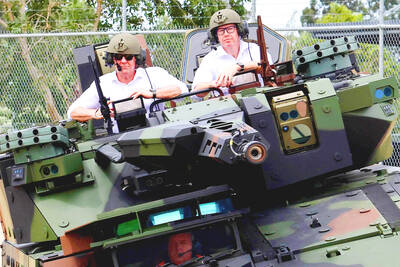
Germany is considering Australia’s Ghost Bat robot fighter as it looks to select a combat drone to modernize its air force, German Minister of Defense Boris Pistorius said yesterday. Germany has said it wants to field hundreds of uncrewed fighter jets by 2029, and would make a decision soon as it considers a range of German, European and US projects developing so-called “collaborative combat aircraft.” Australia has said it will integrate the Ghost Bat, jointly developed by Boeing Australia and the Royal Australian Air Force, into its military after a successful weapons test last year. After inspecting the Ghost Bat in Queensland yesterday,
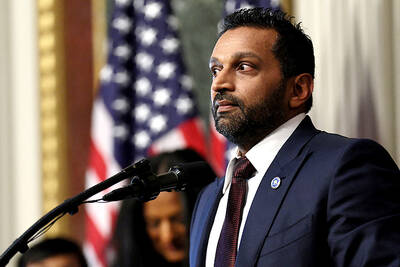
A pro-Iran hacking group claimed to breach FBI Director Kash Patel’s personal e-mail inbox and posted some of the contents online. The e-mails provided by the hacking group include travel details, correspondence with leasing agents in Washington and global entry, and loyalty account numbers. The e-mail address the hackers claim to have compromised has been previously tied to Patel’s personal details, and the leaked e-mails contain photos of Patel and others, in addition to correspondence with family members and colleagues. “The FBI is aware of malicious actors targeting Director Patel’s personal email information,” the agency said in a statement on


 RSS
RSS