


Denise Christ regularly comes across injured wildlife in her work rescuing beached or stranded marine mammals along the California coast, but she has been shocked by the hundreds of sea lions and dolphins found on the shore in recent weeks, dead or dying from neurotoxin poisoning.
“Heartbreaking, to say the least,” said Christ, the Ventura County stranding coordinator for the Channel Islands Marine and Wildlife Institute (CIMWI).
The animals were sickened by domoic acid, a neurotoxin produced by algae that are a food source for fish, which are then eaten by sea lions and dolphins.
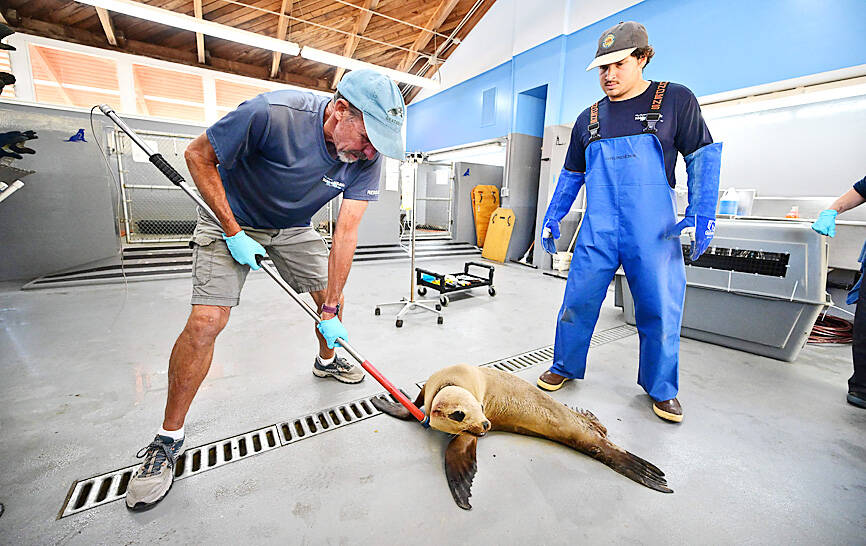
Photo: AFP
Algal blooms are not unusual this time of year, but this summer’s crisis follows another one less than a year ago, alarming and overwhelming the CIMWI team based about 190km north of Los Angeles.
“We had a pretty intense bloom last summer, but this year is way worse than we’ve ever seen in the 35 years I’ve been practicing marine mammal medicine,” CIMWI executive director and cofounder Sam Dover said.
“We had over 300 sea lions up on the beach, and over 150 dolphins that also were affected by it. It was just so sad,” said Ken Hughes, CIMWI’s stranding coordinator for Santa Barbara.
There is no official explanation for the outbreak, but experts have several theories.
Algal blooms are fed by agricultural runoff, and this year California experienced heavier than normal rainfall.
“So there’s a lot more runoff from the whole state, not just from the local regions,” Dover said.
Others from the institute said that warming oceans due to climate change were spurring algae growth.
“I believe it is the new reality and things are changing. The ocean’s changing,” Christ said.
When sea lions consume the toxin, they suffer neurological effects that include disorientation, foaming at the mouth, head bobbing and seizures.
“They basically don’t know they’re a sea lion. They don’t know where they’re at or what they’re doing,” Hughes said.
The animals then head for the shore, where they wander erratically, attracting the attention of beachgoers.
Dover said last year’s domoic acid outbreak took place in mid-August, but this year his group started getting calls reporting stricken animals in late May.
“We started getting one animal a day. So we knew it was coming, and then on June 8, literally the floodgates opened and animals just started showing up everywhere,” he said. “This is definitely the worst we’ve ever seen.”
CIMWI rescued about 300 animals last year — this year they were getting more than 300 calls each day.
Another unusual feature of this year’s outbreak is dolphins getting sick and dying from the toxin, with Dover counting more than 110 of the mammals dead over the past few weeks.
There is no cure for domoic acid poisoning, so the only way to treat the animals is with fluids, food, anti-seizure medicine and patience, experts said.
Younger animals have a better chance of survival because they eat less fish than adults, and therefore consume less of the toxin.
“Those are the ones we’re putting most of our efforts toward now and we’re having some pretty good success in flushing out the toxin from their system,” Dover said, as volunteers hosed down spacious enclosures where the rescued sea lions eat fish, float in pools and nap.
Treating, housing and feeding the sick animals demands a lot of resources, and CIMWI stays afloat through a combination of government grants, donations and volunteer labor.
“Essentially, every day is a battle with the animals and with our finances,” Dover said.

School bullies in Singapore are to face caning under new guidelines, but the education minister on Tuesday said it would be meted out only as a last resort with strict safeguards. Human rights groups regularly criticize Singapore for the use of corporal punishment, which remains part of the school and criminal justice systems, but authorities have defended it as a deterrent to crime and serious misconduct. Caning was discussed in the parliament after legislators asked how it would be used in relation to bullying in schools. The debate followed stricter guidelines on serious student misconduct, including bullying, unveiled by the Singaporean Ministry of

As evening falls in Fiji’s capital, a steady stream of people approaches a makeshift clinic that is a first line of defense against one of the world’s fastest-growing HIV epidemics. In the South Pacific nation — a popular tourist destination of just under a million people — more than 2,000 new HIV cases were recorded last year, a 26 percent increase from 2024. The government has declared an HIV outbreak and described it as a national crisis. “It’s spreading like wildfire,” said Siteri Dinawai, 46, who came to be tested. The Moonlight Clinic, a converted minibus parked in a suburban cul-de-sac in Suva, is

A MESSAGE: Japan’s participation in the Balikatan drills is a clear deterrence signal to China not to attack Taiwan while the US is busy in the Middle East, an analyst said The Japan Self-Defense Forces yesterday fired a Type 88 anti-ship missile during a joint maritime exercise with US, Australian and Philippine forces, hitting a decommissioned Philippine Navy ship in waters facing the disputed South China Sea, in drills that underscore Tokyo’s rising willingness to project military power on China’s doorstep. The drill took place as Manila and Tokyo began talks on a potential defense equipment transfer, made possible by Japan’s decision to scrap restrictions on military exports. The discussions include the possible early transfer of Abukuma-class destroyers and TC-90 aircraft to the Philippines, Japanese Minister of Defense Shinjiro Koizumi said. Philippine Secretary of
Separatists in Alberta are preparing to submit a petition tomorrow that they said has enough signatures to force a referendum on independence for the oil-rich Canadian province. Polls indicate the pro-independence camp remains a minority among Alberta’s 5 million people, but has hit a historic high of roughly 30 percent. Alberta separatists are also closer than ever to forcing a referendum, riding momentum fueled by intensifying grievances over Ottawa’s control of the provincial oil industry. They have also undeniably gotten a boost from the return to power of US President Donald Trump. After launching a petition in January, Stay Free Alberta, the group


 RSS
RSS