


An exhibition by a provocative Chinese artist that criticizes the country’s human rights record on Friday opened at a Polish state-run museum despite pressure from the Chinese embassy to cancel it.
The director of the Center for Contemporary Art in the capital, Warsaw, said the No. 2 diplomat at the Chinese embassy in Warsaw visited his museum demanding the cancelation of the exhibition by the artist, who goes by the name Badiucao (巴丟草).
“It wasn’t a request, but a firm demand,” museum director Piotr Bernatowicz said, describing the Chinese government’s behavior as unacceptable.
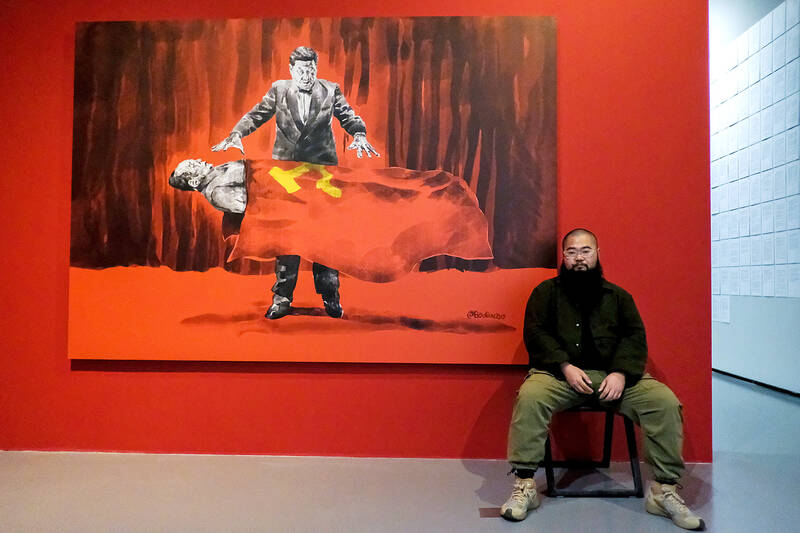
Photo: EPA-EFE
He said the Chinese official warned that having the exhibition could harm Polish-Chinese ties, adding that a Chinese representative also sent a letter of protest to the Polish Ministry of Culture and National Heritage.
Badiucao, who has lived in exile in Australia for many years, said the Chinese government accused him of hurting the feelings of Chinese patriots.
He said his works are in no way against Chinese or China, merely against the government.
The exhibition is titled “Tell China’s Story Well.” Its promotional image shows Chinese President Xi Jinping (習近平) eating human flesh. It also takes on other sensitive issues.
Among them are the Tiananmen Square Massacre of 1989, Hong Kong democracy demonstrations queled by China and what the museum is calling “the disturbing relationship between China and Russia in light of the war in Ukraine.”
In a performance for reporters ahead of the opening, Badiucao threw eggs filled with paint at a portrait of Mao Zedong (毛澤東) in tribute to protesters who were arrested in the Tiananmen Square protests who did the same.
He described his performance as a continuation of their struggle.
“They should be celebrated as heroes instead of treated as prisoners or enemies of the state,” the artist, born in 1986, said.
Beijing has exerted pressure in the past in an attempt to censure Badiucao’s work.
An exhibition planned in Hong Kong in 2018 was called off at the last minute following threats to the artist and his family.
The Italian city of Brescia faced veiled economic threats by the Chinese government in 2021, but went ahead with a show of his work.
The artist kept his identity secret for many years, wearing masks during public appearances to protect his family members. The long-held secrecy drew comparisons to British graffiti artist Banksy, whose true identity remains shrouded in mystery.
The exhibition is due to run until Oct. 15.
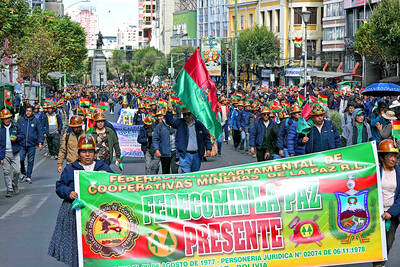
The Bolivian government on Friday struck a deal with protesting miners, but was still grappling with blockades and demonstrations by other workers across La Paz. Other groups are still blocking access roads into the city, which is also the seat of the government. Police on Thursday prevented the miners from entering the main square by using tear gas, while the demonstrators hurled stones and explosives with slingshots. Protests against the policies of Bolivian President Rodrigo Paz have convulsed the Andean nation since early this month, and roadblocks were choking routes into La Paz throughout Friday, the national road authority said. Miners demanded that Paz
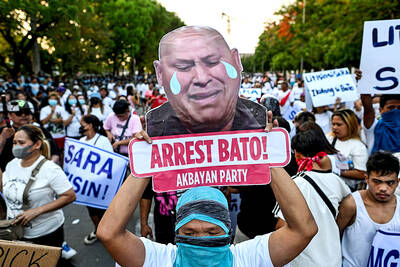
The Philippines said it has asked the country’s Supreme Court to allow it to arrest former Philippine president Rodrigo Duterte’s chief drug war enforcer to stand trial in an international tribunal. The International Criminal Court (ICC) last week unsealed an arrest warrant against Philippine Senator Ronald dela Rosa, accusing him along with Duterte and other “coperpetrators” of the “crime against humanity of murder.” Dela Rosa briefly sought refuge in the Philippine Senate last week while asking the Philippine Supreme Court to stop an ongoing attempt by government agents to arrest him. “By his own conduct, he has placed himself outside the protection of

A ship anchored off the United Arab Emirates (UAE) was seized and taken toward Iran and another — a cargo ship near Oman — sank after being attacked, authorities said on Thursday, as tensions escalated near the Strait of Hormuz. It was not immediately clear who was behind these incidents, but they happened as a senior Iranian official reiterated his country’s claim of control over the waterway and another said it had a right to seize oil tankers connected to the US. The turmoil in the strait has been a sticking point for weeks in talks between the US and Iran to
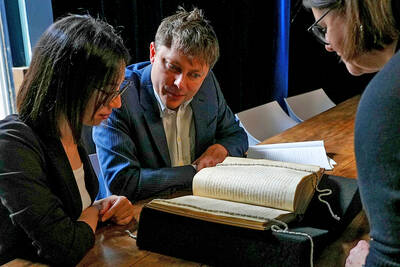
The researchers in Ireland looked at their computer screen, marveling at a medieval book tracked down in a Roman library. They flipped through its digitized pages and found their sought-after treasure: the oldest surviving English poem. “We were extremely surprised. We were speechless. We couldn’t believe our eyes when we first saw that,” said Elisabetta Magnanti, a visiting research fellow at Trinity College Dublin’s school of English. The poem was also within the main body of Latin text, she said, calling it “extraordinary.” Composed in Old English by a Northumbrian agricultural worker in the 7th century, Caedmon’s Hymn appears within some copies of


 RSS
RSS