


With 12 stories, a breathtaking view of Cape Town’s imposing Table Mountain and a minimal ecological footprint, the world’s tallest building made with industrial hemp is soon to open its doors in South Africa.
Workers in central Cape Town are putting the finishing touches to the 54-room Hemp Hotel, which is due to be completed next month.
“Hempcrete” blocks derived from the cannabis plant have been used to fill the building’s walls, supported by a concrete and cement structure.
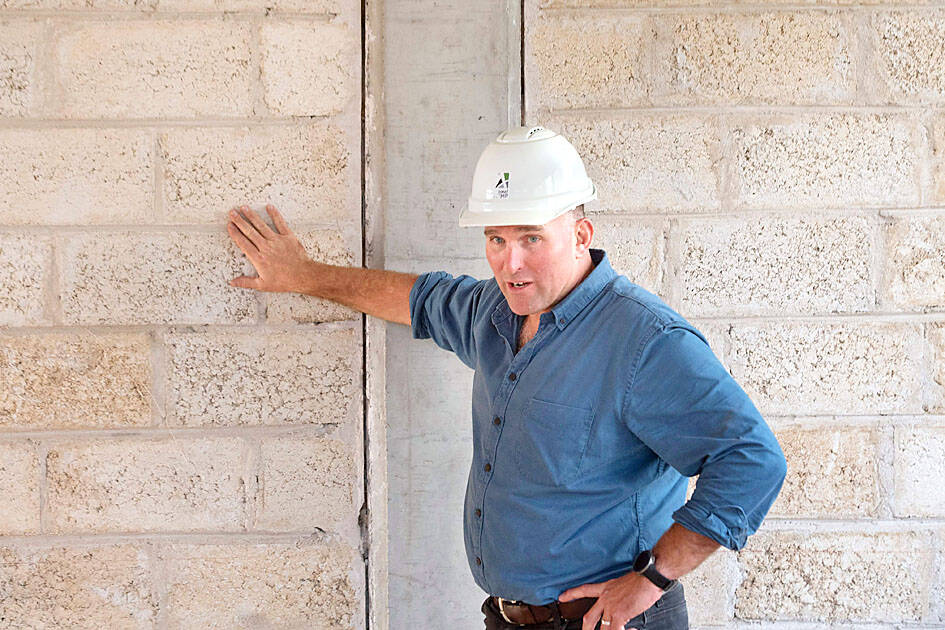
Photo: AFP
Hemp bricks are becoming increasingly popular in the construction world thanks to their insulating, fire-resistant and climate-friendly properties. Used notably in Europe for thermal renovation of existing buildings, the blocks are carbon negative — meaning their production sucks more planet-warming gases out of the atmosphere than it puts in.
“The plant absorbs the carbon, it gets put into a block and is then stored into a building for 50 years or longer,” said Boshoff Muller, director of Afrimat Hemp, a subsidiary of South African construction group Afrimat, which produced the bricks for the hotel.
“What you see here is a whole bag full of carbon, quite literally,” Muller said as he patted a bag of mulch at a brick factory on the outskirts of Cape Town, where hemp hurds, water and lime are mixed together to make the blocks.
The industrial hemp used for the Hemp Hotel had to be imported from Britain, as South Africa banned local production up to last year, when the government started issuing cultivation permits. South African President Cyril Ramaphosa has made developing the country’s hemp and cannabis sector an economic priority, saying that it could create more than 130,000 jobs.
Afrimat Hemp is preparing to produce its first blocks made only with South African hemp.
Hemp Hotel architect Wolf Wolf, 52, sees this as a game-changer to make hemp buildings more widespread in this corner of the world.
“It shouldn’t be just a high-end product,” said Wolf, whose firm is involved in several social housing projects in South Africa and neighboring Mozambique.
Yet cost remains an issue.
“Hemp is 20 percent more expensive to build with” compared with conventional materials, Afrimat Hemp’s carbon consultant Wihan Bekker said.
However, as the world races to lower carbon emissions, the firm sees “huge opportunities” for its green bricks, Bekker said.
Carbon credits — permits normally related to the planting of trees to safeguard tropical rainforests that companies buy to offset their emissions — could help make hempcrete blocks more financially palatable, he said.
“We can fund forests, or we can fund someone to live in a hemp house. It’s the same principle,” Bekker said.
The carbon footprint of a 40m2 house built with hemp is 3 tonnes of carbon dioxide lower than that of a conventional building, Afrimat Hemp said.
“We see this as a bit of a lighthouse project,” Muller said of the Hemp Hotel. “It shows hemp has its place in the construction sector.”
Hemp Hotel has been ranked the “tallest building to incorporate hemp-based materials in the world” by Steve Allin, director of the Ireland-based International Hemp Building Association.
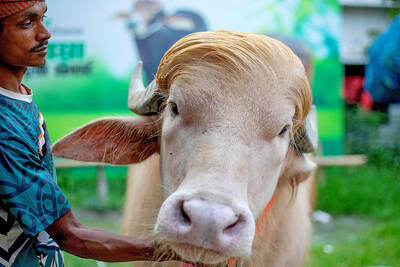
Crowds in Bangladesh are flocking to snap photographs with an unlikely social media star — an albino buffalo with flowing blond hair nicknamed “Donald Trump” that is due to be sacrificed within days. Owner Zia Uddin Mridha, 38, said his brother named the 700kg bull over its flowing helmet of hair resembling the signature look of the US president. “My younger brother picked this name because of the buffalo’s extraordinary hair,” he said at his farm in Narayanganj, just outside the capital, Dhaka. Mridha said that a constant stream of curious visitors — social media fans, onlookers and children — have come throughout

It began as a satirical online project. Now millions of young people in India are flocking to it as an outlet for their frustration. A parody political party called the Cockroach Janta Party, with the insect as its symbol, has exploded across India’s social media by turning absurdist humor into protest. Memes and short videos mocking corruption, joblessness and political dysfunction have flooded social media sites, where millions of users are embracing the cockroach — known for its ability to survive harsh conditions — as a tongue-in-cheek symbol of endurance. The online movement’s rise has been unusually rapid. The Cockroach Janta Party (CJP)
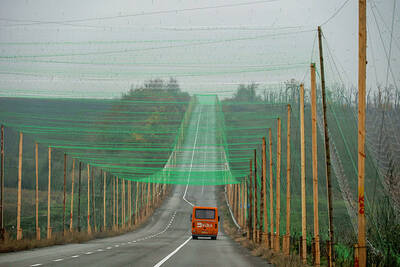
BIGGER ROLE: Beijing has said it maintains an impartial stance on the war in Ukraine, but by training Russian troops, China is far more involved than previously known China’s armed forces secretly trained about 200 Russian military personnel in China late last year, and some have since returned to fight in Ukraine, according to three European intelligence agencies and documents seen by Reuters. While China and Russia have held a number of joint military exercises since Moscow’s full-scale invasion of Ukraine in 2022, Beijing has repeatedly said that it is neutral in the conflict and presents itself as a peace mediator. The covert training sessions, which predominantly focused on the use of drones, were outlined in a dual-language Russian-Chinese agreement signed by senior Russian and Chinese officers in Beijing on
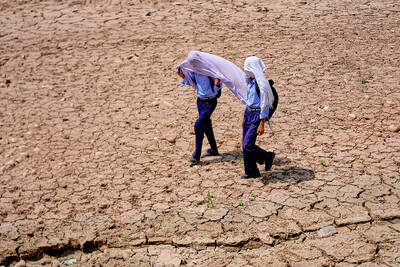
HOTTER: While Indians are accustomed to summer heat, climate change has caused northwestern India to warm faster than other parts of the country, an academic said Roads and markets have emptied during afternoons and some farmers have switched to nighttime work to avoid scorching temperatures as a heat wave grips large parts of India. The India Meteorological Department forecast maximum temperatures for yesterday of about 45°C in the capital, New Delhi, where authorities have opened temporary “cooling zones” to help people cope. The weather department warned that conditions would likely persist across several northern regions in the coming days, with temperatures staying well above seasonal averages. Authorities urged people to stay indoors during the hottest hours and take precautions against heat-related illnesses. India declares a heat wave whenever maximum temperatures


 RSS
RSS