


A Saudi Arabian delegation has concluded a round of peace talks in the Yemeni capital, Sana’a, with the Houthi movement, whose officials cited progress and said further discussions were needed to iron out remaining differences.
In a significant confidence-building measure, the International Committee of the Red Cross (ICRC) yesterday said that the release and swap of nearly 900 detainees by the two sides in the conflict had started.
Saudi Arabia, which leads a coalition that has been battling the Iranian-aligned group since 2015, is seeking a permanent ceasefire agreement to end its military involvement in a war that has killed tens of thousands of people and left millions hungry.
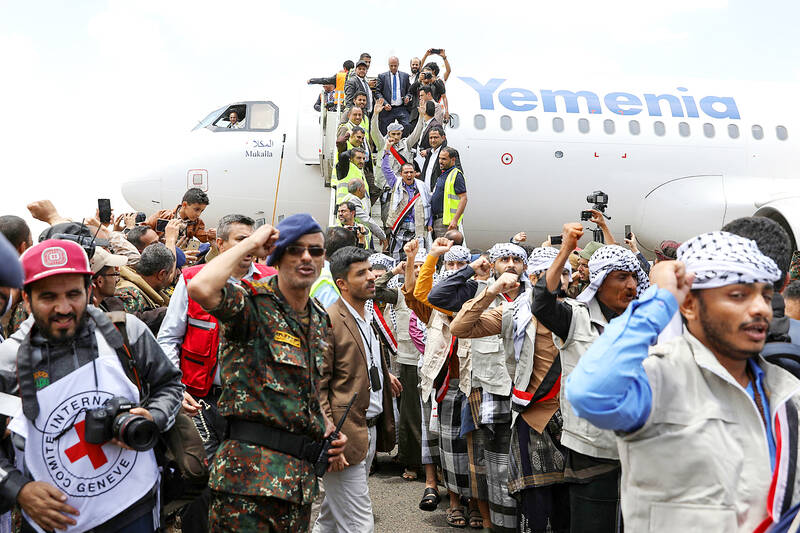
Photo: Reuters
Two Yemeni sources said the Saudi team departed Sana’a on Thursday following a visit that signaled movement to build on an expired UN-brokered truce and followed last month’s deal between Saudi Arabia and Iran to restore ties.
Houthi politburo official Mohammed al-Bukhaiti described the negotiations as “going well.”
Another Houthi official, Abdulmalik Alejri, said on Twitter that “with determination and honest intentions remaining difficulties can be resolved.”
Sources have told Reuters that the Saudi-Houthi talks facilitated by Oman were focused on a ceasefire, full reopening of Houthi-controlled ports and Sana’a airport, payment of public sector wages, rebuilding efforts and the withdrawal of foreign forces from Yemen.
Two Yemeni sources, also speaking on condition of anonymity, said the parties could agree on an extended truce deal as they work out remaining differences.
The main sticking points include payment of civil servant salaries — which the Houthis have insisted include armed forces — using oil revenue and a timeline for foreign forces to exit the country, three sources familiar with the negotiations said.
The conflict, in which the coalition intervened against the Houthis after they ousted the Saudi-backed government from Sana’a in late 2014, is a multifaceted one with several Yemeni factions vying for influence.
The Houthis are de facto authorities in northern Yemen. The internationally recognized government is represented by a presidential council formed under Saudi auspices last year, which took over power from Yemen’s president-in-exile.
Meanwhile, a major exchange of prisoners got under way yesterday, with the first airplane departing rebel-held Sana’a for government-controlled Aden, the ICRC said.
“The first flight from Sana’a has left,” ICRC media adviser Jessica Moussan said, signaling the start of a three-day operation that would see nearly 900 prisoners released.
More than 300 prisoners were to fly between the two cities yesterday. Later, detainees would also be released in Marib and Mokha in Yemen, and in Riyadh and Abha in Saudi Arabia.
Additional reporting by AFP

School bullies in Singapore are to face caning under new guidelines, but the education minister on Tuesday said it would be meted out only as a last resort with strict safeguards. Human rights groups regularly criticize Singapore for the use of corporal punishment, which remains part of the school and criminal justice systems, but authorities have defended it as a deterrent to crime and serious misconduct. Caning was discussed in the parliament after legislators asked how it would be used in relation to bullying in schools. The debate followed stricter guidelines on serious student misconduct, including bullying, unveiled by the Singaporean Ministry of

As evening falls in Fiji’s capital, a steady stream of people approaches a makeshift clinic that is a first line of defense against one of the world’s fastest-growing HIV epidemics. In the South Pacific nation — a popular tourist destination of just under a million people — more than 2,000 new HIV cases were recorded last year, a 26 percent increase from 2024. The government has declared an HIV outbreak and described it as a national crisis. “It’s spreading like wildfire,” said Siteri Dinawai, 46, who came to be tested. The Moonlight Clinic, a converted minibus parked in a suburban cul-de-sac in Suva, is
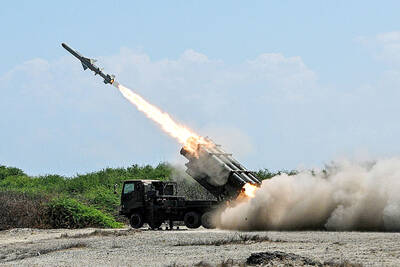
A MESSAGE: Japan’s participation in the Balikatan drills is a clear deterrence signal to China not to attack Taiwan while the US is busy in the Middle East, an analyst said The Japan Self-Defense Forces yesterday fired a Type 88 anti-ship missile during a joint maritime exercise with US, Australian and Philippine forces, hitting a decommissioned Philippine Navy ship in waters facing the disputed South China Sea, in drills that underscore Tokyo’s rising willingness to project military power on China’s doorstep. The drill took place as Manila and Tokyo began talks on a potential defense equipment transfer, made possible by Japan’s decision to scrap restrictions on military exports. The discussions include the possible early transfer of Abukuma-class destroyers and TC-90 aircraft to the Philippines, Japanese Minister of Defense Shinjiro Koizumi said. Philippine Secretary of
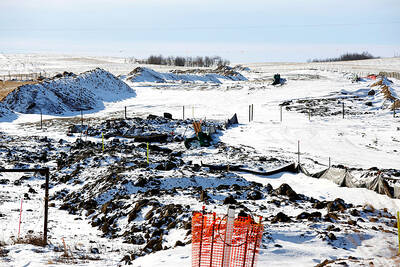
Separatists in Alberta are preparing to submit a petition tomorrow that they said has enough signatures to force a referendum on independence for the oil-rich Canadian province. Polls indicate the pro-independence camp remains a minority among Alberta’s 5 million people, but has hit a historic high of roughly 30 percent. Alberta separatists are also closer than ever to forcing a referendum, riding momentum fueled by intensifying grievances over Ottawa’s control of the provincial oil industry. They have also undeniably gotten a boost from the return to power of US President Donald Trump. After launching a petition in January, Stay Free Alberta, the group


 RSS
RSS